The short answer
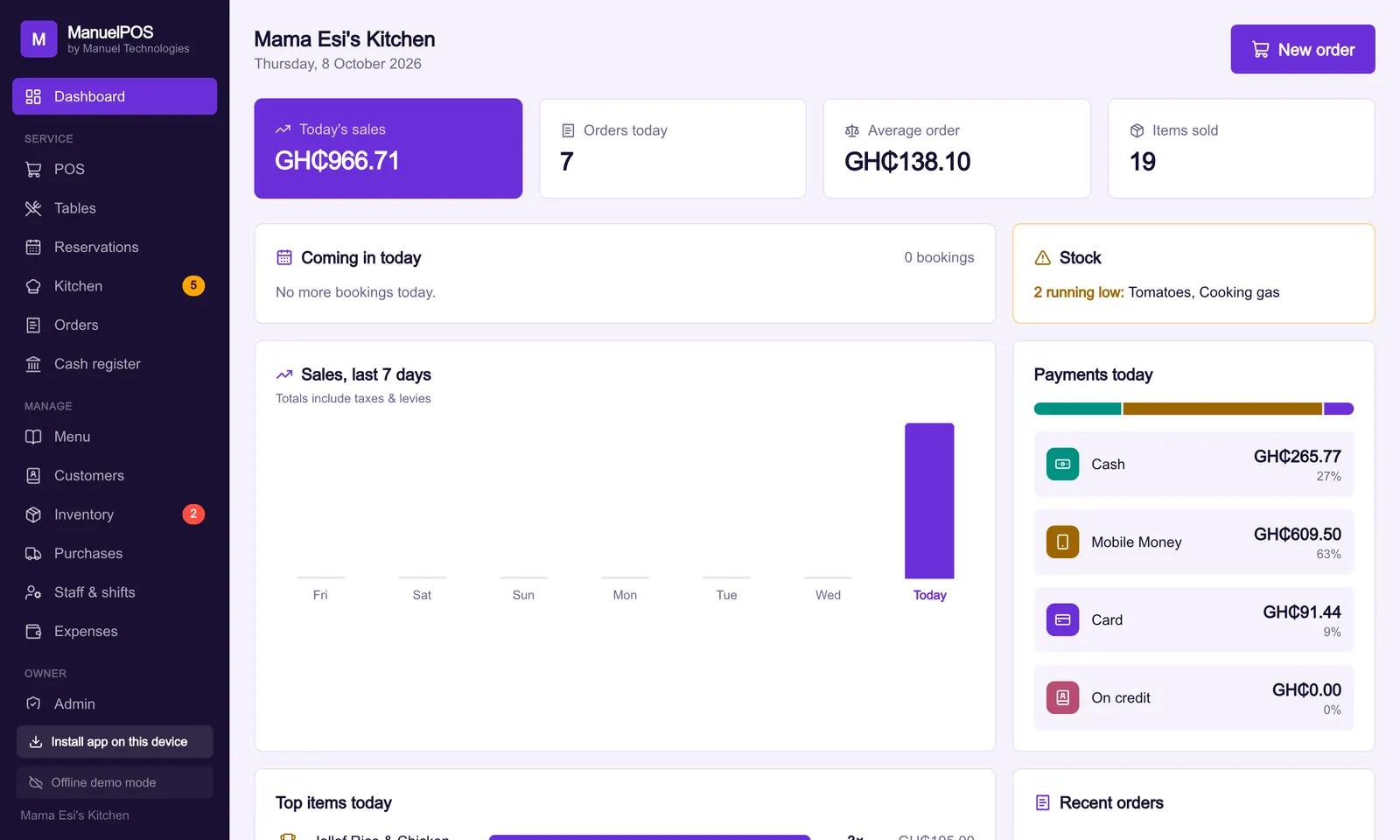
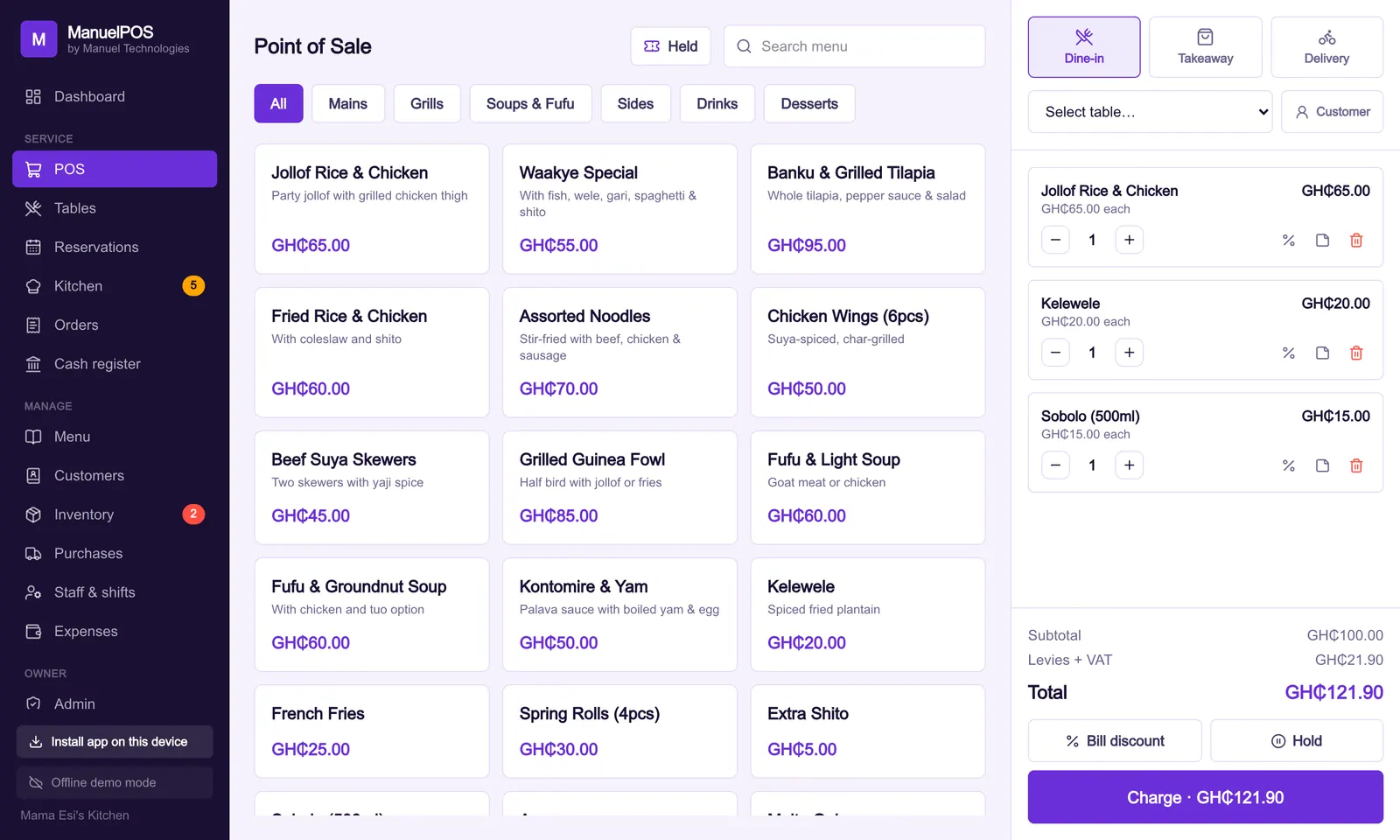
A restaurant or chop bar in Ghana runs well when every order is rung in before it is cooked, every cedi and MoMo payment is matched at each cash-up, plates are costed so the prices pay, ingredients are counted weekly, and receipts show the 2026 taxes correctly. A POS built for restaurants puts tables, the kitchen, bills, payments and reports in one place, so the owner can see it all from anywhere.
Key takeaways
- Get the FDA Food Hygiene Permit and your GTA licence sorted before you worry about software.
- No ticket, no food: every order is rung in before the kitchen or bar prepares it.
- Cost your best-selling plates and re-cost them when market prices move.
- Count your main ingredients and drinks weekly, and keep a waste sheet.
- One login per person, manager approval for voids, and a counted cash-up every shift.
- Choose a POS that keeps working offline and records MoMo with the transaction ID.
On this page16 sections
- 01What makes running a restaurant hard?
- 02Which permits and licences does a restaurant need?
- 03How do you set menu prices that pay?
- 04How should orders flow from table to kitchen?
- 05How do you handle split bills, merged tables and tabs?
- 06How do you run takeaway, delivery and WhatsApp orders?
- 07How should you handle cash, MoMo and card?
- 08How do you control ingredient stock and waste?
- 09How do you stop theft by waiters and cashiers?
- 10What tax goes on a restaurant receipt?
- 11What happens when the network or the light goes off?
- 12How do you choose a POS for a restaurant?
- 13How do you set up a restaurant POS in a week?
- 14What does a restaurant POS cost?
- 15How does MPOS fit a restaurant?
- 16Where to start
Running a restaurant in Ghana, whether it is a chop bar in Kumasi, a waakye joint in Nima, a kenkey and fish spot in Teshie, a café in East Legon or a bar in Takoradi, is two jobs at once. One is the food: cooking well, every day, at a price people will pay. The other is the information: who ordered what, what was paid and how, what is left in the store, and where the money went. Most restaurants that struggle are not struggling with the first job.
This guide covers the second job from start to finish. Each section gives you the short answer and links to a full article for the detail.
In this guide:
- Permits and licences before you open
- Setting menu prices that pay
- Tables, the kitchen and the flow of orders
- Bills, splits and tabs
- Takeaway, delivery and WhatsApp orders
- Cash, MoMo and card payments
- Ingredient stock and waste
- Stopping theft by staff
- Tax on your receipts
- When the network or the light goes off
- Choosing and setting up a POS, and what it costs
Facts about laws and fees are as of October 2026, from the sources listed at the end. Any figures marked as examples are examples, not data.
What makes running a restaurant hard?
The hard part is keeping track. A busy chop bar takes many small orders an hour, in cash and MoMo, from tables, the counter, the phone and WhatsApp, while the kitchen works from memory and shouted orders. Every gap in that flow is a place where food goes out without being paid for, a payment is recorded wrong, or a plate is sold for less than it costs.
The common problems are the same in most places:
| Problem | What it costs you | Where to read more |
|---|---|---|
| Orders lost between table and kitchen | Wrong food, slow service, unhappy guests | Running a busy chop bar |
| Prices set by guesswork | Plates that sell well and lose money | Costing a plate |
| Stock nobody counts | Waste and losses nobody can explain | Ingredient stock and waste |
| Group bills done by hand | Slow tables and totals that are off | Split bills and tabs |
| Takeaway and delivery mix-ups | Wrong bags, cold food, riders' cash short | Takeaway and delivery |
| Voids and cash with no record | Money that leaves with staff | Stopping theft |
| Old tax sums on receipts | Overcharged customers, wrong returns | Tax on restaurant receipts |
None of these needs an expensive fix. Each one needs a habit, and most of the habits are easier with a till that records everything as it happens.
Which permits and licences does a restaurant need?
Before software, sort out the paperwork, because it decides whether you can trade at all. Three authorities matter most for a food business:
- Food and Drugs Authority (FDA). FDA says operators of food service establishments, including hoteliers, restaurateurs and traditional or indigenous food providers, need a valid Food Hygiene Permit, and that registered establishments must display their certificates.
- Ghana Tourism Authority (GTA). GTA lists restaurants, fast food joints, traditional catering establishments (chop bars), drinking bars, pubs and night clubs among the tourism enterprises it must register and license under the Tourism Act 2011 (Act 817). Licensed enterprises also collect a 1% tourism levy.
- Ghana Revenue Authority (GRA). You need a TIN, and you must find out whether your turnover means you have to register for VAT.
Ask your Metropolitan, Municipal or District Assembly what it requires as well. Requirements and fees change, so check with each office directly before you open or renew, and keep copies of every permit where you can find them.
How do you set menu prices that pay?
Cost each plate from the pot, then divide by the share of the price you want to spend on food. Weigh what goes into one pot of jollof or light soup, write down what you paid, count the plates that come out, and add the protein, sides and pack for one plate. That is your plate cost.
GH₵30.00
- ChickenGH₵18.00 (60%)
- RiceGH₵5.00 (16.7%)
- Oil, paste, onions, spicesGH₵2.75 (9.2%)
- Shito and saladGH₵2.50 (8.3%)
- Frying oilGH₵1.00 (3.3%)
- GasGH₵0.75 (2.5%)
Source: Example figures
If you want food to be 35% of the price, that GH₵30 plate needs about GH₵86 before tax. If you are VAT-registered and your menu prices include tax, remember that only about 83% of the menu price is yours, so a GH₵100 plate is GH₵83.33 of income.
There is no single right food-cost target. It depends on your rent, your staff and how many plates you sell. The point is to know your number, and to re-cost your best sellers every time chicken, rice or oil jumps in price. The full method, with a worked table, is in how to cost a plate and set menu prices.
How should orders flow from table to kitchen?
Every order should reach the kitchen in writing the moment it is taken, and the kitchen should cook only from those tickets. That single rule fixes forgotten orders, mixed-up tables and food that leaves without being charged.
A good flow looks like this:
- Waiter opens the table and takes the order
- Order is rung in with notes on each dish
- Ticket prints in the kitchen or shows on the kitchen screen
- Drinks go to the bar printer
- Kitchen marks the food ready; waiter serves it
- Bill is already complete when the table asks for it
A live table plan tells everyone which tables are free, eating or waiting to pay. Separate printers or screens for the kitchen and the bar stop the cook from reading drinks orders and the barman from missing them. Reservations and a waitlist help on Friday nights, when the queue at the door is as important as the tables inside. Read running a busy chop bar: tables, kitchen tickets and WhatsApp orders for a full busy night.
How do you handle split bills, merged tables and tabs?
Keep one open bill per table from the first order, then split it at the end by item, into equal shares or by amount. Each part payment is recorded on its own, with a MoMo transaction ID for every MoMo share. Merge bills when two groups join up, and move a bill when a group changes table, rather than closing one bill and typing everything again.
Bar tabs need a name, a phone number and a limit for people you do not know, and every tab should be closed before cash-up. A tab that a regular will settle tomorrow is a sale on credit to that customer, not a missing bill.
Removing items from a bill should always need a manager, because the end of a busy group meal is an easy moment for a "mistake". The details are in splitting and merging bills and running open tabs.
How do you run takeaway, delivery and WhatsApp orders?
Treat every takeaway and delivery order exactly like a table order: ring it in first, mark it takeaway or delivery so the kitchen packs it correctly, and attach the customer's name, phone number and notes. Charge packs and the delivery fee as menu items, so they are never forgotten.
At the pass, check each bag against its ticket before it leaves. Settle every rider after each run, with cash counted against the orders and MoMo matched by transaction ID, rather than one confused count at closing time.
WhatsApp is where many Ghanaian customers prefer to order. The tidy way to take those orders is a menu page that customers open from a QR code or a link in your status. They pick from your real menu and prices, and the order arrives on WhatsApp already listed. If you also sell through a delivery app, ring those orders into your own till as well, under their own payment type, so your reports are complete. Read takeaway and delivery orders without mistakes.
How should you handle cash, MoMo and card?
Record every payment with how it was paid, and match each type at the close. Cash is counted against the till report. MoMo is matched to your wallet statement by transaction ID. Card payments on a separate terminal are matched to the terminal's own report.
Source: Example figures
The most important rule for MoMo is that it goes only to the business wallet. Put the number on the menu, the table cards and the receipt, and record the transaction ID on the bill. If a staff member asks customers to send money to their own number, that money never touches your records. The full end-of-day method is in how to reconcile Mobile Money payments at the end of the day.
How do you control ingredient stock and waste?
Count the few ingredients that cost the most, every week, at the same time, before cooking starts. For most kitchens that is rice, oil, chicken, fish, meat, gas and every drink you buy in to resell.
Work out what you used (opening stock plus purchases minus closing stock) and compare it with what your sales say you should have used. If you sold 520 plates using 200 g of rice each, you should have used about 104 kg. Anything above that is either written on the waste sheet, or a gap to look into.
A waste sheet on the kitchen wall, where staff write down what was thrown away and why, separates honest spoilage from losses nobody can explain. It also shows you which dish you keep over-cooking. Buy and cook to what the sales report says you sell on each day of the week, use the oldest stock first, and portion with fixed ladles and scoops. The weekly routine is in how to control ingredient stock and kitchen waste.
How do you stop theft by waiters and cashiers?
Most staff are honest, and good controls protect them as well as you. The controls that matter are simple:
- No ticketNo food from the kitchen or bar
- 1 loginPer person, never shared
- ManagerApproves voids, refunds and big discounts
- Every shiftCounted float and counted cash-up
Source: Good practice
The most common till trick is a void after the customer has paid, so voids need a manager, and the void list is read every week. One server with far more voids than the others is not proof of anything, but it tells you where to look. A counted cash-up at every shift change means a shortage has one name and one shift attached. The table of common tricks and what closes each one is in how to stop theft by waiters and cashiers.
What tax goes on a restaurant receipt?
As of October 2026, a VAT-registered restaurant charges VAT at 15%, NHIL at 2.5% and GETFund at 2.5%, each on the same price before tax, which is 20% in all. GRA says these rules apply from 1 January 2026, that the 1% COVID-19 levy has been abolished, and that the receipt must show NHIL, GETFund and VAT with their total.
| Menu price, tax included | Yours, before tax | Tax inside it |
|---|---|---|
| GH₵60.00 | GH₵50.00 | GH₵10.00 |
| GH₵120.00 | GH₵100.00 | GH₵20.00 |
If you are not VAT-registered, you should not add VAT to bills at all. GRA's threshold for businesses dealing in goods is GH₵750,000 a year; GRA has also said there is no threshold for services, and a restaurant sells food with a service, so check with GRA or your accountant which rule applies to you. Separately, the Ghana Tourism Authority's 1% tourism levy is collected by licensed restaurants and bars as GTA's agent: ask GTA how they want it shown and paid.
Read tax on restaurant receipts in Ghana for a full table and a checklist, and Ghana VAT in 2026: what changed on your receipts for the change itself.
What happens when the network or the light goes off?
Your till should keep taking orders and payments when the internet drops, and send everything up when it comes back. A restaurant cannot stop serving because the network is down on a Friday night. Check this before you buy any system: switch off the Wi-Fi during the demo and ring up an order.
For power, a till that runs on a phone, tablet or laptop with a charged battery keeps going through a short light-off, and a small UPS for the router and the kitchen printer helps too. Read keep selling when the network goes off: how an offline POS works.
How do you choose a POS for a restaurant?
Choose by what your restaurant actually does every day, not by the longest feature list. A chop bar with ten tables and a WhatsApp line needs different things from a café with one counter. Ask every supplier the same questions:
| Question | Why it matters |
|---|---|
| Does it have tables, kitchen tickets and a kitchen screen? | Orders reach the kitchen in writing |
| Can it split, merge and move bills, and run tabs? | Group tables and bars are the norm |
| Does it do dine-in, takeaway and delivery? | Each needs different packing and payment |
| Does it record MoMo with the transaction ID? | MoMo is matched at every close |
| Does it work offline? | The network will go off on a busy night |
| Are voids and refunds approved and logged? | The main control against till theft |
| Does it do the 2026 VAT, NHIL and GETFund sums? | Receipts and returns are right |
| What does it cost over three years? | Setup fees and renewals add up |
For the full checklist, read how to choose a POS system for your business in Ghana. If you are weighing a one-time price against a monthly fee, one-time licence or monthly subscription works through the sums. If your accountant already keeps your books in Tally, MPOS vs Tally explains how the till and the books fit together. If you are moving from Aronium, read MPOS vs Aronium.
How do you set up a restaurant POS in a week?
Set it up in a quiet week, one piece at a time, and run it alongside your old way for a day or two before you switch over.
- Day 1: enter the menu with prices, extras, packs and the delivery fee
- Day 2: set up tables, the kitchen screen or printer, and the bar printer
- Day 3: create a login for every staff member with the right role
- Day 4: train servers and the kitchen on a slow afternoon
- Day 5: run a full service, then do a proper cash-up together
A few tips from setting up restaurants:
- Enter the menu the way you sell it. If waakye comes with a choice of fish, egg or wele, make those extras with their own prices, so they are charged and counted.
- Put the busiest staff on first. If your best server likes the system, the others follow.
- Do the first cash-up with the cashier. It is the moment everyone sees why the records matter.
- Read the reports after the first week. The items report tells you what sells; the void list tells you how the team is using the till.
What does a restaurant POS cost?
Restaurant systems are usually sold either as a monthly subscription or as a one-time licence with a yearly renewal, plus any hardware you need. Hardware is often the part people forget: a phone or tablet for each waiter if they take orders at the table, a screen or a thermal printer for the kitchen, a printer for the bar, and a receipt printer at the counter. Many restaurants start with devices they already own.
MPOS has no published price. There is one setup and licence fee agreed with each business, then a yearly renewal for cloud, data and support. There is a 14-day free trial with no card, so you can try it with your own menu before you agree anything.
How does MPOS fit a restaurant?
MPOS runs in the browser on any phone, tablet, laptop or Mac, installs like an app, and keeps selling offline, syncing later. For restaurants it has:
- tables, a kitchen screen and kitchen tickets, with separate printers for the kitchen and the bar,
- dine-in, takeaway and delivery orders, open tabs, and moving, merging and splitting bills,
- reservations and a waitlist,
- a public page with a QR menu and WhatsApp ordering,
- cash, MoMo with the transaction ID (the money goes to your own wallet), card recorded, credit, custom payment types and split payments,
- VAT, NHIL and GETFund on every receipt, printed or sent by WhatsApp,
- logins with roles, manager approval for voids, refunds and big discounts, and an activity log,
- a float, cash in and out, a counted close, X and Z reports, and an SMS to the owner when a till closes short,
- sales, items, staff, payments, taxes and profit and loss reports, with a weekly email to the owner, across several tills and branches.
It does not connect to food delivery apps, take online card payments or do GRA E-VAT e-invoicing. If those matter to you today, plan around them.
Where to start
Start with the one problem that costs you most. If the kitchen is chaos, fix the order flow first. If the money never adds up, start with logins, voids and the cash-up. If you are busy but not making money, cost your five best-selling plates this week.
When you are ready to see it with your own menu, start a free trial. Every article in this guide is listed below:
- Running a busy chop bar: tables, kitchen tickets and WhatsApp orders
- How to cost a plate and set menu prices
- How to control ingredient stock and kitchen waste
- Splitting and merging bills and running open tabs
- Takeaway and delivery orders without mistakes
- Tax on restaurant receipts in Ghana
- How to stop theft by waiters and cashiers
Every article in this guide
- How to cost a plate and set menu prices for a restaurant in GhanaA worked GH₵ example for costing a plate of jollof and chicken, choosing a food-cost target, and setting a menu price that still pays you after tax.
- How to control ingredient stock and kitchen waste in a restaurantA simple weekly routine for rice, oil, chicken and drinks: count, compare usage with sales, keep a waste sheet, and buy to what you really sell.
- Splitting and merging bills and running open tabs in a restaurantHow to split a group's bill without a calculator, merge tables, move a bill, run a bar tab, and take part cash and part MoMo without the totals going wrong.
- Takeaway and delivery orders without mistakes: a guide for restaurantsHow to take phone, WhatsApp and counter orders for takeaway and delivery, label them for the kitchen, pack them right, and keep riders' money straight.
- Tax on restaurant receipts in Ghana: VAT, NHIL, GETFund and the tourism levyWhat a restaurant or chop bar receipt should show in 2026: VAT, NHIL and GETFund included in the price, when you need to register, and the 1% tourism levy.
- How to stop theft by waiters and cashiers in a restaurant or barThe common ways money and food leave a restaurant or bar, and the simple controls that close each one: tickets, logins, manager approval and a proper cash-up.
- Ghana VAT in 2026: what changed on your receiptsFrom 1 January 2026, VAT, NHIL and GETFund are charged on the same price, the COVID-19 levy is gone and the flat rate scheme has ended.
- How to choose a POS system for your business in GhanaTen questions to ask before you pay for a till system, from what happens when the network goes off to who can see your profits.
- How to reconcile Mobile Money payments at the end of the dayA simple daily routine for matching MoMo payments to sales, spotting fake payment messages and closing the till with confidence.
- One-time licence or monthly subscription: what should you pay for business software?Monthly fees, one-time licences and yearly renewals compared, with the questions that protect you whichever you choose.
- Running a busy chop bar: tables, kitchen tickets and WhatsApp ordersHow to keep orders flowing from table to kitchen and back on your busiest nights, and how to take WhatsApp orders without losing track.
- Keep selling when the network goes off: how an offline POS worksLight off, data finished, network down. What an offline-first till does differently, and what to check before you trust one.
See it with your own products
Free for 14 days. No card needed. Works on the phone or laptop you have.
Sources
- Citi Newsroom: GH¢750k VAT threshold applies to goods, not services, GRA clarifies (2 January 2026)
- Food and Drugs Authority: acquisition of FDA hygiene permits
- Ghana Tourism Authority: registration and licensing of tourism enterprises and payment of the 1% levy
- Ghana Tourism Authority: Tourism Development Fund and the 1% tourism levy
- Graphic Online: Ghana Tourism Authority to clamp down on unlicensed enterprises and levy defaulters
- Ghana Revenue Authority: VAT
FAQ
Frequently asked questions
Quick answers to what business owners ask us about this.
What licences do I need to open a restaurant in Ghana?
At least a Food Hygiene Permit from the Food and Drugs Authority, registration and a licence from the Ghana Tourism Authority, which lists restaurants, chop bars and drinking bars as tourism enterprises, and a TIN from GRA. Ask your district assembly what it requires too. Check current requirements with each office.
What is the best POS for a restaurant in Ghana?
One that has tables, kitchen tickets, split bills and takeaway, records MoMo with the transaction ID, keeps working offline, makes voids need a manager, and does the 2026 VAT, NHIL and GETFund sums. Try it with your own menu before you pay.
Can a chop bar use a POS on a phone?
Yes. A browser-based POS such as MPOS runs on a phone, tablet or laptop, so a small chop bar can start with the devices it already has and add a kitchen printer later.
How do restaurants in Ghana handle MoMo payments?
Customers send MoMo to the business wallet, and the cashier records the transaction ID against the bill. At the close, the till's MoMo total is matched to the wallet statement.
Do restaurants in Ghana charge VAT?
VAT-registered restaurants charge VAT at 15%, NHIL at 2.5% and GETFund at 2.5% on the same price, as of October 2026. Businesses that are not registered should not charge VAT.
How do I stop staff stealing in my chop bar?
Make the kitchen cook only from tickets, give each person their own login, require a manager for voids and big discounts, count the cash at every shift change, and read the void list every week.
How much does MPOS cost for a restaurant?
There is no published price. MPOS agrees one setup and licence fee with each business, then a yearly renewal for cloud, data and support. The 14-day free trial needs no card.
Still have a question?
Talk to the team on WhatsApp: real people in Ghana who know your kind of business.
About the author
Emmanuel Akyeam is the founder of Manuel Technologies in Ghana, which builds MPOS: the till, bookings and stock system for restaurants, salons, barbershops and shops. He works directly with business owners to set up their systems.
You may also like
- Restaurants
How to cost a plate and set menu prices for a restaurant in Ghana
A worked GH₵ example for costing a plate of jollof and chicken, choosing a food-cost target, and setting a menu price that still pays you after tax.
21 October 2026 · 7 min read
- Restaurants
How to control ingredient stock and kitchen waste in a restaurant
A simple weekly routine for rice, oil, chicken and drinks: count, compare usage with sales, keep a waste sheet, and buy to what you really sell.
21 October 2026 · 6 min read