The short answer
Add up what one portion costs you in ingredients, including its share of the pot, oil, gas and packs, then divide by the food-cost share you are aiming for. If you are VAT-registered, remember the menu price includes VAT, NHIL and GETFund, so work out your food cost on the price before tax.
Key takeaways
- Cost a plate from the whole pot: weigh what went in, count the plates that came out.
- Include the hidden costs: frying oil, gas, shito, salad and takeaway packs.
- Pick your own food-cost target, then price = plate cost divided by that target.
- If you are VAT-registered, a menu price that includes tax leaves you about 83% of it.
- Re-cost your top sellers whenever market prices move, not once a year.
Most chop bar and restaurant prices in Ghana are set by looking at the place next door. That is a fair starting point, but it does not tell you whether your own plate makes money. Rice, oil and chicken prices move, and a plate that paid well in January can quietly lose money by June.
Costing a plate takes about an hour for each dish the first time. After that, you only update the prices that changed. All the figures below are example figures: use your own market prices.
What does one plate cost you?
A plate costs what went into it: its share of the pot, the protein, the sides and anything that leaves with the customer, such as a takeaway pack. The easiest way to find it is to cost a whole pot, then divide by the number of plates it serves.
Do it once properly. Weigh or measure everything that goes into one pot of jollof, write down what you paid, and count the plates you dish from it. Then cost the protein and sides per plate, because they are portioned one by one.
Worked example: a plate of jollof with chicken
| Item | What you paid | Plates it serves | Cost per plate |
|---|---|---|---|
| Rice, 8 kg (part of a 25 kg bag) | GH₵200.00 | 40 | GH₵5.00 |
| Oil, tomato paste, onions, pepper, spices | GH₵110.00 | 40 | GH₵2.75 |
| Gas for the pot (share of a cylinder) | GH₵30.00 | 40 | GH₵0.75 |
| Chicken leg (from a carton) | GH₵18.00 | 1 | GH₵18.00 |
| Frying oil (share) | GH₵1.00 | 1 | GH₵1.00 |
| Shito and salad | GH₵2.50 | 1 | GH₵2.50 |
| Plate cost | GH₵30.00 |
GH₵30.00
- ChickenGH₵18.00 (60%)
- RiceGH₵5.00 (16.7%)
- Oil, paste, onions, spicesGH₵2.75 (9.2%)
- Shito and saladGH₵2.50 (8.3%)
- Frying oilGH₵1.00 (3.3%)
- GasGH₵0.75 (2.5%)
Source: Example figures
The chicken is more than half the cost of this plate. That is common for any dish with a protein, and it tells you where to look first: portion size and the price you pay per carton.
Do not forget the hidden costs
The costs owners miss most are the ones that are not on the plate itself:
- Frying oil that is used for many batches and then thrown away.
- Gas or charcoal, which is easy to cost per pot once you know how many pots a cylinder or bag gives you.
- Packs, bags and cutlery for takeaway. A pack at GH₵1.50 is a cost on every takeaway plate.
- Free extras: the extra spoon of shito, the free sachet water, the "small" top-up of rice.
How do you turn the cost into a menu price?
Choose the share of the price you want to spend on food, then divide the plate cost by it. That share is your food-cost target. If you want food to be 35% of the price, a GH₵30 plate needs a price of GH₵30 ÷ 0.35 = GH₵85.71 before tax.
There is no single right target. It depends on your rent, your staff, your gas and how many plates you sell. A roadside chop bar with low rent can live on a higher food-cost share than a restaurant in Osu paying for air conditioning and waiters. Work out what your other costs are each month, and choose a target that leaves money after them.
| Food-cost target | Price before tax for a GH₵30 plate |
|---|---|
| 30% | GH₵100.00 |
| 35% | GH₵85.71 |
| 40% | GH₵75.00 |
Round to a price your customers find easy: GH₵85 or GH₵90 rather than GH₵85.71. Then check the result against what nearby places charge. If your price is far above theirs, look again at the portion and the buying, not only the price.
What changes if you are VAT-registered?
If your business is VAT-registered, your menu price usually includes VAT, NHIL and GETFund, and that part is not yours. Since 1 January 2026, the Ghana Revenue Authority charges VAT at 15%, NHIL at 2.5% and GETFund at 2.5%, each on the same value, which is 20% on top of the price before tax.
So a menu price of GH₵100 that includes tax is GH₵83.33 for you and GH₵16.67 in tax. Your food cost must be measured against the GH₵83.33.
Source: Example figures
The same plate at the same GH₵100 price is a 30% food cost for a business that is not registered, and 36% for one that is. If you have just registered for VAT and did not change your prices, your margin shrank by the tax.
If you are not registered, do not add VAT to your prices at all. GRA's threshold for businesses dealing in goods is GH₵750,000 a year. GRA has also said there is no threshold for services. A restaurant supplies both food and service, so ask GRA or your accountant which rule applies to you. Our article on tax on restaurant receipts goes through it.
How often should you re-cost the menu?
Re-cost your five best-selling dishes every time you notice a big price change in the market, and the whole menu every few months. A plate you sell 60 times a day loses real money quickly when chicken goes up and your price does not.
- Write down everything that goes into one pot, with what you paid
- Count the plates you dish from that pot
- Add the protein, sides and pack for one plate
- Divide the plate cost by your food-cost target
- Take tax off first if you are VAT-registered
- Round to a simple price and compare with nearby places
A few habits keep the numbers honest:
- Fix the portion. Use the same ladle and the same scoop every time. A costing is only true if every plate is the same.
- Watch the sales report. If a dish sells very well, small savings on it matter most. If a dish hardly sells, take it off and stop buying for it.
- Price the extras. An extra piece of fish or an extra egg should be a menu item with its own price, so it is charged and counted.
Where does a POS help?
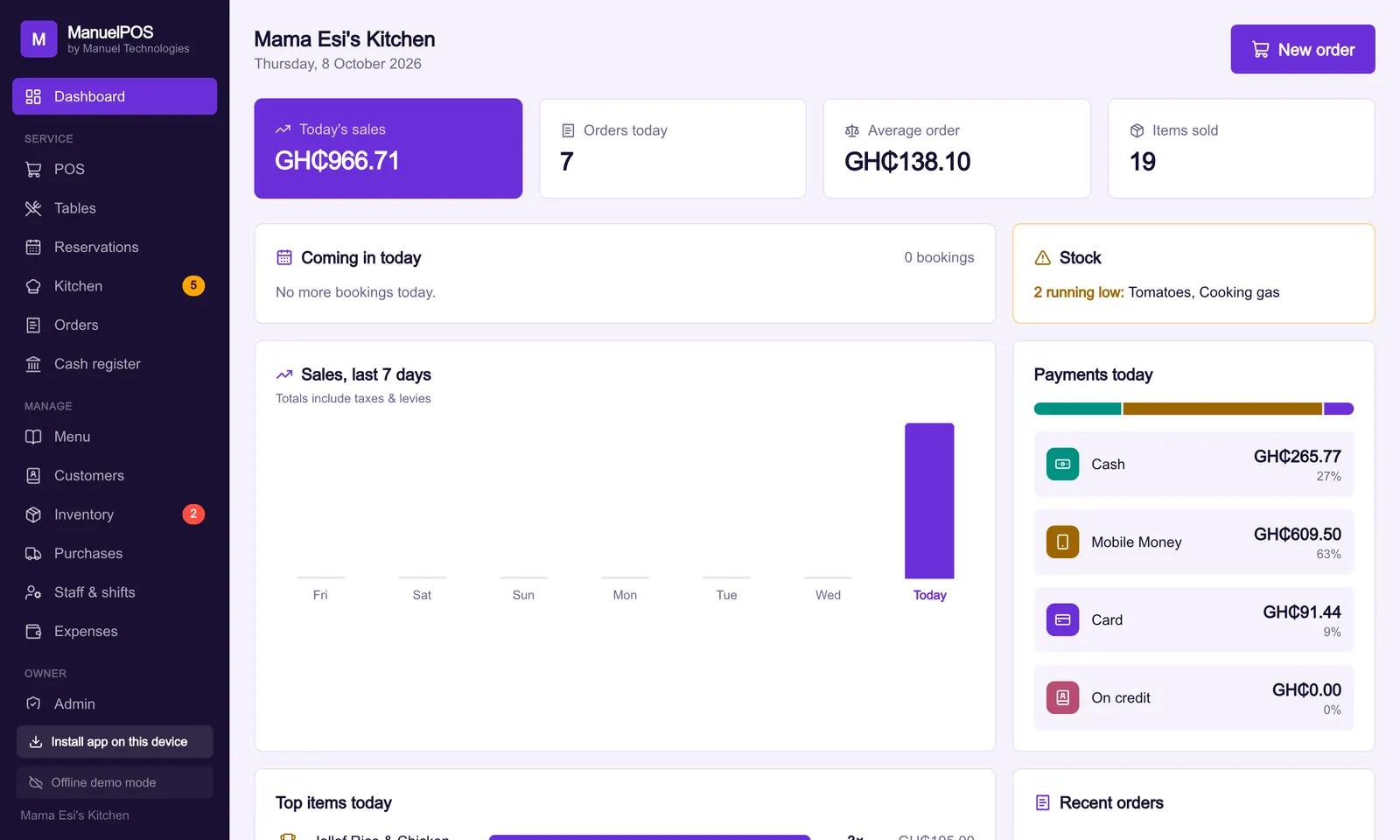
A POS will not cost your plates for you, but it shows you which plates matter. The items report tells you how many of each dish you sold in any period, so you know which five dishes to cost first. The profit and loss report shows your sales against what you spent, so you can see whether your food-cost target is holding.
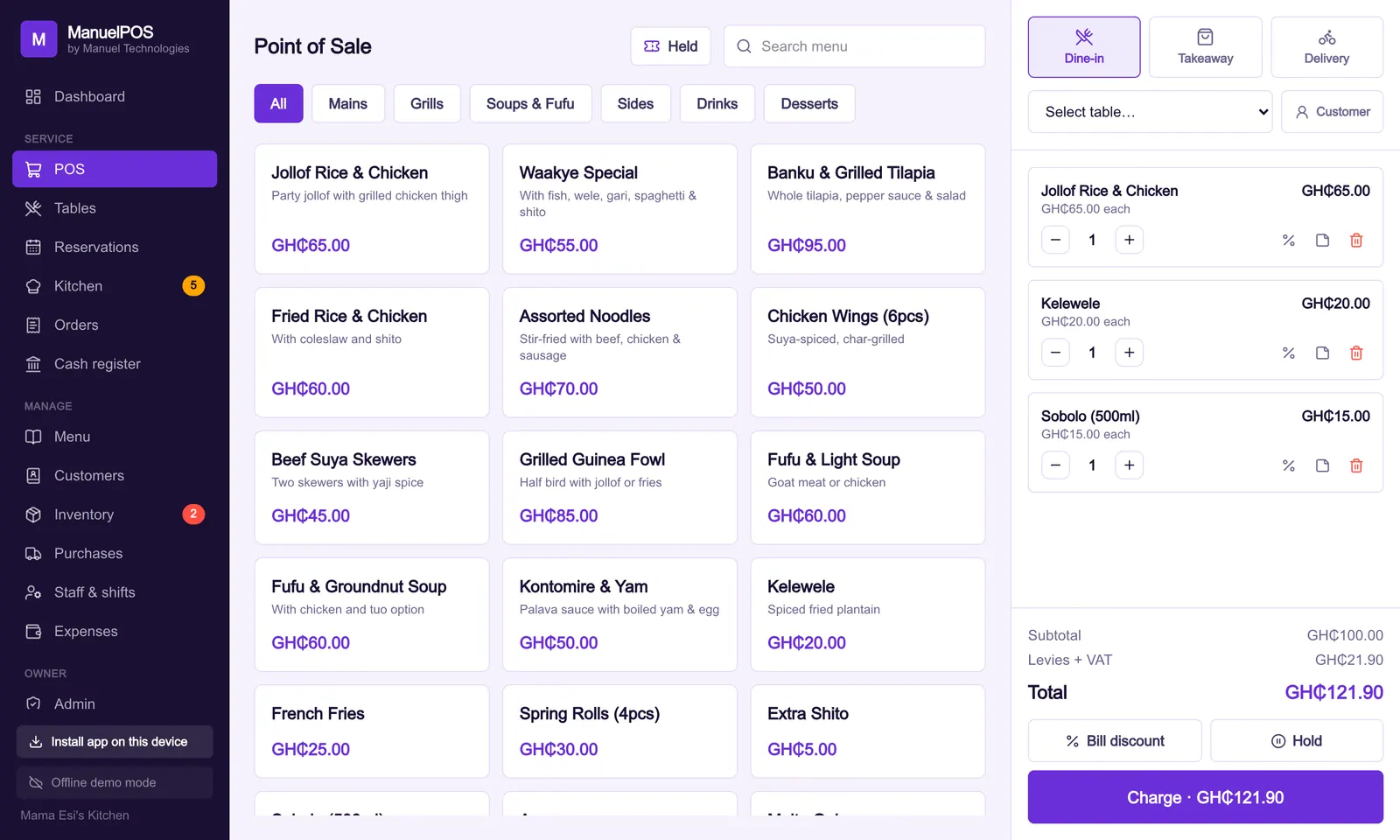
In MPOS, menu prices include tax by default, and receipts show VAT, NHIL and GETFund separately, so the price before tax is always visible. Extras such as an extra egg or a takeaway pack can be their own items, so they are charged every time. To keep the ingredients themselves under control, read how to control ingredient stock and kitchen waste, or go back to the complete guide to running a restaurant in Ghana.
If you want to see your own menu and items report, you can start a free trial.
See it with your own products
Free for 14 days. No card needed. Works on the phone or laptop you have.
Sources
FAQ
Frequently asked questions
Quick answers to what business owners ask us about this.
What is a good food cost percentage for a restaurant in Ghana?
There is no single right figure. It depends on your rent, staff and other costs. Work out your monthly costs outside food, then choose a target that leaves you money after them. Many owners start by costing their best sellers and seeing where they stand.
How do I calculate food cost per plate?
Cost a whole pot: add up what you paid for everything that went in, then divide by the number of plates it served. Add the protein, sides and takeaway pack for one plate. That total is your plate cost.
How do I set a menu price from the food cost?
Divide the plate cost by your food-cost target. A GH₵30 plate with a 35% target needs GH₵85.71 before tax. If you are VAT-registered, add 20% for VAT, NHIL and GETFund on top.
Does my menu price include VAT?
If you are VAT-registered, menu prices in Ghana usually include VAT, NHIL and GETFund, and the receipt shows them. If you are not registered, you should not charge VAT.
Should a takeaway pack be charged separately?
Many places do, because the pack is a real cost on every takeaway plate. Either add it as its own item or build it into a separate takeaway price.
Still have a question?
Talk to the team on WhatsApp: real people in Ghana who know your kind of business.
About the author
Emmanuel Akyeam is the founder of Manuel Technologies in Ghana, which builds MPOS: the till, bookings and stock system for restaurants, salons, barbershops and shops. He works directly with business owners to set up their systems.
You may also like
- Restaurants
How to control ingredient stock and kitchen waste in a restaurant
A simple weekly routine for rice, oil, chicken and drinks: count, compare usage with sales, keep a waste sheet, and buy to what you really sell.
21 October 2026 · 6 min read
- Restaurants
Splitting and merging bills and running open tabs in a restaurant
How to split a group's bill without a calculator, merge tables, move a bill, run a bar tab, and take part cash and part MoMo without the totals going wrong.
21 October 2026 · 6 min read