The short answer
Count your main ingredients at the same time each week, work out what you actually used (opening stock plus purchases minus closing stock), and compare it with what your sales say you should have used. Write down every spoilt or thrown-away item as it happens, so the gap that is left is the part you need to explain.
Key takeaways
- Count the few ingredients that cost the most, every week, at the same time.
- Usage = opening stock + purchases - closing stock. Compare it with what sales say.
- Write waste down when it happens; an unexplained gap is a different problem from spoilage.
- Keep bought-in drinks and water as stock items and count them like a shop does.
- Buy to what the sales report says you sell, especially on slow days.
In a kitchen, money leaves in small amounts: a pot of stew that went sour, chicken left out of the freezer during a light-off, a bag of rice that is lighter than it should be by Friday. None of it shows on the till, so many owners only notice when the month's profit is lower than the busy days suggested.
The fix is not counting everything every day. It is counting the right few things, at the same time each week, and comparing them with what you sold. All the numbers below are example figures.
Which ingredients should you count?
Count the ingredients that cost you the most money, not all of them. For most chop bars and restaurants that is a short list: rice, oil, chicken and fish, meat, gas, and every drink you buy in to resell. Salt and spices are not worth a weekly count.
A good rule is to list everything you buy, sort it by what you spend on it in a month, and count the top eight to ten. Those few items are usually most of your food spend.
| Count weekly | Count monthly | Do not count |
|---|---|---|
| Rice, oil, chicken, fish, meat | Tomato paste, flour, beans | Salt, Maggi, spices |
| Gas cylinders | Packs and bags | Matches, cleaning cloths |
| Beer, soft drinks, Voltic, Malt | Spirits by the bottle |
How do you know what you should have used?
Work out what you actually used, then compare it with what your sales say you should have used. Actual usage is:
Opening stock + what you bought - closing stock = what you used
Expected usage comes from your sales report and your portions. If one plate of jollof uses 200 g of rice and you sold 520 plates that week, you should have used about 104 kg.
Worked example: rice for one week
| Line | Amount |
|---|---|
| Opening stock (Monday morning) | 50 kg |
| Bought during the week | 100 kg |
| Closing stock (next Monday morning) | 30 kg |
| Actually used | 120 kg |
| Plates sold that use rice | 520 |
| Portion per plate | 0.2 kg |
| Should have used | 104 kg |
| Gap | 16 kg |
Source: Example figures
At GH₵25 a kilo, 16 kg is GH₵400 in one week. Some of it is honest: the burnt bottom of a pot, rice that went off in the heat. That is what the waste sheet is for. The rest, the unexplained part, is portions that are too big, plates that were never rung up, or stock that walked out.
Keep a waste sheet
A waste sheet is a page on the kitchen wall where staff write down anything thrown away, as it happens: the date, the item, the amount and why. Without it, every gap looks like theft. With it, you can see that most of the loss is the Sunday soup that nobody bought.
Keep it simple:
- One line per item: "Tue, light soup, half pot, soured after light-off".
- The cook or kitchen lead signs each line.
- Add it up each week, in kilos or in cedis.
The waste sheet also tells you what to change. If the same item is thrown away every week, you are making too much of it, storing it badly, or it needs to leave the menu.
How do you cut waste without running out?
Make and buy to what you actually sell. Your sales report shows how many plates of each dish sold on each day of the week, and the pattern is usually steady: Friday and Saturday busy, Monday slow, one dish that sells out by two o'clock and one that is always left over.
- Count the top ingredients at the same time, before cooking starts
- Add up what you bought this week from your supplier receipts
- Work out what you used and what sales say you should have used
- Add up the waste sheet
- Look into the gap that is left over
- Set next week's buying from the sales by day
Some practical habits that cut waste:
- First in, first out. Put new stock behind old stock, in the freezer and on the shelf, so the oldest is used first.
- Cook in smaller batches on slow days. A second smaller pot at noon wastes less than one large pot at seven in the morning.
- Plan for light-offs. Know which items cannot stand a long outage and do not overstock them.
- Portion with fixed tools. The same ladle and the same scoop for every plate. A bigger scoop is waste that nobody writes down.
- Use the leftovers properly. If yesterday's stew becomes today's staff meal, write it on the waste sheet so the count still makes sense.
Food safety comes before saving money. Food service establishments in Ghana need a Food Hygiene Permit from the Food and Drugs Authority, and FDA asks registered establishments to display it. Keep to FDA's hygiene rules on storage and leftovers, and when in doubt, throw it out and write it down.
What about drinks and bought-in items?
Treat drinks like a shop treats its stock. A crate of beer, a pack of Voltic or a carton of Malt is bought at a known price and sold one by one, so the count should match the sales exactly. If you bought 10 crates of 24 bottles, sold 230 bottles and have 10 bottles left, that is a clean week. If you have 2 left, eight bottles need an answer.
Drinks are also where the bar and the kitchen meet. If the bar has its own printer and its own staff, make sure every drink is rung up before it is poured or opened.
How does a POS help with stock and waste?
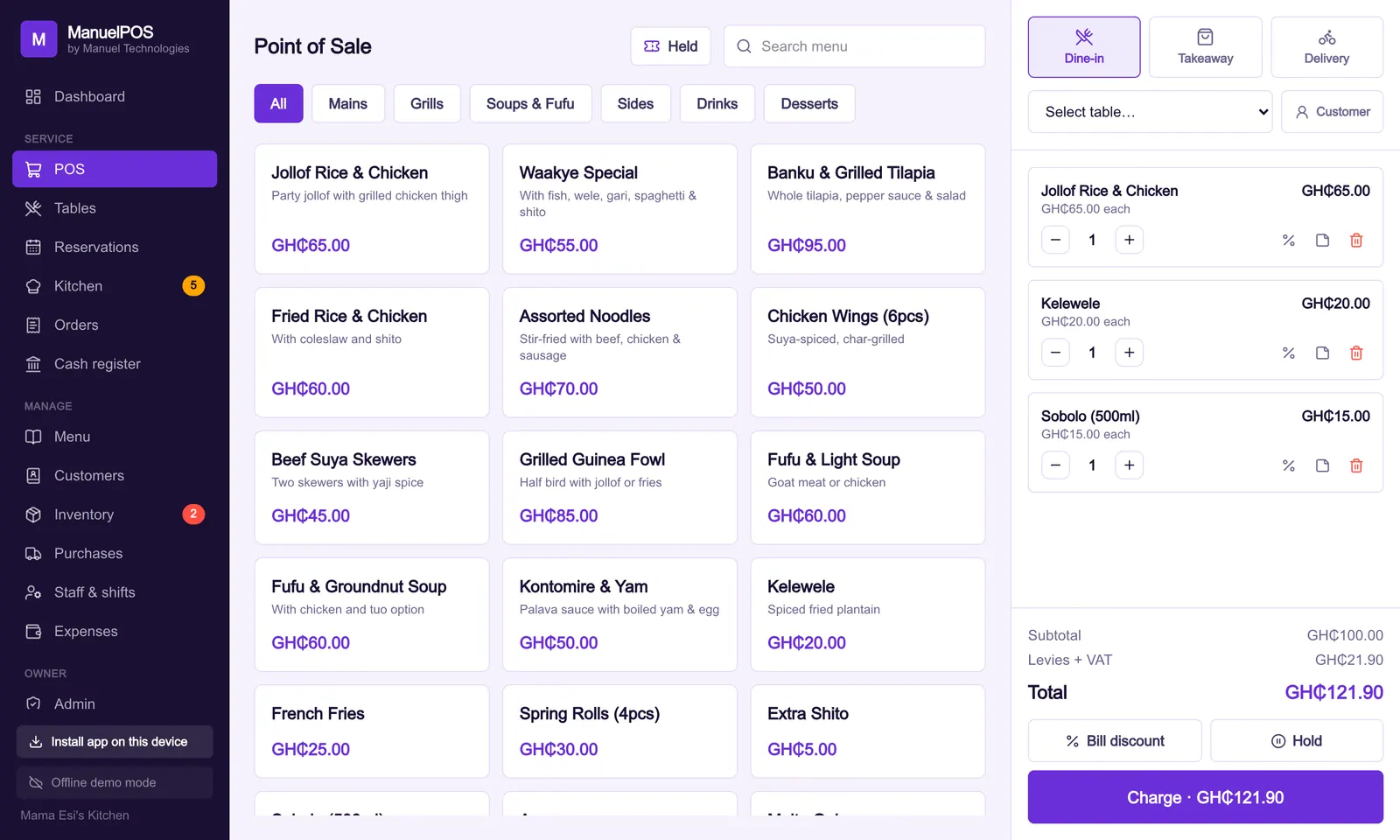
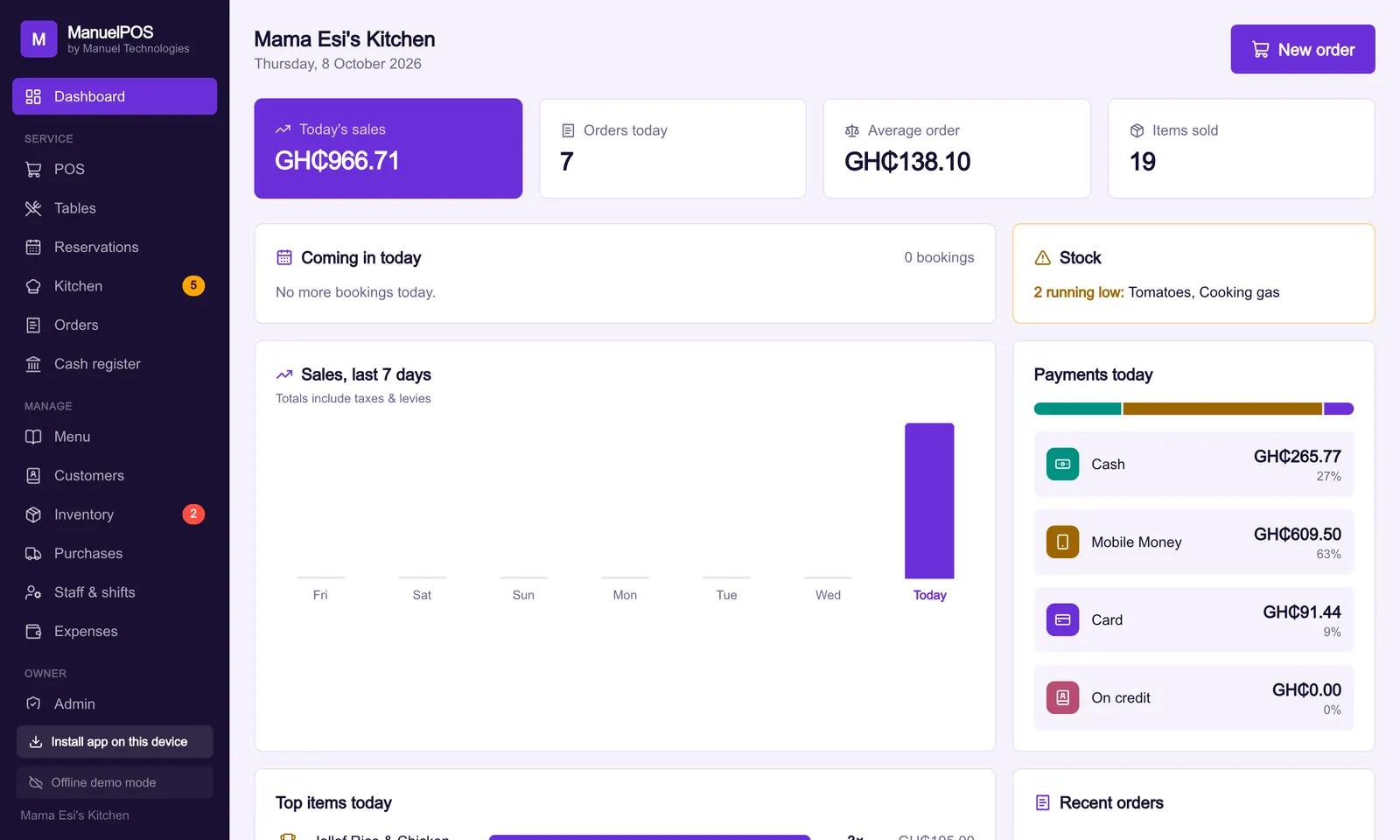
A POS gives you the "should have used" side of the sum: what sold, by day and by item. In MPOS you can keep your ingredients and supplies, such as rice, oil, gas and packs, alongside the drinks you resell, record purchases from each supplier, and get a low-stock warning before you run out. The stock value report shows what is sitting on your shelves and in your freezer.
For drinks and other items you sell as they are, a regular stock take shows exactly what is missing. And because every void and price change is in the activity log, you can rule out the till before you blame the kitchen. For more on the till side, read how to stop theft by waiters and cashiers. For pricing the plates themselves, read how to cost a plate and set menu prices.
The shop version of the same idea is in stop stock and cash leakage in your mini-mart, and the whole restaurant picture is in the complete guide to running a restaurant in Ghana. You can start a free trial and put your own ingredients in.
See it with your own products
Free for 14 days. No card needed. Works on the phone or laptop you have.
Sources
FAQ
Frequently asked questions
Quick answers to what business owners ask us about this.
How often should a restaurant count stock?
Count your most expensive ingredients and every bought-in drink once a week, at the same time, before cooking starts. Count the cheaper items monthly. Daily counts are only worth it for items that go missing.
How do I calculate ingredient usage?
Opening stock plus what you bought, minus closing stock, is what you used. Compare it with the portions sold that week from your sales report. The difference is waste or a problem to look into.
What is a waste sheet?
A sheet in the kitchen where staff write down every item thrown away, with the date, amount and reason. It separates honest spoilage from stock that cannot be explained.
How do I reduce food waste in a chop bar?
Cook to what you sell on each day of the week, cook smaller batches on slow days, use the oldest stock first, portion with fixed ladles and scoops, and take dishes that are always left over off the menu.
Does a restaurant in Ghana need an FDA permit?
Yes. The Food and Drugs Authority says food service establishments, including restaurants and traditional food providers, need a valid Food Hygiene Permit and must display it. Check the current requirements with FDA.
Still have a question?
Talk to the team on WhatsApp: real people in Ghana who know your kind of business.
About the author
Emmanuel Akyeam is the founder of Manuel Technologies in Ghana, which builds MPOS: the till, bookings and stock system for restaurants, salons, barbershops and shops. He works directly with business owners to set up their systems.
You may also like
- Restaurants
How to cost a plate and set menu prices for a restaurant in Ghana
A worked GH₵ example for costing a plate of jollof and chicken, choosing a food-cost target, and setting a menu price that still pays you after tax.
21 October 2026 · 7 min read
- Restaurants
Splitting and merging bills and running open tabs in a restaurant
How to split a group's bill without a calculator, merge tables, move a bill, run a bar tab, and take part cash and part MoMo without the totals going wrong.
21 October 2026 · 6 min read