The short answer
A shop in Ghana does not need to buy barcodes to scan its stock: you scan the codes already on branded goods and print your own in-store labels for loose or unlabelled items. You only need official GS1 barcodes from GS1 Ghana if you make or pack your own products to sell through other shops.
Key takeaways
- Most branded goods already carry a barcode you can scan as it is.
- Print your own in-store labels for loose, repacked or unlabelled items.
- You need a GS1 Ghana barcode only if you make or pack products that other shops will sell.
- A barcode's first digits do not tell you where a product was made.
- Never let one barcode sit on two products: it is the most common scanning mistake.
On this page8 sections
- 01Do you need to buy barcodes to scan in your shop?
- 02Which items will need your own labels?
- 03When do you need a GS1 Ghana barcode?
- 04How do you print your own price tags with barcodes?
- 05What happens when two products share a barcode?
- 06How do you add barcodes for a whole shop at the start?
- 07Which barcode scanner should you buy?
- 08How MPOS handles barcodes
Scanning is the single biggest step up for a shop moving from a notebook to a till. Prices come up right, the queue moves, and stock is taken off as you sell. But owners often ask the same questions first. Where do I get barcodes? Do I have to pay for them? What about the items with no code at all?
Here are the answers.
Do you need to buy barcodes to scan in your shop?
No. To sell in your own shop, you scan the barcodes that manufacturers already print on their goods, and you make your own labels for anything without one. Buying barcodes is for producers, not for the shop that resells their goods.
Most of what a mini-mart sells, from Milo tins to Voltic bottles to toothpaste, already has a barcode. You scan it once when you add the product, enter your price, and from then on it scans at the till.
Which items will need your own labels?
Items without a usable barcode need a label you print yourself. In a typical Ghanaian shop that means:
- Goods you repack: rice, sugar, groundnuts or gari bagged in the shop.
- Loose items sold singly, such as sweets or sachet drinks taken out of a bag.
- Imported goods whose barcode does not scan cleanly or is damaged.
- Cartons and packs with no barcode of their own.
- Hand-made or local goods, such as shea butter or black soap from a small supplier.
When do you need a GS1 Ghana barcode?
You need an official GS1 barcode when you make or pack a product that will be sold in other people's shops, especially supermarkets. GS1 is the organisation that runs the global barcode system, and it licenses barcodes for use around the world. In Ghana that is done by GS1 Ghana.
GS1 Ghana says that to get barcodes you become a member and request unique barcodes for your business, by filling in an online application or contacting them. Their website does not list fees, so ask them directly for the current cost before you plan around it.
Does a barcode starting with 603 mean the product is from Ghana?
No. 603 is the prefix given to GS1 Ghana, but GS1 prefixes do not identify where a product was made. A company can make goods anywhere and license its codes from the GS1 office of its choice. Do not use the barcode to judge where something comes from.
| Your situation | What you need |
|---|---|
| You resell branded goods | Scan the code already on the pack |
| You repack goods in the shop | Print your own in-store labels |
| You sell your own product in other shops | GS1 barcodes from GS1 Ghana |
| A carton has no code | Print a label for the carton unit |
How do you print your own price tags with barcodes?
Print small labels that carry the item name, the price and a barcode that only your shop uses. Stick them on the item or the shelf edge, and the cashier scans them like any other code.
- List every item with no barcode
- Add each one as a product with its price
- Give it a code only your shop uses
- Print the price tags
- Stick them on the item or shelf
- Test-scan one of each at the till
A few tips from the shop floor:
- Use a label printer, not ink on paper. Thermal labels are cheap, quick and scan well.
- Put the price on the tag in big numbers. Customers read the price before the barcode.
- Reprint when a price changes. An old tag on the shelf with a new price in the till leads to arguments at the counter.
- For loose items, keep a scan sheet at the till. A laminated card with the barcodes for sweets, sachets and loose items saves hunting for a tag.
What happens when two products share a barcode?
When two products share a barcode, the till cannot tell them apart. The cashier scans a 1 kg bag of sugar and the 500 g price comes up, or the stock of one item goes down when the other is sold. It is one of the most common reasons a stock count does not match.
It usually happens in three ways:
- Variants with one code. Some makers use the same barcode for every flavour or colour.
- Re-used labels. A label printed for one item gets stuck on another.
- Typing mistakes. A code entered by hand with a digit wrong matches another product.
The fix is to give each product its own code. If a manufacturer uses one barcode for several flavours, keep their code on the most common one and print your own labels for the others.
How do you add barcodes for a whole shop at the start?
Add them shelf by shelf, not all at once. Start with your fastest movers, since those are the items that slow the queue when they do not scan. Scan each item's code, check the name and price, and put it back. Then do the next shelf the following day.
Once the branded goods are in, walk the shop with a list and write down everything that did not scan. Those are the items that need your own labels. Print them in one batch, stick them on, and test-scan a few at the till before the next busy day. Most mini-marts can finish this in a week of quiet mornings.
Which barcode scanner should you buy?
A wired USB scanner is the simplest choice for a counter with a laptop or desktop. A Bluetooth scanner suits a tablet or phone till, and lets you walk the shelves during a stock count. Both type the code in like a keyboard, so the till needs no special setup. Some phone apps can read barcodes with the camera, but MPOS does not scan with the camera: plan on a scanner for every till.
How MPOS handles barcodes
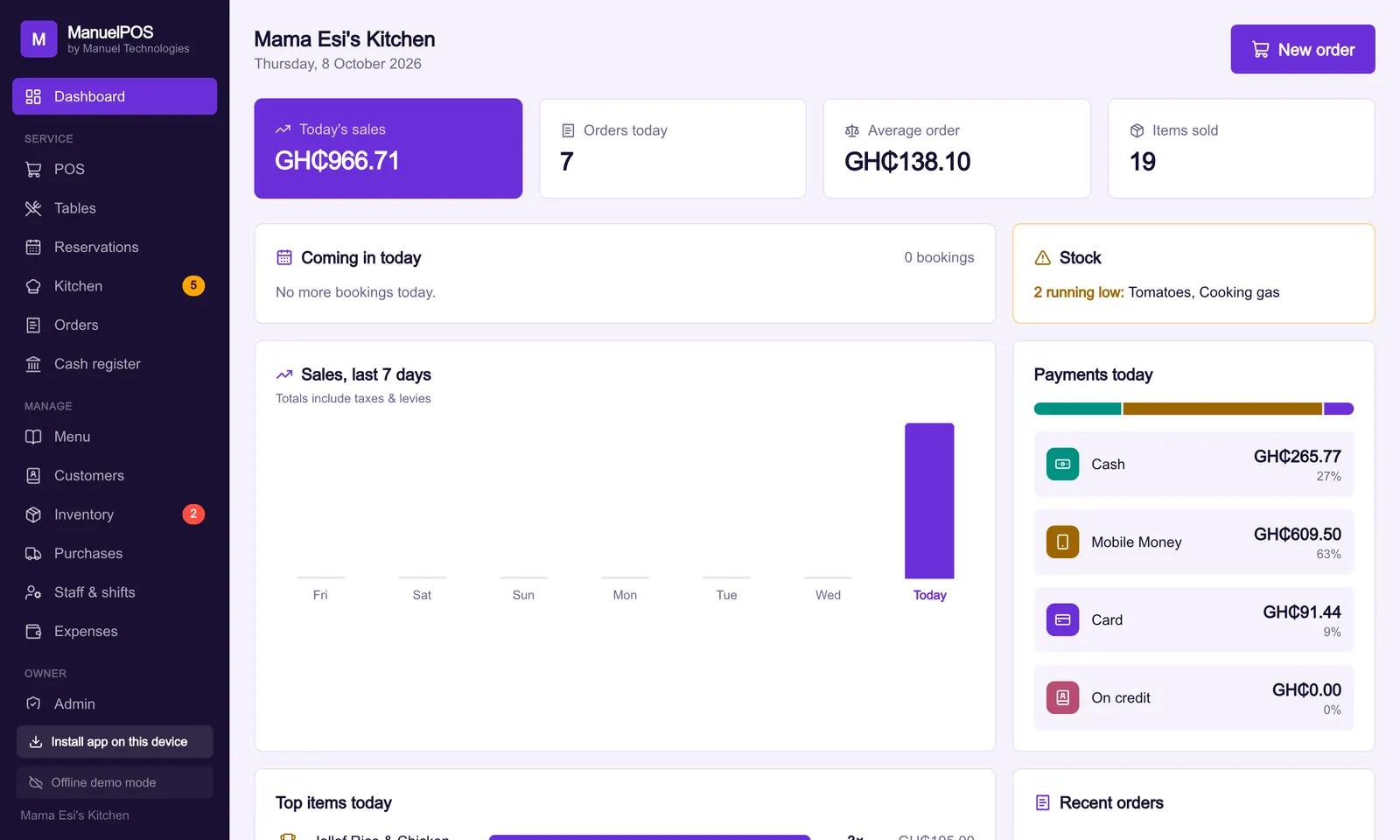
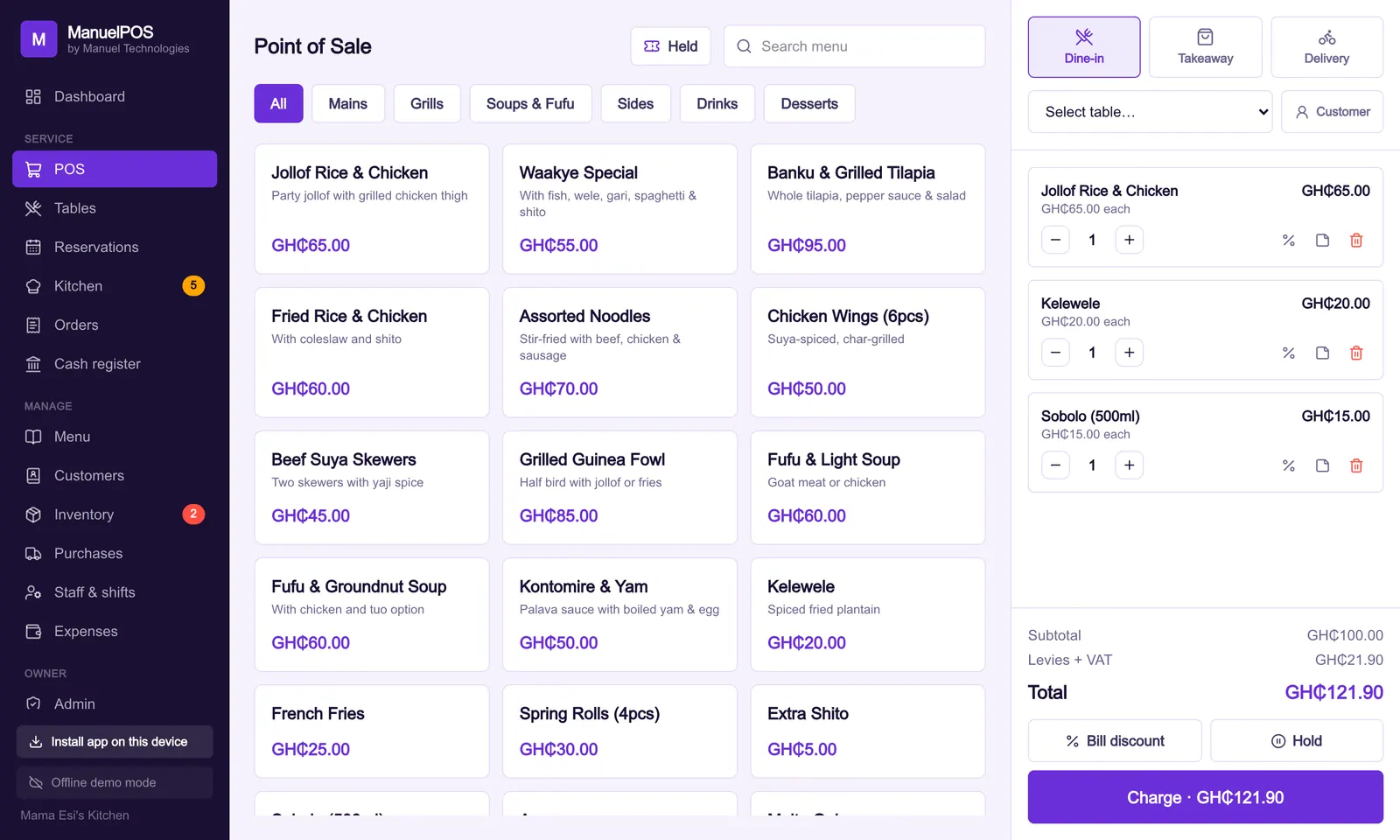
MPOS has a scan-first till. You scan an item, it asks how many, you type the number and press Enter, or scan the next item to keep the quantity at 1. Cartons and packs can have their own barcode and price. For items with no code, you give each one a code of your own and it prints price tags with that barcode.
It also refuses to put the same barcode on two products, so the duplicate problem above cannot creep in when someone adds a new item. If you are moving from another system, you can import your products and barcodes from Excel or CSV, including Aronium's export.
To try it on your own shelf, start a free trial. For setting up cartons and packs, read selling by carton, pack and single piece, and for the full picture, the complete guide to running a shop in Ghana.
See it with your own products
Free for 14 days. No card needed. Works on the phone or laptop you have.
Sources
FAQ
Frequently asked questions
Quick answers to what business owners ask us about this.
Where can I get barcodes in Ghana?
From GS1 Ghana, by becoming a member and applying online or contacting them. You only need these if you make or pack products that other shops will sell. To scan goods in your own shop, use the codes on the packs and print your own labels for the rest.
How much does a barcode cost in Ghana?
GS1 Ghana's barcode page does not list fees, so contact GS1 Ghana for the current cost. In-store labels you print for your own shop cost only the label paper.
Does a barcode that starts with 603 mean made in Ghana?
No. 603 is GS1 Ghana's prefix, but GS1 prefixes do not show where a product was made.
Can two products have the same barcode?
They should not. The till cannot tell them apart, so prices and stock go wrong. Give each product its own code, printing your own labels where a maker uses one code for several items.
Can I scan barcodes with my phone?
Not with the phone camera in MPOS. Pair a Bluetooth barcode scanner with the phone or tablet instead: it types each code in like a keyboard, and it is faster at a busy counter too.
Still have a question?
Talk to the team on WhatsApp: real people in Ghana who know your kind of business.
About the author
Emmanuel Akyeam is the founder of Manuel Technologies in Ghana, which builds MPOS: the till, bookings and stock system for restaurants, salons, barbershops and shops. He works directly with business owners to set up their systems.
You may also like
- Shops and retail
Selling by carton, pack and single piece without losing count
How to set up cartons, packs, half cartons and single pieces in your shop so prices are right, stock adds up and the till stays fast.
21 October 2026 · 6 min read
- Shops and retail
How to do a stock take without closing your shop
A step-by-step way to count stock in a mini-mart or provision shop while you keep selling, with a count sheet, a timetable and what to do with the differences.
21 October 2026 · 6 min read