The short answer
Set retail and wholesale prices from your cost, not from your neighbour's shelf: decide the margin each price must earn, divide the cost by one minus that margin, and round to a price customers accept. If your shop is VAT-registered, work margins on the price before VAT, NHIL and GETFund, which is the tax-inclusive price divided by 1.20.
Key takeaways
- Markup is profit as a share of cost; margin is profit as a share of the selling price.
- Price from cost: selling price equals cost divided by one minus the margin you want.
- Wholesale earns less per item, so it needs volume and quick payment to pay off.
- If you are VAT-registered, the tax inside a tax-inclusive price is one sixth of it.
- Update your cost every time a delivery comes in, or your margins drift.
Ask most shop owners how much they make on a tin of Milo and you will hear a number in cedis. Ask what margin that is, and many are not sure. That matters most when you sell both retail and wholesale, because a small mistake on a wholesale price is repeated on every carton.
This guide works through the sums with example figures in GH₵.
What is the difference between markup and margin?
Markup is your profit as a share of what the item cost you. Margin is your profit as a share of the selling price. They describe the same profit but give different percentages, and mixing them up is how prices end up too low.
Example: a tin costs you GH₵50 and you sell it for GH₵60. Profit is GH₵10.
- Markup = 10 ÷ 50 = 20%
- Margin = 10 ÷ 60 = 16.7%
If you want a 20% margin and add 20% to cost, you only get 16.7%. Over a year of sales, that gap is real money.
| Markup on cost | Margin on price |
|---|---|
| 10% | 9.1% |
| 20% | 16.7% |
| 25% | 20.0% |
| 33.3% | 25.0% |
| 50% | 33.3% |
How do you price from cost?
To hit a margin, divide your cost by one minus the margin. For a 20% margin on an item costing GH₵50:
Price = 50 ÷ (1 − 0.20) = 50 ÷ 0.80 = GH₵62.50
Then round to a price that works at the counter. GH₵62.50 is fine for a tin of Milo. For a sachet, round to a coin customers carry.
Your cost should include what it took to get the goods onto your shelf: transport from Makola or the depot, loading, and any packaging if you repack.
How should wholesale prices differ from retail?
Wholesale prices should earn a smaller margin per item, because the buyer takes a carton or a bag at once and you handle the stock less. The lower margin only pays off if the volume is high and the money comes in quickly.
Here is an example for a carton of 24 tins of evaporated milk that costs you GH₵228, or GH₵9.50 a tin.
| Price list | Price per tin | Profit per tin | Margin | Profit on a carton |
|---|---|---|---|---|
| Retail | GH₵12.00 | GH₵2.50 | 20.8% | GH₵60.00 |
| Wholesale | GH₵10.50 | GH₵1.00 | 9.5% | GH₵24.00 |
These are example figures.
Source: Example figures
Retail earns more per carton, but it may take a week to sell 24 tins one at a time. A wholesale customer takes the carton today. If you sell 10 cartons a week wholesale on top of your retail trade, that is GH₵240 more profit, with your money back in days.
Rules worth keeping
- Set a minimum for wholesale. A carton, a half carton or a fixed number of pieces. Otherwise everyone asks for the wholesale price.
- Keep wholesale above your full cost. Include transport and handling, not only the invoice price.
- Be careful with wholesale on credit. A thin margin disappears fast if the buyer pays late. See selling to customers on credit.
- Write the prices down. Cashiers should not decide the wholesale rate from memory.
How does VAT change your prices?
If your shop is registered for VAT, your shelf price includes VAT, NHIL and GETFund, and part of every sale is not yours. Under the Value Added Tax Act, 2025 (Act 1151), from 1 January 2026, VAT is 15%, NHIL 2.5% and GETFund 2.5%, all charged on the same value, according to the Ghana Revenue Authority. Together they add 20% to the price before tax.
So the price before tax is the tax-inclusive price divided by 1.20, and the tax inside the price is one sixth of it.
GH₵60.00
- Price before taxGH₵50.00 (83.3%)
- VAT 15%GH₵7.50 (12.5%)
- NHIL 2.5%GH₵1.25 (2.1%)
- GETFund 2.5%GH₵1.25 (2.1%)
Source: Ghana Revenue Authority rates; example price
In this example, a tin sold for GH₵60 brings in GH₵50 before tax. If it cost you GH₵45 before tax, your profit is GH₵5, not GH₵15. Work your margins on the before-tax figures.
Do you need to register?
The GRA raised the VAT registration threshold for businesses dealing in goods from GH₵200,000 to GH₵750,000 under the new law. The VAT Flat Rate Scheme was abolished, and NHIL and GETFund can now be claimed as input tax. Check with the GRA whether your shop must register, as of October 2026. Our article on Ghana VAT in 2026 explains what changed on receipts.
Some goods are exempt from VAT. If you sell them, mark them as exempt so no tax is added, and confirm the list with the GRA.
Keep your margins from drifting
Margins drift when costs rise and prices stay the same. A supplier puts up the carton price by GH₵12 and nobody changes the shelf price for a month.
- Record each delivery at its real cost
- Compare the new cost with the last one
- Reprice items whose cost went up
- Reprint shelf tags for changed prices
- Read the profit report each month
How MPOS helps with pricing
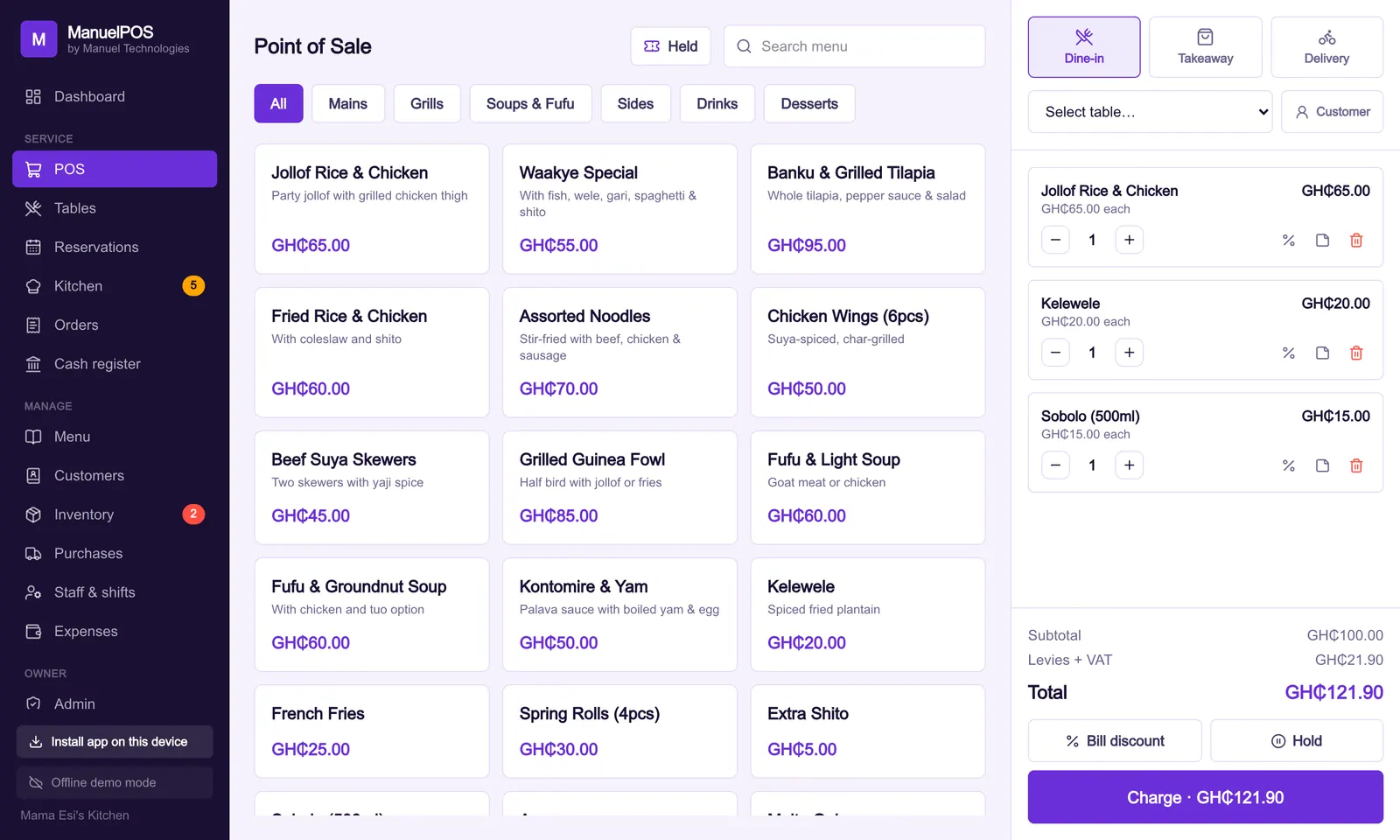
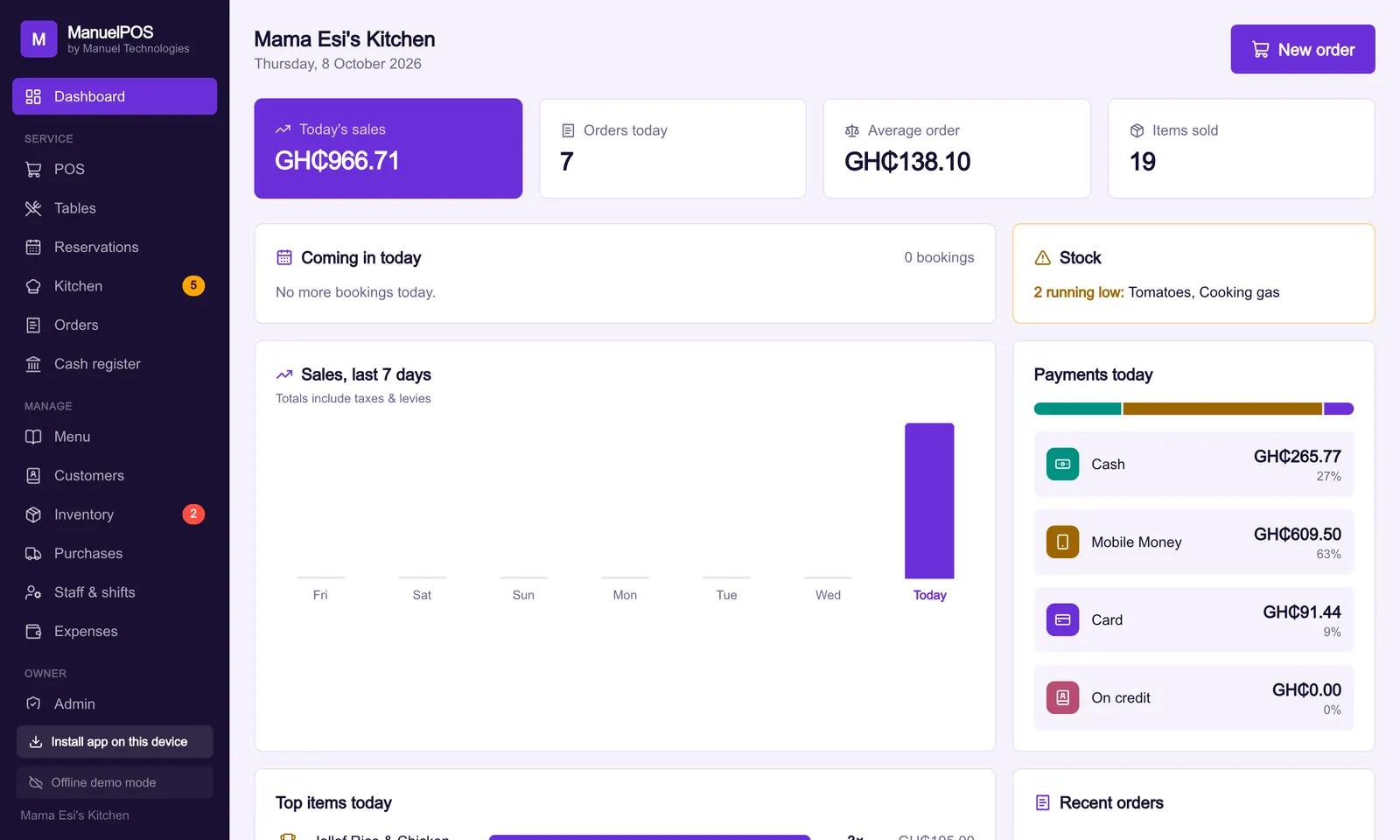
MPOS lets each item carry a retail and a wholesale price, and cartons and packs can have their own prices. Purchases from suppliers record what each delivery cost, and the last cost fills in on the next order, so a rise is easy to spot. Keep each item's cost price up to date, and the profit and loss and item reports show what you earn for any period. Prices include tax by default, items can be marked VAT-exempt, and receipts show the VAT, NHIL and GETFund breakdown. Every price change is in the activity log, with the person who made it.
To try it with your own prices, start a free trial. For the rest of the setup, read the complete guide to running a shop in Ghana, and for pack prices, selling by carton, pack and single piece.
See it with your own products
Free for 14 days. No card needed. Works on the phone or laptop you have.
Sources
FAQ
Frequently asked questions
Quick answers to what business owners ask us about this.
How do I calculate a selling price from cost?
Divide the cost by one minus the margin you want. For a 25% margin on an item that costs GH₵30, the price is 30 ÷ 0.75 = GH₵40.
What is the difference between markup and margin?
Markup is profit divided by cost. Margin is profit divided by the selling price. A GH₵10 profit on a GH₵50 cost is a 20% markup but a 16.7% margin.
What margin should a wholesaler make in Ghana?
There is no single figure. Wholesale margins are thinner than retail, so set yours from your full cost including transport, and make sure volume and prompt payment make up for the lower margin.
How much tax is inside a VAT-inclusive price in Ghana?
Under Act 1151, VAT 15%, NHIL 2.5% and GETFund 2.5% are charged on the same value, 20% in total. The price before tax is the shelf price divided by 1.20, so the tax is one sixth of the shelf price.
What is the VAT registration threshold for shops in Ghana?
The GRA raised the threshold for businesses dealing in goods from GH₵200,000 to GH₵750,000 from 1 January 2026. Check with the GRA how it applies to your shop.
Still have a question?
Talk to the team on WhatsApp: real people in Ghana who know your kind of business.
About the author
Emmanuel Akyeam is the founder of Manuel Technologies in Ghana, which builds MPOS: the till, bookings and stock system for restaurants, salons, barbershops and shops. He works directly with business owners to set up their systems.
You may also like
- Shops and retail
Selling by carton, pack and single piece without losing count
How to set up cartons, packs, half cartons and single pieces in your shop so prices are right, stock adds up and the till stays fast.
21 October 2026 · 6 min read
- Shops and retail
Barcodes for a Ghanaian shop: getting them, printing tags, fixing duplicates
Which barcodes a shop can scan, when you need GS1 Ghana codes, how to print your own price tags, and what to do when two products share a barcode.
21 October 2026 · 6 min read