The short answer
From 1 January 2026, a VAT-registered business in Ghana charges VAT at 15%, NHIL at 2.5% and the GETFund levy at 2.5%, each on the same price, so GH₵100 becomes GH₵120. The 1% COVID-19 levy has been repealed and the 3% flat rate scheme has ended.
Key takeaways
- Since 1 January 2026, VAT (15%), NHIL (2.5%) and GETFund (2.5%) are each charged on the same price: 20% in all.
- The 1% COVID-19 Health Recovery Levy has been repealed. It should no longer appear on new receipts.
- The 3% VAT flat rate scheme for retailers has ended.
- Businesses selling goods only have to register for VAT once turnover passes GH₵750,000 a year.
- If you are not VAT-registered, you should not be adding VAT to your customers' bills.
The VAT Act, 2025 (Act 1151) and the law repealing the COVID-19 levy both took effect on 1 January 2026. For most businesses the change is good news: the effective rate on a standard sale went down, and the sum is simpler. But many tills, spreadsheets and old receipt books in Ghana still use the old method. If yours does, you may be charging customers too much, or showing figures your accountant cannot use.
This guide explains what changed, shows the new calculation with real numbers, and lists what to check in your business this week. It is based on the Ghana Revenue Authority's own published guidance. For anything specific to your business, speak to GRA or your accountant.
What changed on 1 January 2026?
Four things matter at the till:
- The COVID-19 levy is gone. The 1% COVID-19 Health Recovery Levy was repealed.
- NHIL and GETFund are back on the VAT base. The National Health Insurance Levy (2.5%) and the GETFund Levy (2.5%) are now charged on the same value as VAT, instead of being added first and then taxed again.
- The flat rate scheme ended. The 3% VAT flat rate scheme that many retailers used for goods has been removed in favour of one standard structure.
- The registration threshold went up. A business supplying goods now only has to register for VAT when its turnover passes GH₵750,000 a year, up from GH₵200,000. GRA describes this as taking micro and small businesses out of VAT.
How is VAT calculated now?
Under the old rules, you added the levies first (NHIL, GETFund and COVID, 6% in total) and then charged 15% VAT on the price plus the levies. That stacking pushed the effective rate to about 21.9%.
Under the new rules, each tax is worked out on the same price. Here is GRA's own example for an item priced at GH₵100 before tax:
| Line on the receipt | Before 2026 | From 1 January 2026 |
|---|---|---|
| Price before tax | GH₵100.00 | GH₵100.00 |
| NHIL 2.5% | GH₵2.50 | GH₵2.50 |
| GETFund 2.5% | GH₵2.50 | GH₵2.50 |
| COVID-19 levy 1% | GH₵1.00 | none |
| VAT 15% | GH₵15.90 (on 106.00) | GH₵15.00 (on 100.00) |
| Customer pays | GH₵121.90 | GH₵120.00 |
On a GH₵100 sale the customer now pays GH₵1.90 less. Across a month of sales, a till still using the old method overcharges every single customer.
Do you even need to charge VAT?
This is the question many small businesses never ask. VAT is charged by VAT-registered businesses. With the threshold for goods now at GH₵750,000 a year, many chop bars, provision shops and beauty shops are below it.
If you are not registered, adding "VAT" to a bill is not something you are entitled to do, and the money is not yours to keep. If you are registered, you must charge it correctly and show it properly. Either way, check your status with GRA rather than copying what the shop next door does.
What should a receipt show?
GRA's invoicing guidance asks for NHIL, the GETFund levy and VAT to be shown, along with their total. A clear receipt from a registered business should include:
- your business name and TIN
- the date and a receipt number
- each item, quantity and price
- the subtotal after any discounts
- NHIL, GETFund and VAT, and the total tax
- the amount paid and how it was paid (cash, MoMo, card)
Discounts come off before tax is worked out. A 10% discount on a GH₵100 item makes the taxable price GH₵90, so the customer pays GH₵108.00, not GH₵110.00.
What should you check this week?
- Confirm whether you are VAT-registered. If you are not, switch tax off on your till.
- Ring up a GH₵100 test sale. If the total is not GH₵120.00, your till is using the old method.
- Remove the COVID levy line from receipt templates and price lists.
- Update printed price lists that were worked out at the old 21.9%.
- Keep your old reports. Sales made in 2025 were taxed under the old rules, and those figures should stay as they were.
How does ManuelPOS handle the 2026 rules?
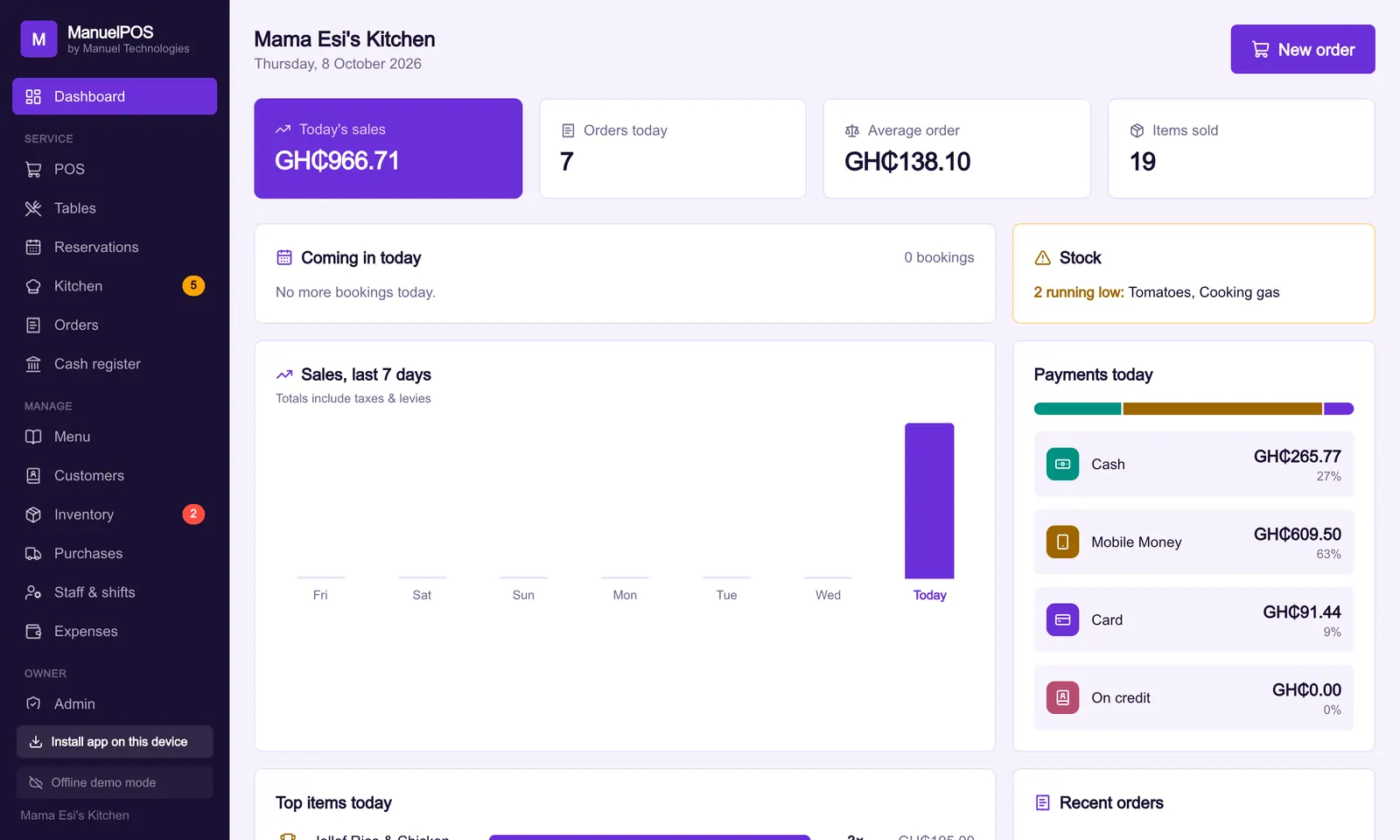
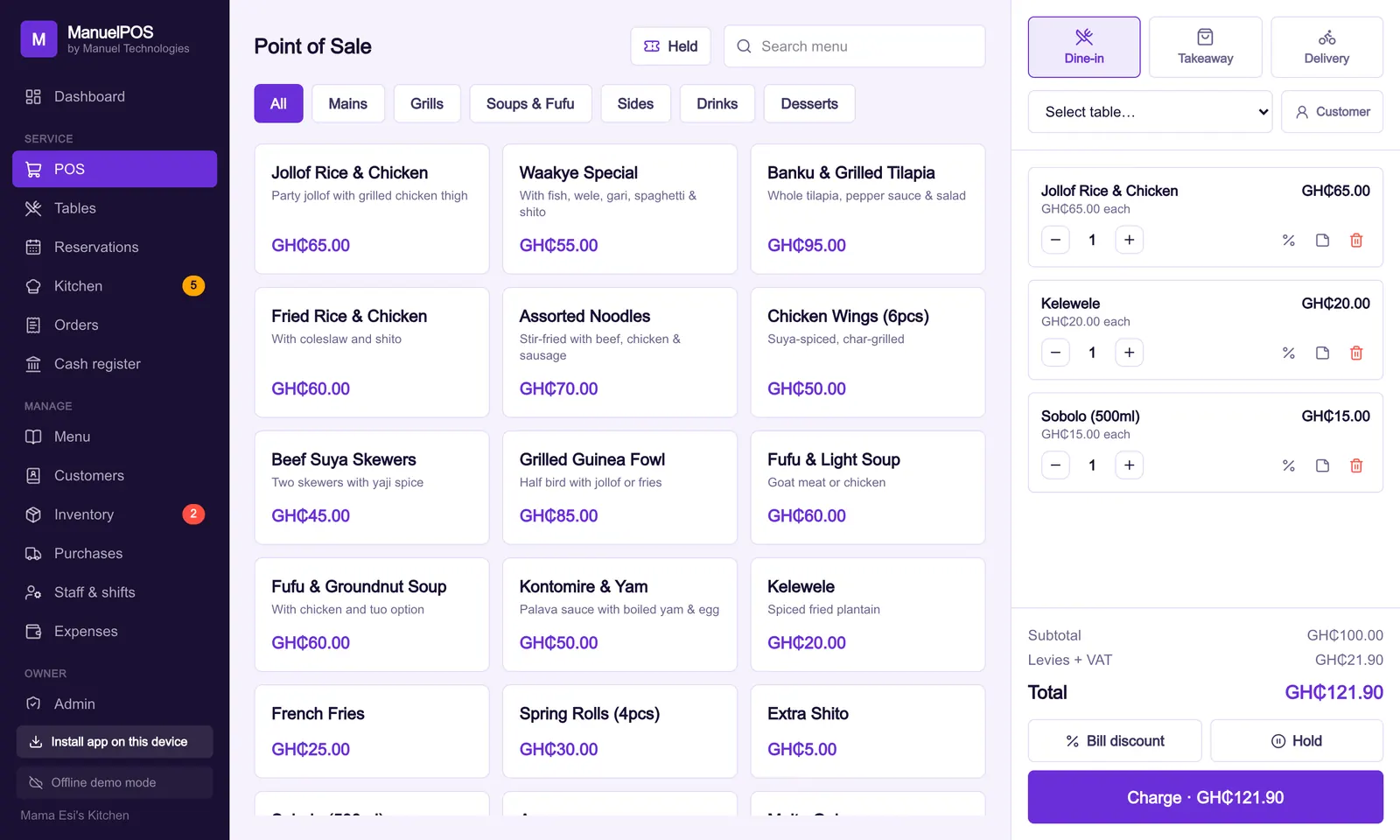
ManuelPOS works out VAT, NHIL and GETFund under the 2026 rules on every sale, shows each one on the receipt, and adds them up in the monthly report for your returns. Sales from before 2026 keep the levy they were charged, so your history stays correct. If you are not VAT-registered, one switch in Settings turns tax off completely.
You can try it on your own products free for 14 days: start your trial.
See it with your own products
Free for 14 days. No card needed. Works on the phone or laptop you have.
Sources
FAQ
Frequently asked questions
Quick answers to what business owners ask us about this.
Is VAT in Ghana now 20%?
The combined rate on a standard sale is 20%: VAT at 15%, NHIL at 2.5% and the GETFund levy at 2.5%, each charged on the same price. VAT on its own is still 15%.
Do I still charge the COVID-19 levy?
No. The COVID-19 Health Recovery Levy was repealed from 1 January 2026. It should not appear on receipts for sales made from that date.
My shop is small. Do I have to charge VAT?
Only VAT-registered businesses charge VAT. For businesses supplying goods, registration is required once turnover passes GH₵750,000 a year. Check your own position with GRA or your accountant.
What happened to the 3% flat rate scheme?
It has been removed. GRA replaced it with a single standard VAT structure from 1 January 2026.
Do discounts come off before or after tax?
Before. The taxes are worked out on the price after the discount, so a discounted sale carries less tax.
Still have a question?
Talk to the team on WhatsApp: real people in Ghana who know your kind of business.
About the author
Emmanuel Akyeam is the founder of Manuel Technologies in Ghana, which builds ManuelPOS: the till, bookings and stock system for restaurants, salons, barbershops and shops. He works directly with business owners to set up their systems.
You may also like
- Running a business
How to choose a POS system for your business in Ghana
Ten questions to ask before you pay for a till system, from what happens when the network goes off to who can see your profits.
10 October 2026 · 5 min read
- Running a business
How to reconcile Mobile Money payments at the end of the day
A simple daily routine for matching MoMo payments to sales, spotting fake payment messages and closing the till with confidence.
8 October 2026 · 3 min read