The short answer
Stock and cash leakage in a mini-mart is stopped by counting the till at every open and close, requiring a manager for voids, refunds and big discounts, counting fast-moving items weekly, and checking deliveries at the door.
Key takeaways
- Most leakage is small and daily: unrecorded sales, quiet voids, 'borrowed' stock and wrong counts.
- Open every till with a counted float and close it with a counted drawer.
- Voids, refunds and big discounts should need a manager.
- Count your fastest-moving items every week, not once a year.
Few shops are robbed. Most lose money slowly: a sale that was never rung up, a void nobody questioned, a carton that left with a relative, a delivery that came in short. Each one is small. Over a year they can be the difference between a good business and a struggling one.
You cannot watch the shop every minute. You can set it up so that gaps show up on their own.
Where do shops usually lose money?
- Sales not rung up. The customer pays cash, the item goes, nothing is recorded.
- Voids and refunds. A real sale is rung up, then voided after the customer leaves, and the cash goes into a pocket.
- Discounts. Friends and family get prices nobody approved.
- Stock walking out. Items are taken without being sold, or used in the house.
- Short deliveries. The supplier invoice says 24, the carton has 20.
- Wrong prices. An old price on the shelf or in the system, so every sale of that item loses money.
How should you open and close the till?
Start each day or shift with a counted opening float. Record any cash that leaves the drawer during the day, such as paying for water or transport, with a reason. At closing, count the cash and compare it to what the system expects.
A small difference now and then is normal. A shortfall that keeps appearing on the same person's shift is a pattern worth a conversation.
Make voids and refunds visible
A cashier should be able to sell, but not cancel a sale on their own. Require a manager for voids, refunds and large discounts, and require a reason. Then read the void report every week. Most owners who start doing this are surprised by what they find.
How often should you count stock?
A full stock count once a year finds problems far too late. Instead, pick your ten fastest-moving or most expensive items and count them every week. Compare the count with what the system says should be on the shelf. A gap tells you exactly where to look.
Check deliveries at the door
Count every delivery against the supplier's invoice before the driver leaves, and record what actually arrived. Recording purchases also keeps your cost prices up to date, so your profit figures stay honest.
Scan, don't type
Barcode scanning removes wrong prices and typing mistakes, and it is much faster at a busy counter. If items have no barcode, print your own price labels with a barcode so every item scans.
How does ManuelPOS help a shop?
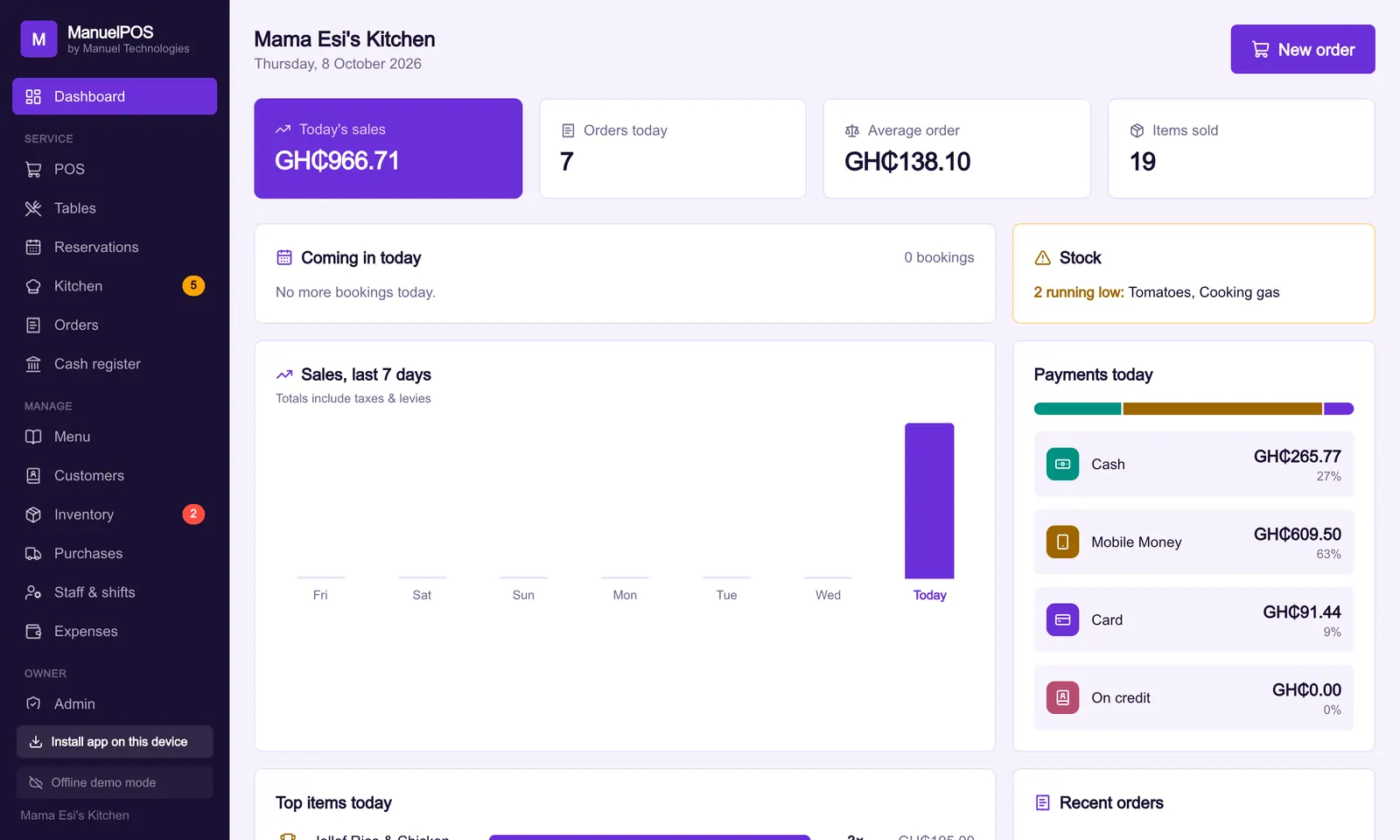
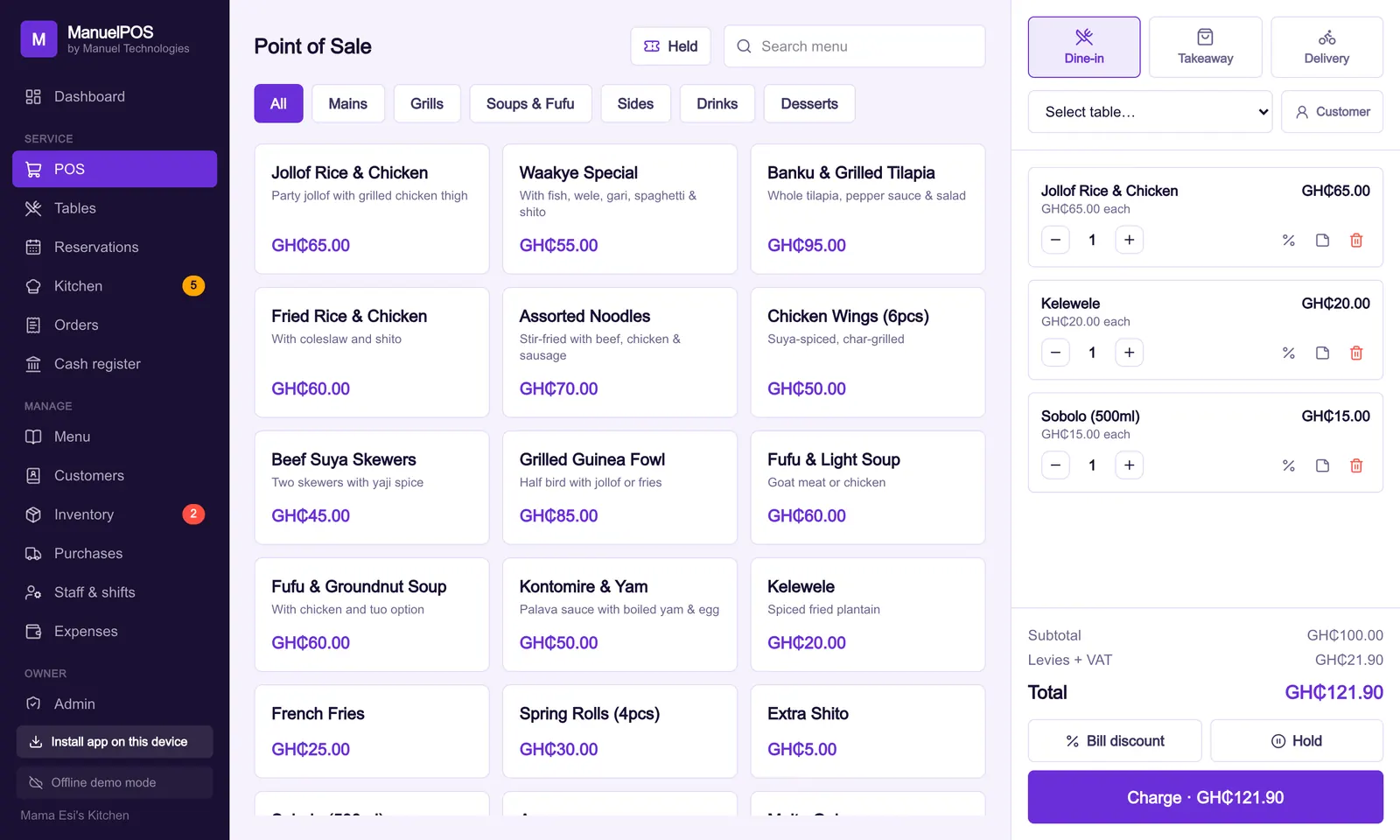
ManuelPOS scans barcodes with a scanner or the phone camera, and prints price tags for items without one. It keeps stock per branch, changing it only through sales, returns, deliveries, counts and transfers, so every movement is recorded.
Each till opens with a float and closes with a count, including a Z report and any shortage. Voids and refunds need a manager and a reason. Every sale, void, refund, price change and stock change is recorded against the person who made it.
You can try it free for 14 days on your own products, or read about reconciling MoMo payments.
See it with your own products
Free for 14 days. No card needed. Works on the phone or laptop you have.
FAQ
Frequently asked questions
Quick answers to what business owners ask us about this.
How often should I count stock?
Count your fastest-moving and most expensive items every week, and do a full count every quarter. Small, frequent counts catch problems early.
What is a Z report?
It is the end-of-day summary for a till: sales by payment type, cash in and out, and the expected cash compared with what was counted.
Can ManuelPOS handle wholesale and retail prices?
Yes. Each item can have a retail and a wholesale price, and you choose the price list per customer or per sale.
I don't have barcodes on my products. Can I still scan?
Yes. ManuelPOS prints price tags with barcodes for your own items, so everything on the shelf can be scanned.
Still have a question?
Talk to the team on WhatsApp: real people in Ghana who know your kind of business.
About the author
Emmanuel Akyeam is the founder of Manuel Technologies in Ghana, which builds ManuelPOS: the till, bookings and stock system for restaurants, salons, barbershops and shops. He works directly with business owners to set up their systems.
You may also like
- Running a business
Ghana VAT in 2026: what changed on your receipts
From 1 January 2026, VAT, NHIL and GETFund are charged on the same price, the COVID-19 levy is gone and the flat rate scheme has ended.
12 October 2026 · 4 min read
- Running a business
How to choose a POS system for your business in Ghana
Ten questions to ask before you pay for a till system, from what happens when the network goes off to who can see your profits.
10 October 2026 · 5 min read