The short answer
To sell the same product by carton, pack and single piece, keep your stock in the smallest unit you sell, then set up each carton or pack as a fixed number of pieces with its own price and barcode. A half carton is then simply half of that number, and your count stays right whichever way the customer buys.
Key takeaways
- Count stock in the smallest unit you sell, usually the single piece.
- Set up each carton or pack as a fixed number of pieces with its own price.
- Give each pack its own barcode so the cashier never has to choose a unit by hand.
- A half carton is half the pack quantity, so it needs no separate product.
- Check your pack prices against your single price so bulk buyers always save a little.
On this page8 sections
- 01Why does selling in different units cause problems?
- 02How should you set up a product sold in several units?
- 03How do you handle half cartons and broken packs?
- 04Should every pack have its own barcode?
- 05How do you price packs so they make sense?
- 06Make the counter fast
- 07What about goods sold by weight?
- 08How MPOS handles units
Walk into any provision shop at Kejetia or Makola and you will see the same tin of milk sold three ways. A mother buys one tin. A chop bar owner buys a pack of six. A smaller shop buys a whole carton, or half of one. Each customer expects a different price, and you expect the stock count to be right at the end of the month.
That only works if the product is set up properly once. This guide shows how.
Why does selling in different units cause problems?
Different units cause problems because most shops record stock in one unit and sell in another. If your book says "20 cartons" and you sell 5 single tins, what is left? The cashier has to work it out, and over a month those small sums go wrong.
The usual signs:
- The count says you have stock, but the shelf is empty.
- A carton was sold at the single-piece price, or a single tin at the carton price per tin.
- Staff open a carton to sell pieces and nobody records it.
- Nobody knows the real profit on a carton sale.
The fix is one rule: count everything in the smallest unit you sell.
How should you set up a product sold in several units?
Set up one product in its smallest unit, then add each bigger unit as a pack of a fixed number of pieces. The pack has its own name, price and barcode, and selling it takes the right number of pieces off your stock.
Here is an example for a tin of evaporated milk sold by the tin, the six-pack and the carton of 24.
| Unit | Pieces in it | Example price | Price per tin |
|---|---|---|---|
| Single tin | 1 | GH₵12.00 | GH₵12.00 |
| Pack of 6 | 6 | GH₵69.00 | GH₵11.50 |
| Carton of 24 | 24 | GH₵264.00 | GH₵11.00 |
| Half carton | 12 | GH₵132.00 | GH₵11.00 |
These are example figures. Use your own cost and the prices in your area.
Source: Example figures
Notice that the half carton has no product of its own. It is half of the carton, sold at the carton rate. That keeps your product list short.
How do you handle half cartons and broken packs?
Sell a half carton as 0.5 of the carton. The till charges half the carton price and takes 12 tins off stock, so the count is still right.
A broken pack is different. It happens when you open a carton to sell single pieces. If your stock is kept in pieces, you do not need to record anything: the 24 tins were always counted as 24 tins. This is the main reason to count in pieces. When stock is kept in cartons, every opened carton needs a manual adjustment, and those are the ones staff forget.
Should every pack have its own barcode?
Yes, where you can. Many cartons already carry a different barcode from the single item inside. When each unit has its own barcode, the cashier scans and the right unit and price come up. Nobody has to choose "carton" from a list during a busy hour.
If the carton has no barcode, print your own label for it. Our guide to barcodes for a Ghanaian shop explains how, and what to do when two products share a code.
How do you price packs so they make sense?
Price each pack so the customer saves a little per piece compared with buying singles, but you still make your margin. Work from your cost per piece.
Say a carton of 24 costs you GH₵228. That is GH₵9.50 a tin.
- Single tin at GH₵12.00: GH₵2.50 profit per tin.
- Pack of 6 at GH₵69.00: GH₵2.00 per tin.
- Carton at GH₵264.00: GH₵1.50 per tin, or GH₵36 on the carton.
These are example figures. The carton earns less per tin, but you sell 24 at once, with less handling. The check that matters: the per-piece price should never be higher in a bigger pack. If it is, regular customers notice and buy singles instead.
For the full method, including wholesale price lists and VAT, read retail and wholesale pricing and margins.
Make the counter fast
The fastest way to sell several of the same item is to scan once and type the quantity. A good till asks how many after each item: the cashier types 6, presses Enter and scans the next item. If the next item is scanned straight away, the quantity stays at 1.
This matters at busy times. A customer buying 10 sachets of Milo, 3 tins of tomato paste and a carton of Voltic should take seconds, not a long line of beeps.
- Create the product in its smallest unit
- Enter the cost and price per piece
- Add each pack with its number of pieces
- Give each pack its own price
- Scan or print a barcode for each unit
- Count the stock in pieces
What about goods sold by weight?
Rice, sugar, gari and beans sold from a bag work the same way. Keep stock in kilograms and sell part quantities, such as 0.5 kg. If you weigh on a label scale that prints barcodes, the till can read the weight or the price from the label.
How MPOS handles units
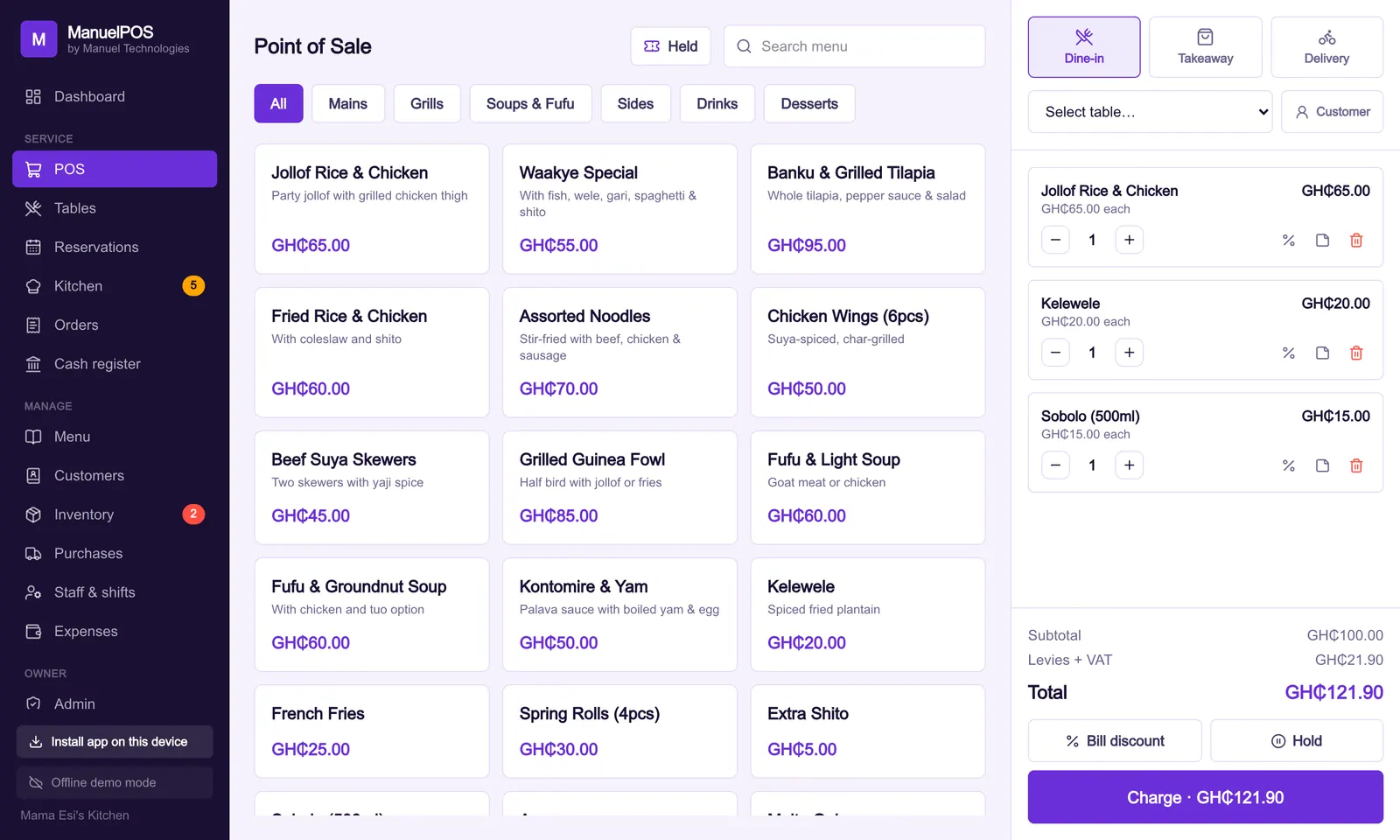
In MPOS each product can have packs, such as a carton or a box of 10, each with its own price and barcode. You can sell part quantities, such as 0.5 of a carton, and sell weighed goods, including scale barcodes. After each scan the till asks how many, so a cashier can type the number, press Enter and carry on. Stock is kept per branch, with a low-stock warning when an item runs short.
If you are moving from another system, you can import your products from Excel or CSV and set up the packs after.
To see your own products in it, start a free trial. Then read the complete guide to running a shop in Ghana for the rest of the setup.
See it with your own products
Free for 14 days. No card needed. Works on the phone or laptop you have.
FAQ
Frequently asked questions
Quick answers to what business owners ask us about this.
Should I count stock in cartons or pieces?
Count in the smallest unit you sell, usually pieces. Then opening a carton to sell singles needs no adjustment, and every sale, whatever the unit, takes the right number of pieces off.
How do I sell half a carton on a POS?
Sell 0.5 of the carton. The till charges half the carton price and takes half the pieces off stock, so you do not need a separate half-carton product.
Do cartons need a different barcode from single items?
It helps. When each unit has its own barcode, the scan brings up the right unit and price. If a carton has no barcode, print a label for it.
How much cheaper should a carton be than single pieces?
There is no fixed rule. Work from your cost per piece and make sure the per-piece price falls as the pack gets bigger, while each unit still covers its cost and your margin.
Can I sell rice and sugar by the kilo on the same till?
Yes. Keep the stock in kilograms and sell part quantities, or use a label scale whose barcodes carry the weight or the price.
Still have a question?
Talk to the team on WhatsApp: real people in Ghana who know your kind of business.
About the author
Emmanuel Akyeam is the founder of Manuel Technologies in Ghana, which builds MPOS: the till, bookings and stock system for restaurants, salons, barbershops and shops. He works directly with business owners to set up their systems.
You may also like
- Shops and retail
Barcodes for a Ghanaian shop: getting them, printing tags, fixing duplicates
Which barcodes a shop can scan, when you need GS1 Ghana codes, how to print your own price tags, and what to do when two products share a barcode.
21 October 2026 · 6 min read
- Shops and retail
How to do a stock take without closing your shop
A step-by-step way to count stock in a mini-mart or provision shop while you keep selling, with a count sheet, a timetable and what to do with the differences.
21 October 2026 · 6 min read