The short answer
Make the kitchen and bar prepare only what has been rung into the till, give every staff member their own login, let only a manager void, refund or give a big discount, and count each till against its report at every cash-up. Then read the void and discount list every week, because theft shows up as a pattern long before it shows up as a big loss.
Key takeaways
- No ticket, no food: the kitchen and bar only prepare what is rung in.
- One login per person, so every sale, void and discount has a name on it.
- Voids, refunds and big discounts need a manager.
- Open each till with a counted float and close it with a counted drawer.
- Read the void and discount list weekly: look for patterns, not single events.
Most restaurant staff are honest. But a busy night, cash on the table and a system with no records make it easy for the few who are not, and hard for the owner to tell an honest mistake from a habit. Good controls protect your honest staff too: when the numbers are clear, nobody is suspected without reason.
Here are the common ways money and food leave a restaurant or bar, and what closes each one.
What are the common tricks?
Almost every case falls into a few patterns. The table lists them with the control that closes each.
| What happens | How it looks | What closes it |
|---|---|---|
| Order served but never rung up | Customer pays cash, server keeps it | Kitchen and bar only prepare from tickets |
| Rung up, paid, then voided | Item removed after the customer has left | Only a manager can void; weekly void review |
| "Discount" for a friend | Big discounts on one person's bills | Big discounts need a manager |
| Fake refund | Refund on a sale that was never returned | Refunds need a manager, with a reason |
| MoMo to a personal number | Customer told to send to the server's number | MoMo only to the business wallet, ID recorded |
| Short cash at the end | Drawer is less than the report | Counted float, counted close, short-till alert |
| Free drinks at the bar | Bottles missing, no sales | Bar rings in before opening; weekly drink count |
No ticket, no food
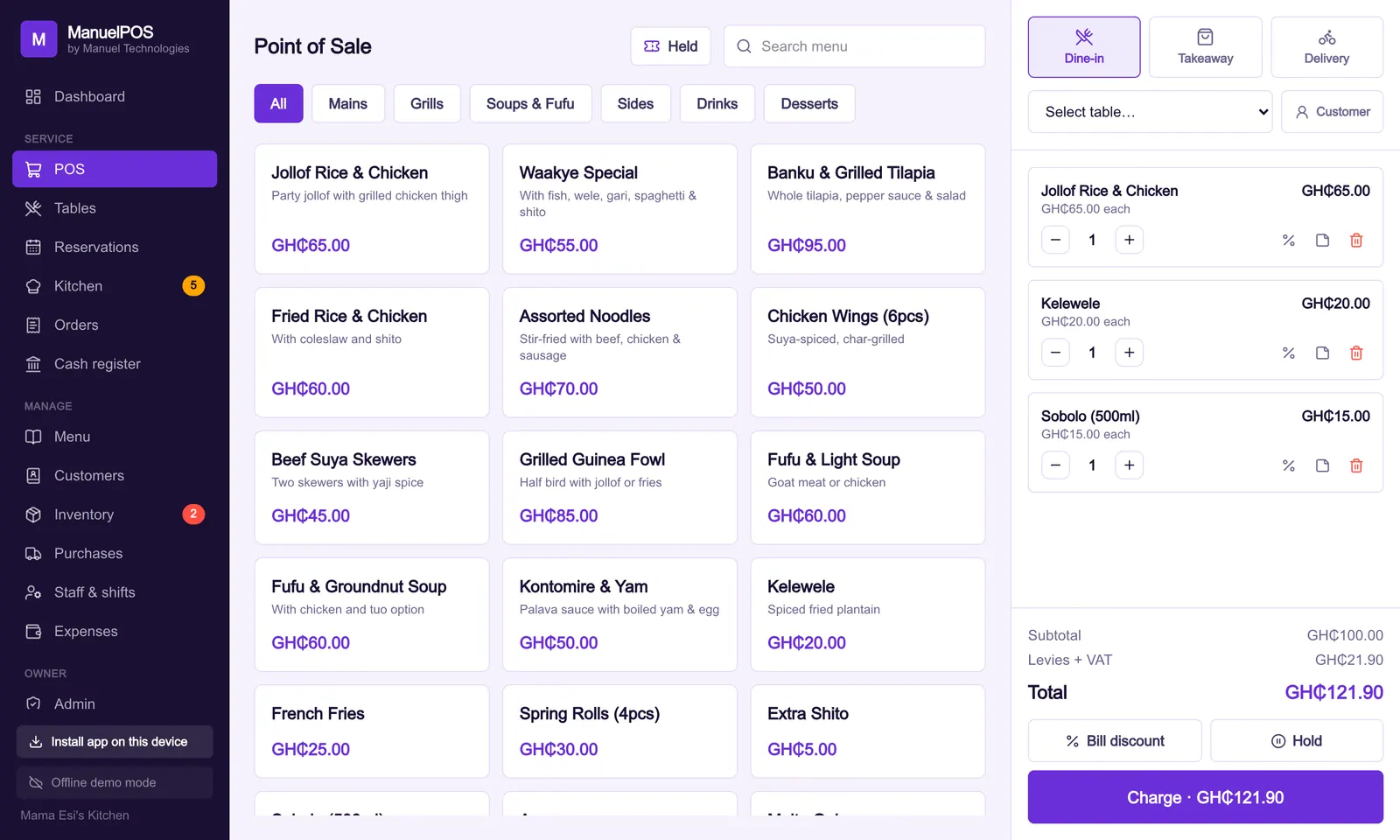
The strongest control in a restaurant costs nothing: the kitchen and the bar prepare only what appears on a ticket or the kitchen screen. If a server cannot get food without ringing it in, they cannot sell it for cash and keep the money.
Make this a firm rule, including for the owner's friends and the staff meal. A staff meal should be rung in too, at zero or at a staff price, so the kitchen's food still matches the sales.
Give everyone their own login
Every sale, void, discount and refund should carry the name of the person who did it. That means one login per person, never a shared "cashier" account, and logins that are never shared, even on a busy night.
Roles keep each person to their job:
- Waiters open tables, add orders and send them to the kitchen.
- Cashiers take payments and print receipts.
- Kitchen staff see tickets and mark food ready.
- Managers approve voids, refunds and big discounts, and check every till close.
When someone leaves, close their login the same day.
Why do voids need a manager?
A void after the customer has paid is the most common till trick, because the bill looks normal at the table and the money disappears afterwards. When only a manager can void, the server has to explain why to someone else, at the time, and the void carries both names.
Honest voids happen: a dish sent back, a double tap on the screen. That is why the rule is approval, not a ban. What you are looking for is the pattern.
Source: Example figures
In this example, three servers have a similar small amount of voids. One has many times more. That does not prove anything by itself, but it tells you whose tables to watch and whose voids to ask about.
How should a cash-up work?
Every till opens with a counted float and closes with a counted drawer, and the count is compared with what the report says should be there. Do it at every shift change, not once at the end of the week, so a shortage has one name and one shift attached.
- Open the till with a counted float, for example GH₵200 in small notes
- Record every cash in and cash out, such as paying the gas seller
- At close, count the cash without looking at the report
- Compare the count with the expected cash
- Match each MoMo payment to the wallet by transaction ID
- Sign off and read the void and discount list
Worked example: one evening's close
| Line | Amount |
|---|---|
| Opening float | GH₵200.00 |
| Cash sales on the report | GH₵1,840.00 |
| Cash paid out (gas refill) | -GH₵150.00 |
| Expected in the drawer | GH₵1,890.00 |
| Counted | GH₵1,860.00 |
| Short | GH₵30.00 |
A small difference now and then is normal: wrong change on a busy night. A shortage every time one person closes is not.
Keep MoMo going to the business
MoMo payments should only go to the business wallet, and every one should have its transaction ID recorded against the bill. A server who tells a customer to "send it to this number" is taking the payment out of your records entirely.
Put the business MoMo number on the table card, the menu and the receipt. At the close, match the MoMo total in the till to the wallet statement. Our guide on how to reconcile Mobile Money payments shows how.
Watch the bar as well as the till
Drinks are easy to give away, because a bottle has no ticket once it is open. Ring every drink in before it is poured or opened, keep bought-in drinks as stock, and count them weekly against sales. Read how to control ingredient stock and kitchen waste for the weekly count.
How does MPOS help stop theft?
MPOS gives each person their own login with a role: owner, manager, cashier, waiter or kitchen. Orders go to a kitchen screen or kitchen tickets, with separate printers for the kitchen and the bar. Voids, refunds and big discounts need a manager, and every void, refund, price change and cash-up is in the activity log.
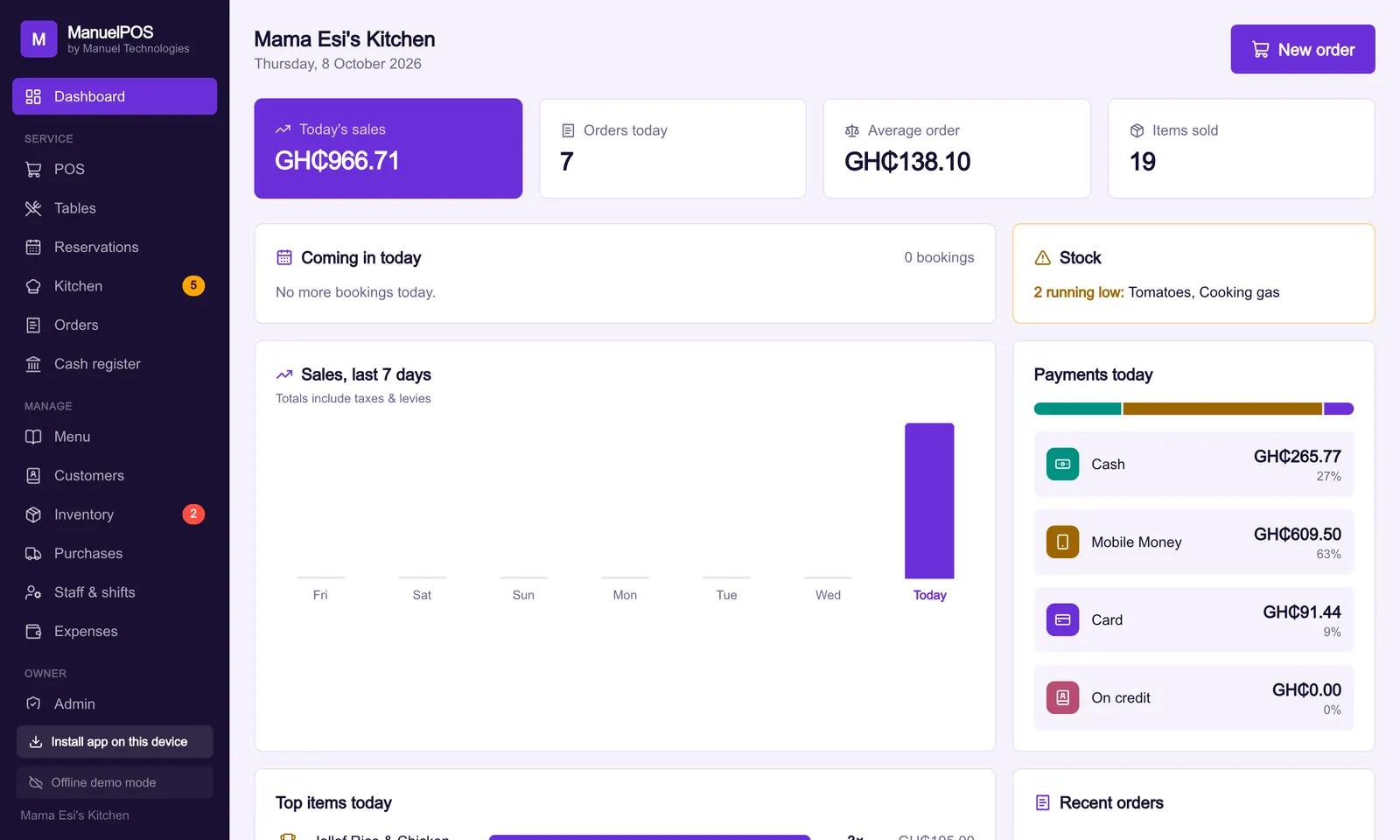
Each till opens with a float, records cash in and out, and closes with a count, with X and Z reports. The owner gets an SMS alert when a till closes short, and the staff and payments reports show who sold what and how it was paid, from anywhere. MoMo is recorded with its transaction ID, and the money goes to your own wallet.
For the shop version of these controls, read stop stock and cash leakage in your mini-mart. For split bills, where many voids happen, read splitting and merging bills, and for the whole picture, the complete guide to running a restaurant in Ghana. You can start a free trial and set up your staff logins.
See it with your own products
Free for 14 days. No card needed. Works on the phone or laptop you have.
FAQ
Frequently asked questions
Quick answers to what business owners ask us about this.
How do I stop waiters stealing in my restaurant?
Make the kitchen and bar prepare only what is rung in, give each waiter their own login, require a manager for voids and big discounts, and read the void list every week for patterns.
What is a void in a POS?
A void removes an item or a whole bill from the till. Honest voids happen, but a void after the customer has paid is a common way to take cash. That is why voids should need a manager and be logged.
How often should I cash up?
At every shift change and at the close of the day. Each till should open with a counted float and close with a counted drawer, so any shortage has one person and one shift attached.
How do I stop staff taking MoMo payments to their own number?
Put the business MoMo number on the menu, table cards and receipts, record every transaction ID against the bill, and match the till's MoMo total to the wallet statement at close.
How do I control free drinks at the bar?
Ring every drink in before it is poured or opened, keep bought-in drinks as stock, and count them weekly against what the till says was sold.
Still have a question?
Talk to the team on WhatsApp: real people in Ghana who know your kind of business.
About the author
Emmanuel Akyeam is the founder of Manuel Technologies in Ghana, which builds MPOS: the till, bookings and stock system for restaurants, salons, barbershops and shops. He works directly with business owners to set up their systems.
You may also like
- Restaurants
How to cost a plate and set menu prices for a restaurant in Ghana
A worked GH₵ example for costing a plate of jollof and chicken, choosing a food-cost target, and setting a menu price that still pays you after tax.
21 October 2026 · 7 min read
- Restaurants
How to control ingredient stock and kitchen waste in a restaurant
A simple weekly routine for rice, oil, chicken and drinks: count, compare usage with sales, keep a waste sheet, and buy to what you really sell.
21 October 2026 · 6 min read