The short answer
A salon or barbershop in Ghana runs well when every service has a real time and a price built from your costs, one diary holds bookings and walk-ins for each stylist, reminders go out before every appointment, and every sale records who did the work. Booking and POS software keeps all of that in one place, so pay, stock, cash and tax come from the same record.
Key takeaways
- Price every service from its time and products, not from the salon next door.
- Keep one diary per stylist that holds bookings and walk-ins together.
- Confirm every booking and remind clients the day before and on the day.
- Record the stylist on every sale, so commission is fair and fast.
- Sell hair and products through the same till, and count back-bar stock weekly.
- Choose software that keeps working when the network goes off.
On this page14 sections
- 01What makes running a salon or barbershop hard?
- 02How should you price salon services?
- 03How do you run one diary for bookings, walk-ins and every stylist?
- 04What reminders should a salon send?
- 05How should you pay stylists and barbers?
- 06How do you keep hair, products and stock under control?
- 07How should a salon take payment and close the till?
- 08Does a salon need to charge VAT?
- 09How do you keep clients coming back?
- 10What changes when you open a second branch?
- 11How do you choose booking and POS software for a salon?
- 12How do you set up a salon system in a week?
- 13What does it cost to run a salon on MPOS?
- 14What to do next
A Saturday in a busy salon in Accra or Kumasi looks the same almost everywhere. Two clients booked for braids at 8:00am, a walk-in who wants a quick wash and set, a regular asking for her usual stylist, the barber next door with a queue out of the door, and a notebook on the counter that is supposed to keep track of it all.
Hair, nails and grooming are skilled work. Running the business around them is a different skill: keeping the diary straight, pricing so that long services make money, paying stylists fairly, keeping stock, taking MoMo and cash without mistakes, and now dealing with VAT. This guide covers all of it, with a short summary of each topic and a link to a fuller article.
In this guide
- What makes running a salon or barbershop hard
- Pricing your services
- One diary for bookings, walk-ins and every stylist
- Reminders that cut no-shows
- Paying stylists and barbers
- Hair, products and stock
- Taking payment and closing the till
- VAT for salons in 2026
- Keeping clients coming back
- Opening a second branch
- Choosing booking and POS software
- Setting up in a week
- What it costs
Every money figure in this guide is an example, labelled as one. Use your own numbers.
What makes running a salon or barbershop hard?
Most of the trouble in a salon comes from four places: time, people, stock and cash. Fix how you record each of them and most daily arguments stop.
| Problem | What it looks like | What fixes it |
|---|---|---|
| Time | Double bookings, clients kept waiting, empty chairs | Real service durations and one diary per stylist |
| No-shows | A three-hour slot lost with no warning | Confirmation and reminders before every booking |
| People | Arguments about who did which client, commission disputes | The stylist recorded on every sale |
| Stock | Braiding hair given away, products finishing too fast | Products sold through the till, weekly counts |
| Cash | MoMo payments that cannot be found, a short till | Every payment recorded with its method, a daily cash-up |
| Prices | Long services that barely cover their costs | Prices built from time, products and commission |
The rest of this guide takes each one in turn.
How should you price salon services?
Price each service from four things: the products it uses, the time it takes, the stylist's share, and your profit. Time is the biggest cost in a salon, because a chair and a stylist can only do one client at a time.
The method in short:
- Add your monthly running costs: rent, electricity, water, data, cleaning, repairs, software.
- Divide by the hours your chairs are actually booked in a month. That is your cost per booked hour.
- For each service, add the products used and the hours it takes multiplied by your hourly cost.
- Divide by what is left after commission and profit. With 35% commission and 20% profit, divide by 0.45.
In our worked example, a salon with GH₵3,400 of monthly running costs and about 421 booked chair-hours has a cost of about GH₵8 per booked hour. Mid-back knotless braids taking 6 hours, with GH₵15 of products, cost GH₵63 to deliver before commission, so the example price is GH₵140, with the client's braiding hair sold separately.
GH₵140
- ProductsGH₵15.00 (10.7%)
- Chair time, 6 hoursGH₵48.00 (34.3%)
- Stylist commission 35%GH₵49.00 (35%)
- Profit 20%GH₵28.00 (20%)
Source: Example figures
Give each length and size its own service, with its own time and price: shoulder, mid-back and waist length take very different amounts of time. Sell braiding hair as a separate item on the same bill, so clients who bring their own hair pay only for the service, and your stock stays right.
Read the full method, with a price table by length: how to price braids and salon services by length and time.
How do you run one diary for bookings, walk-ins and every stylist?
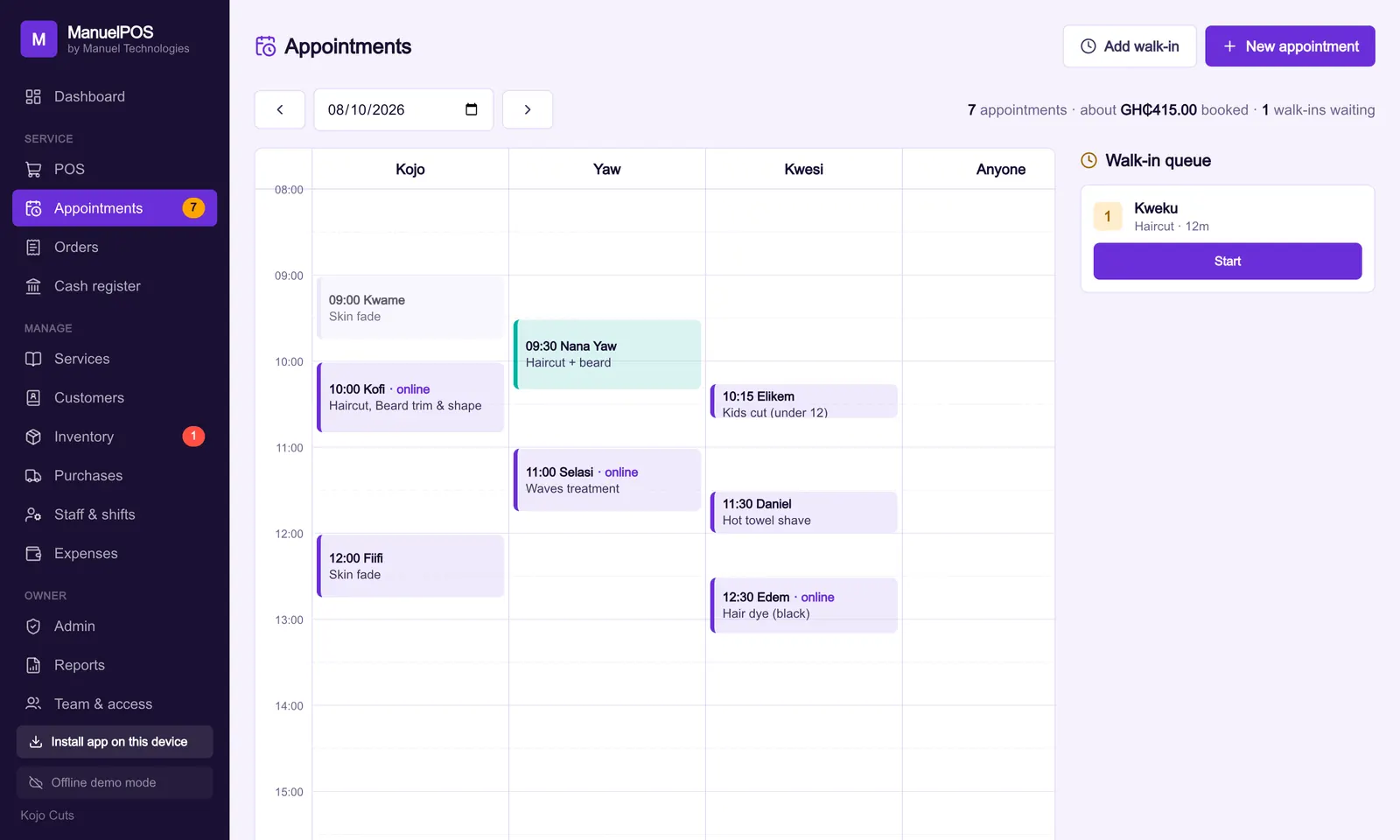
Keep one diary with a column for each stylist or barber, give every service a real duration, and put walk-ins in a visible queue that is fitted around the bookings. Then nobody is double-booked and nobody jumps the queue.
Bookings
When every service has a duration that includes set-up and clean-down, a booking blocks exactly that much of the stylist's time. Knotless braids block most of a day; a line-up blocks 15 or 30 minutes. Nobody should book over them, and a good diary warns you if someone tries.
An online booking page lets clients choose a service, a stylist and a day and time at 10pm on their phone, without calling. Share the link on your WhatsApp status, your Instagram bio and a QR code at reception. See online booking for salons: fill your diary and cut no-shows.
Walk-ins
Barbershops in particular live on walk-ins. Add each one to a queue with their name, the service and any barber they want. Everyone can see their place, and the next free barber calls the next person. Because bookings have durations, you can see whether a walk-in fits before the next appointment. See walk-ins and bookings: keeping a barbershop queue fair.
Several stylists, days off and busy days
With several stylists, the diary has to show who is actually in. Agree days off in advance, put them on a shared rota, and make sure nobody books that stylist on those days. Before each week starts, check the diary against the rota.
Watch which days fill first. If Saturday is always full and Tuesday is empty, consider moving days off to quiet days, opening earlier on Saturday, or asking regular clients to come midweek.
What reminders should a salon send?
Send three messages for every booking: a confirmation when the booking is made, a reminder the day before, and a final reminder about two hours before. Each one gives the service, the stylist, the day and time, where you are and how to move the booking.
- Confirmation, as soon as the booking is made
- Reminder, the day before
- Final reminder, about two hours before
The day-before reminder does most of the work: it arrives early enough for a client to cancel, and for you to give the slot to someone else. SMS reaches every phone, even without data; WhatsApp is friendlier and easier to reply to. Many salons send SMS automatically and use WhatsApp for conversation.
Read the full guide, with example messages: salon appointment reminders by SMS and WhatsApp.
How should you pay stylists and barbers?
There are four common ways: commission, chair rent, salary, and a base plus commission. They differ in who carries a quiet month. Whichever you choose, record the stylist on every sale and pay from the report, not a notebook.
| Way of paying | How it works | Who carries a quiet month |
|---|---|---|
| Commission | The stylist earns a share of their sales | Both, in proportion |
| Chair rent | The stylist pays a fixed rent and keeps their takings | The stylist |
| Salary | A fixed amount whatever the sales | The salon |
| Base plus commission | A smaller fixed amount plus a smaller share | Mostly the salon |
In our worked example, a stylist who brings in GH₵3,000 in a quiet month leaves the salon GH₵1,800 under 40% commission, GH₵1,200 under a GH₵1,200 chair rent, and GH₵1,200 under a GH₵1,800 salary.
Source: Example figures
Salaries bring employer duties. GRA explains that PAYE is deducted from an employee's income and paid by the employer, and the National Tripartite Committee set the 2026 national daily minimum wage at GH₵21.77. Check current rules with GRA and SSNIT, or an accountant.
Read the worked comparison for a busy month and a quiet one: paying stylists: commission, chair rent or salary.
How do you keep hair, products and stock under control?
Treat retail stock and back-bar stock differently. Retail stock (braiding hair, wigs, creams, beard oil) is sold through the till, so every sale reduces the count. Back-bar stock (relaxer, gel, mousse, acrylic) is used on clients, so you count it every week and compare it with the services done.
- Scan or count each back-bar product
- Count the fast-selling hair colours
- Compare with last week and the services done
- Note big differences and ask about them
- Order what is running low
Set colours and lengths of braiding hair up as variants, so you can see that 1B sells fast while other colours sit on the shelf. Set low-stock warnings at the level that covers your busiest weekend plus your supplier's delivery time. Record deliveries as purchases from the supplier so cost prices stay current.
Selling products at the till, straight after the service, is income that does not need a chair. Clients often ask what was used on their hair. Keep the products your stylists actually use on a small display near the till.
Read more: tracking hair products and retail stock in a salon. If stock keeps going missing, the checks in stopping stock and cash leakage in a mini-mart work in a salon too.
How should a salon take payment and close the till?
Record every payment with its method, whether cash, MoMo or card, at the moment the client pays, and close the till each day with a count. That way MoMo payments can be matched to your wallet, cash can be counted against what the system expects, and nobody has to guess.
- MoMo: record the transaction ID with the payment. At the end of the day, match the MoMo total against your wallet. See how to reconcile Mobile Money payments at the end of the day.
- Split payments: a client paying GH₵100 in cash and the rest by MoMo is common for long services. Record both on the same bill.
- Cash: open the till with a float, record any cash taken out for supplies, and close with a count.
- Credit: regular clients who pay later need a balance and a statement, not a note on a scrap of paper.
Source: Example figures
Does a salon need to charge VAT?
GRA said in January 2026 that the GH₵750,000 VAT registration threshold applies only to goods, and that there is no threshold for services. Salons, barbershops, nail bars and spas provide services, so they should expect to register, whatever their size. Confirm your own position with your GRA office.
Registered businesses charge VAT 15%, NHIL 2.5% and GETFund 2.5% on the same price, 20% in total. If your prices include tax, divide by 1.2 to find the price before tax: a GH₵240 set of braids is GH₵200 before tax and GH₵40 of tax.
- 15%VAT
- 2.5%NHIL
- 2.5%GETFund
- 20%Total on the same price
Source: Ghana Revenue Authority, VAT Act 2025 (Act 1151)
Read does a salon or barbershop need to charge VAT in Ghana, and for receipts, Ghana VAT in 2026: what changed on your receipts.
How do you keep clients coming back?
Remember every client and give her a reason to return. A good client record lets any stylist serve her well, and loyalty points give her something to come back for.
Record more than a phone number: her usual services and stylist, the products used, allergies or a sensitive scalp, her preferences, and when she last had each service. Book her next visit before she leaves the chair, and message her when her style is due for a redo.
For loyalty points, a simple setup is one point per GH₵1 spent, with each point worth GH₵0.05, which gives back 5%. Work out what that costs on a regular client's yearly spend before you start, and pay for it from your profit, not from commission.
Client records are personal data. Ghana's Data Protection Commission says data controllers and processors must register with it; check what applies to you.
Read more: building repeat clients with client records and loyalty points.
What changes when you open a second branch?
A second branch doubles the places where things can go wrong while you are not there. The answer is the same records in both places, and a way to see them from wherever you are.
Give each branch its own till and its own stock, so a pack of braiding hair sold in East Legon does not come off the shelf in Tema. Give each staff member their own login with a role, so that voids, refunds and big discounts need a manager, and you always know who did what. Check the activity log for voids, refunds and price changes each week. Compare the branches side by side: sales per stylist, the most popular services and the daily cash-up. When one branch closes short or its product use drifts, you will see it in days, not months.
How do you choose booking and POS software for a salon?
Choose software that does bookings and the till together, so the stylist on the booking is the stylist on the sale. Then check that it keeps working when the network goes off, and that you understand what it costs over three years, not just the first month.
| Question to ask | Why it matters for a salon |
|---|---|
| Does it have a diary per stylist with service durations? | Stops double bookings |
| Does it handle walk-ins as well as bookings? | Barbershops and many salons live on walk-ins |
| Can clients book online? | Fills the diary outside working hours |
| Does it send SMS and WhatsApp reminders? | Cuts no-shows |
| Does it work out commission from sales? | Fair, fast payday |
| Does it sell products and track stock on the same till? | One bill, stock that stays right |
| Does it record MoMo with the transaction ID? | Easy end-of-day matching |
| Does it work offline? | Keeps selling when the network drops |
| Does it handle VAT, NHIL and GETFund? | Correct receipts under the 2026 rules |
| What does it cost over three years? | Avoids surprises later |
Our general guide, how to choose a POS system for your business in Ghana, goes through these in more detail. On offline working, read keep selling when the network goes off. On cost models, read one-time licence or monthly subscription.
How do you set up a salon system in a week?
Most of the work is deciding your services, prices and staff, not the software. Do it in this order and the salon can be running on the new system within a week.
- Day 1: list every service with its time and price
- Day 2: add your stylists, their logins and commission rates
- Day 3: add your products, colours and opening stock
- Day 4: share your booking page and turn on reminders
- Day 5: run the till alongside your notebook
- Day 6: compare the two and fix any gaps
- Day 7: retire the notebook
Run the old and new way side by side for a day or two. Staff trust the new system faster when they see the totals match.
What does it cost to run a salon on MPOS?
MPOS has no published price. Each business agrees one setup and licence fee, then pays a yearly renewal for cloud, data and support. There is a 14-day free trial, and no card is needed to start it.
For a salon, that covers the appointments diary by staff member, the walk-in queue, the online booking page, booking SMS (a confirmation, a reminder the day before and about two hours before, when you turn SMS on), one-tap WhatsApp reminders, commission per staff member, products with variants and stock, loyalty points, client credit balances, cash, MoMo, card and split payments, VAT on receipts, and reports for any period. It runs in the browser on a phone, tablet or laptop, keeps selling offline and syncs later, and the owner can see every branch from anywhere.
It does not take deposits for bookings, take online card payments, or run payroll with SSNIT and PAYE, so plan for those separately if you need them.
What to do next
Start with the part that costs you most today. If it is empty chairs, set up your diary and reminders first. If it is pay arguments, start recording the stylist on every sale. If it is prices, recost your five most popular services this week.
When you are ready to put it all in one place, you can start a free trial and set up your services, stylists and booking page in an afternoon.
Every article in this guide
- How to price braids and salon services by length and timeA step-by-step way to price knotless braids, cornrows, nails and other services by length and time, with a worked GH₵ example you can copy.
- Paying stylists: commission, chair rent or salary?Commission, chair rent, salary or base plus commission: how each way of paying stylists and barbers works, with worked GH₵ examples for a busy month and a quiet one.
- Tracking hair products and retail stock in a salonHow a salon or barbershop keeps braiding hair, wigs, creams and the products used in services under control, with a weekly count and a worked GH₵ example.
- Salon appointment reminders by SMS and WhatsApp: what to send and whenThe three reminders every salon and barbershop booking needs, what each message should say, when to send it, and when to use SMS or WhatsApp. Example messages included.
- Building repeat clients with client records and loyalty pointsWhat to keep in a salon or barbershop client record, how loyalty points work, and how to set a reward rate you can afford, with a worked GH₵ example.
- Does a salon or barbershop need to charge VAT in Ghana?What the 2026 VAT rules mean for hair salons, barbershops, nail bars and spas in Ghana: registration, the 20% total, prices that include tax, and receipts.
- Ghana VAT in 2026: what changed on your receiptsFrom 1 January 2026, VAT, NHIL and GETFund are charged on the same price, the COVID-19 levy is gone and the flat rate scheme has ended.
- How to choose a POS system for your business in GhanaTen questions to ask before you pay for a till system, from what happens when the network goes off to who can see your profits.
- How to reconcile Mobile Money payments at the end of the dayA simple daily routine for matching MoMo payments to sales, spotting fake payment messages and closing the till with confidence.
- One-time licence or monthly subscription: what should you pay for business software?Monthly fees, one-time licences and yearly renewals compared, with the questions that protect you whichever you choose.
- Walk-ins and bookings: keeping a barbershop queue fair and commission rightHow busy barbershops mix appointments with walk-ins without arguments, and work out each barber's commission without a notebook.
- Online booking for salons: fill your diary and cut no-showsWhy salons and nail studios lose hours to no-shows and double bookings, and how online booking with real service times and WhatsApp reminders fixes it.
- Keep selling when the network goes off: how an offline POS worksLight off, data finished, network down. What an offline-first till does differently, and what to check before you trust one.
See it with your own products
Free for 14 days. No card needed. Works on the phone or laptop you have.
Sources
FAQ
Frequently asked questions
Quick answers to what business owners ask us about this.
What software does a salon in Ghana need?
A diary per stylist with service durations, a walk-in queue, online booking, SMS or WhatsApp reminders, a till that sells services and products together, commission per stylist, stock tracking, MoMo and cash recording, VAT on receipts, and offline working.
How do I stop no-shows at my salon?
Give every service a real duration, let clients book online, and send a confirmation, a reminder the day before and a final reminder about two hours before.
How should I price braids?
Add the products used and the hours taken multiplied by your cost per booked hour, then divide by what is left after commission and profit. Give each length its own service.
How should I pay my stylists?
Commission, chair rent, salary or a base plus commission. Each shares quiet months differently. Whichever you choose, record the stylist on every sale and pay from the report.
Do salons need to register for VAT in Ghana?
GRA said in January 2026 that the GH₵750,000 threshold applies only to goods, and that there is no threshold for services. Confirm your position with your GRA office.
Can MPOS take booking deposits?
No. MPOS does not take deposits for bookings or online card payments. It reduces no-shows with SMS and WhatsApp reminders.
How much does MPOS cost for a salon?
There is no published price. Each business agrees one setup and licence fee, then a yearly renewal for cloud, data and support. The 14-day free trial needs no card.
Still have a question?
Talk to the team on WhatsApp: real people in Ghana who know your kind of business.
About the author
Emmanuel Akyeam is the founder of Manuel Technologies in Ghana, which builds MPOS: the till, bookings and stock system for restaurants, salons, barbershops and shops. He works directly with business owners to set up their systems.
You may also like
- Salons and barbers
How to price braids and salon services by length and time
A step-by-step way to price knotless braids, cornrows, nails and other services by length and time, with a worked GH₵ example you can copy.
21 October 2026 · 7 min read
- Salons and barbers
Paying stylists: commission, chair rent or salary?
Commission, chair rent, salary or base plus commission: how each way of paying stylists and barbers works, with worked GH₵ examples for a busy month and a quiet one.
21 October 2026 · 7 min read