The short answer
Keep two kinds of salon stock apart: retail stock such as braiding hair, wigs and creams that clients buy, which you sell through the till so every sale reduces the count, and back-bar products used on clients, which you count every week and compare with the services you did.
Key takeaways
- Separate retail stock (sold to clients) from back-bar stock (used on clients).
- Sell every pack of braiding hair through the till, never from a drawer.
- Set up colours and lengths as variants, so you know which ones run out.
- Count back-bar products weekly and compare usage with the services done.
- Set low-stock warnings on the products you cannot run out of on a Saturday.
On this page8 sections
- 01What is the difference between retail and back-bar stock?
- 02How should a salon track braiding hair and wigs?
- 03How do you keep track of products used in services?
- 04A weekly stock routine that takes 20 minutes
- 05How do you stop running out on a busy weekend?
- 06Buying from suppliers and keeping cost prices right
- 07Selling products alongside services
- 08How MPOS helps
A salon can be fully booked and still lose money on stock. A pack of braiding hair given away without being charged. A tub of relaxer that finishes far sooner than it should. A popular colour that runs out on the Friday before a wedding weekend. None of these show up in a paper diary.
The fix is to treat the products you sell and the products you use as two different things, and to give each one a simple routine.
What is the difference between retail and back-bar stock?
Retail stock is anything a client takes home or pays for as a product: braiding hair, bundles, wigs, edge control, shampoo, beard oil, nail polish. Back-bar stock is what your staff use on clients during a service: relaxer, gel, mousse, shampoo from the wash station, acrylic powder, wax.
| Retail stock | Back-bar stock | |
|---|---|---|
| Examples | Braiding hair, wigs, creams, beard oil | Relaxer, gel, mousse, acrylic, wax |
| How it leaves | Sold on a bill | Used during a service |
| How you track it | Every sale takes it off stock | Count it each week |
| What to watch | Items not charged, colours running out | Usage that does not match services |
Retail stock is the easier one, because every unit should leave through the till. Back-bar stock needs a count, because nobody rings up "a bit of gel".
How should a salon track braiding hair and wigs?
Sell every pack of braiding hair, every bundle and every wig through the till, on the same bill as the service. Then the count goes down when it is sold, and the client's receipt shows what they paid for the hair and the service separately.
Braiding hair comes in many colours and lengths. Set each product up once, then add the colours (1B, 2, 27, 30 and so on) and lengths as variants. You can then see that colour 1B is selling fast while 613 sits on the shelf, and buy accordingly.
Most packs already carry a barcode. Scanning it is faster and more accurate than finding the colour on a list. For packs without a barcode, print your own price tag with a barcode.
How do you keep track of products used in services?
Count your back-bar products at the same time each week and compare what you used with the services you did. You do not need to measure every scoop. You need to notice when usage drifts.
Here is a worked example with relaxer, using example numbers.
- Tubs at the start of the month: 10
- Tubs bought during the month: 6
- Tubs left at the end of the month: 9
- Tubs used: 10 + 6 - 9 = 7
- Relaxer services done that month: 42
- Services per tub: 42 / 7 = 6
If last month you got 8 services from each tub, and this month only 6, ask why. It might be longer hair, a new stylist using more, or tubs leaving the salon.
Source: Example figures
Put the product cost into your service price too. If a GH₵60 tub does 6 relaxers, each service uses GH₵10 of relaxer. Our guide to pricing salon services shows how to build that into the price.
A weekly stock routine that takes 20 minutes
Pick a quiet time, such as Monday morning before the first client, and do the same thing every week.
- Scan or count each back-bar product
- Count the fast-selling hair colours
- Compare with last week and the services done
- Note any big differences and ask about them
- Order what is running low
Count retail stock fully once a month. When the count and the system disagree, the difference is either a mistake or a loss. Either way, you want to know.
How do you stop running out on a busy weekend?
Set a low-stock warning on every product you cannot afford to run out of, at the level that covers your busiest weekend plus the time it takes your supplier to deliver.
If you sell about 30 packs of colour 1B on a busy weekend and your supplier at Makola needs two days, set the warning at about 40 packs, not 5. Check the warnings on Wednesday so stock arrives before Friday.
Buying from suppliers and keeping cost prices right
Record each delivery as a purchase from the supplier, with the quantity and the cost. Your stock goes up, the cost price stays current, and you can see what you spent with each supplier over the month. If a carton comes damaged or in the wrong colour, record the return to the supplier, so stock is right and you have a note of what you are owed.
Products with expiry dates, such as relaxers, dyes and some creams, can be recorded in batches with their expiry dates. The oldest batch is sold first, which keeps expired stock off your shelves.
Selling products alongside services
Product sales are income that does not need a chair. Clients often ask what was used on their hair or nails, and the best time to sell it is at the till, straight after the service, on the same bill.
Keep a small display near the till of the products your stylists actually use. Decide whether stylists earn commission on products they sell, and write that down: our guide to paying stylists covers the choices.
How MPOS helps
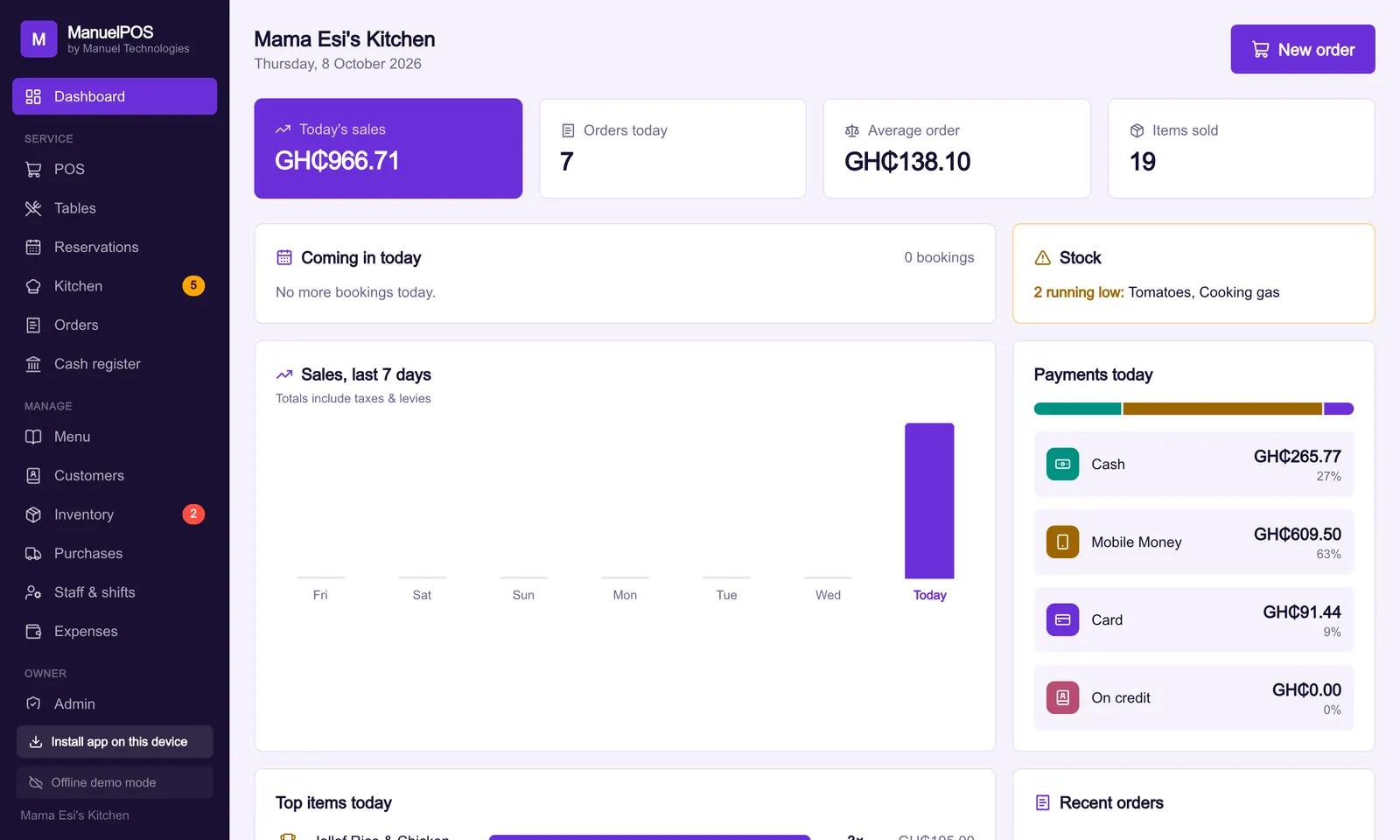
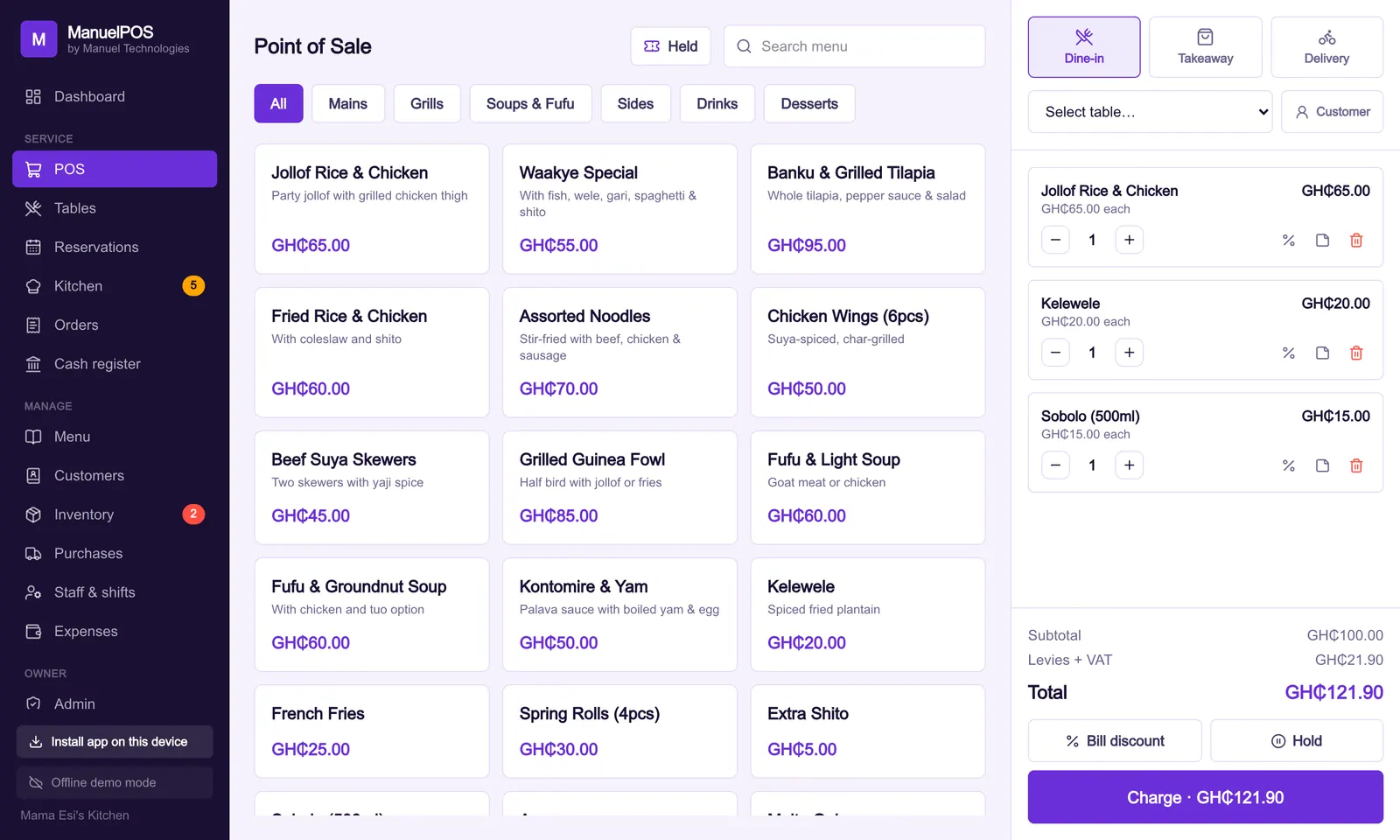
MPOS puts services and products on the same till and the same bill. Products can have variants for colours and sizes, barcodes for scanning, low-stock warnings, stock per branch, and batches with expiry dates sold first-expiring-first. Stock takes are done by scanning, deliveries are recorded as purchases from suppliers, supplier returns are recorded too, and you can print price tags with barcodes or import your product list from Excel. The stock value report shows what is on your shelves for any date.
Back-bar products are not on a client's bill, so keep them as stock items and use the weekly count above: the stock take shows the difference, and that difference is what you used.
For the rest of running a salon, read the complete guide to running a salon or barbershop. If your counts keep coming up short, the ideas in stopping stock and cash leakage in a mini-mart work in a salon too. You can start a free trial and import your products in an afternoon.
See it with your own products
Free for 14 days. No card needed. Works on the phone or laptop you have.
FAQ
Frequently asked questions
Quick answers to what business owners ask us about this.
How do I track braiding hair stock?
Sell every pack through the till on the same bill as the service. Set colours and lengths up as variants so you can see which ones sell and which ones run out.
How do I track products used during services?
Count them at the same time every week and compare what was used with the number of services done. A drop in services per tub or bottle is a sign to ask questions.
Should product costs be in my service prices?
Yes. Work out how many services one tub or bottle does, divide its cost by that number, and include it when you price the service.
When should I set a low-stock warning?
Set it at the amount you sell on your busiest weekend plus what you sell while you wait for your supplier to deliver.
How do I track back-bar products in MPOS?
Keep them as stock items and count them by scanning in a weekly stock take. Products sold on a bill come off stock as they are sold; the weekly count shows how much was used on clients.
Still have a question?
Talk to the team on WhatsApp: real people in Ghana who know your kind of business.
About the author
Emmanuel Akyeam is the founder of Manuel Technologies in Ghana, which builds MPOS: the till, bookings and stock system for restaurants, salons, barbershops and shops. He works directly with business owners to set up their systems.
You may also like
- Salons and barbers
How to price braids and salon services by length and time
A step-by-step way to price knotless braids, cornrows, nails and other services by length and time, with a worked GH₵ example you can copy.
21 October 2026 · 7 min read
- Salons and barbers
Paying stylists: commission, chair rent or salary?
Commission, chair rent, salary or base plus commission: how each way of paying stylists and barbers works, with worked GH₵ examples for a busy month and a quiet one.
21 October 2026 · 7 min read