The short answer
As of October 2026, a VAT-registered restaurant in Ghana charges VAT at 15%, NHIL at 2.5% and GETFund at 2.5%, each on the same price before tax, so a GH₵120 bill that includes tax holds GH₵20 of tax. Restaurants, chop bars and drinking bars are also listed by the Ghana Tourism Authority as tourism enterprises, which collect a separate 1% tourism levy.
Key takeaways
- Since 1 January 2026, VAT 15%, NHIL 2.5% and GETFund 2.5% are each worked out on the same price.
- A menu price that includes tax is about 83% yours and about 17% tax.
- GRA says the receipt must show NHIL, GETFund and VAT, and their total.
- If you are not VAT-registered, do not add VAT to the bill.
- The Ghana Tourism Authority's 1% tourism levy is separate from VAT: ask GTA how it applies to you.
Restaurant owners ask two questions about tax more than any other: "Is VAT included in my menu price?" and "What must my receipt show?" The rules changed on 1 January 2026, and many receipt books and old tills still use the old sums.
This article explains the 2026 rules as the Ghana Revenue Authority (GRA) publishes them, how to read the tax inside a menu price, and the separate 1% tourism levy that the Ghana Tourism Authority (GTA) collects through licensed restaurants and bars. Facts are as of October 2026. Tax rules change, so check anything specific to your business with GRA, GTA or your accountant.
What taxes are on a restaurant bill in 2026?
A VAT-registered restaurant charges three taxes on the same price: VAT at 15%, NHIL at 2.5% and GETFund at 2.5%, which is 20% on top of the price before tax. GRA's VAT reforms, in force from 1 January 2026, made each of these taxes work on the same value.
- 15%VAT
- 2.5%NHIL
- 2.5%GETFund
- 20%In all, on the price before tax
Source: Ghana Revenue Authority, VAT reforms from 1 January 2026
Two older items are gone. GRA says the 1% COVID-19 Health Recovery Levy has been abolished, and the 3% flat rate scheme for goods has been removed. If your receipts still show a COVID levy line, or you were charging 3% flat, that needs to change.
GRA's own example uses a GH₵1,000 sale: under the old method, where the levies were added first and VAT was charged on top of them, the customer paid GH₵1,219. Under the 2026 rules, the same sale is GH₵1,200.
How do you read the tax inside a menu price?
Most restaurants show prices that already include tax. To find the tax inside a price, divide the price by 1.2 to get the price before tax, then work out each tax on that figure.
GH₵120.00
- Price before taxGH₵100.00 (83.3%)
- VAT 15%GH₵15.00 (12.5%)
- NHIL 2.5%GH₵2.50 (2.1%)
- GETFund 2.5%GH₵2.50 (2.1%)
Source: Ghana Revenue Authority, VAT reforms from 1 January 2026
| Menu price, tax included | Price before tax | VAT 15% | NHIL 2.5% | GETFund 2.5% |
|---|---|---|---|---|
| GH₵30.00 | GH₵25.00 | GH₵3.75 | GH₵0.63 | GH₵0.63 |
| GH₵60.00 | GH₵50.00 | GH₵7.50 | GH₵1.25 | GH₵1.25 |
| GH₵120.00 | GH₵100.00 | GH₵15.00 | GH₵2.50 | GH₵2.50 |
| GH₵480.00 | GH₵400.00 | GH₵60.00 | GH₵10.00 | GH₵10.00 |
The GH₵30 line shows rounding: NHIL and GETFund are each GH₵0.625, which a receipt shows as about 63 pesewas. On a full bill, a good till works the tax out on the whole bill so the lines add up.
This matters for pricing. Only the price before tax is yours, so a GH₵120 plate is GH₵100 of income. Our guide on how to cost a plate and set menu prices works through what that does to your food-cost share.
Discounts come off before tax
If you give a discount, take it off the price first, then work out the tax on what is left. The tax follows the price the customer actually pays.
What must a restaurant receipt show?
GRA says the receipt or invoice must show NHIL at 2.5%, GETFund at 2.5% and VAT at 15% on separate lines, and that the field for the total of NHIL, GETFund and VAT is mandatory. A clear receipt from a VAT-registered restaurant should include:
- your business name and TIN,
- the date, time and a receipt number,
- each item, the quantity and the price,
- any discount,
- NHIL, GETFund and VAT, and their total,
- the amount paid and how it was paid: cash, MoMo or card.
A handwritten bill on the back of an order pad does not show any of this. If a customer asks for a proper receipt, for example a business guest who needs to claim the meal, you should be able to give one.
Do you need to charge VAT at all?
Only VAT-registered businesses charge VAT. GRA has raised the registration threshold for businesses that deal in goods from GH₵200,000 to GH₵750,000 a year, which GRA says takes micro and small businesses out of VAT. GRA also said in January 2026 that there is no threshold for services, so a restaurant should not assume it is below the line because its sales are under GH₵750,000.
A restaurant sells food and a service with it, so do not assume which rule applies to you. Ask GRA or your accountant whether your turnover means you must register. If you are not registered, you should not add VAT, NHIL or GETFund to your customers' bills, and your till should have tax switched off.
What is the 1% tourism levy?
The tourism levy is a separate charge from VAT, run by the Ghana Tourism Authority rather than GRA. GTA describes it as a 1% levy payable by a patron of a tourism enterprise, charged on the net cost of the service or products bought. It is set up under the Tourism Act 2011 (Act 817) and the Tourism (Levy) Regulations 2012 (L.I. 2185).
GTA's list of tourism enterprises that must be registered and licensed includes restaurants, fast food joints, traditional catering establishments (chop bars), drinking bars, pubs and night clubs. Under L.I. 2185, a licensed operator collects the levy as GTA's agent. GTA says an operator has a one-month collection period and then the next 30 days to pay in what was collected.
| VAT, NHIL and GETFund | Tourism levy | |
|---|---|---|
| Run by | Ghana Revenue Authority | Ghana Tourism Authority |
| Rate | 15% + 2.5% + 2.5% | 1% |
| Who charges it | VAT-registered businesses | Licensed tourism enterprises, as GTA's agent |
| Paid in | To GRA | To GTA's Tourism Development Fund |
How the levy should appear on your bills, and how it sits alongside VAT, is a question for GTA. Contact your regional GTA office, confirm that your licence is current, and ask how they want the levy shown and paid.
- Confirm with GRA whether you are VAT-registered
- Ring up a GH₵100 test bill: with tax it should be GH₵120.00
- Remove any COVID levy line from receipts and price lists
- Check that receipts show NHIL, GETFund, VAT and their total
- Confirm your GTA licence and how to handle the 1% tourism levy
- Keep your monthly tax report for your accountant
How does MPOS handle restaurant tax?
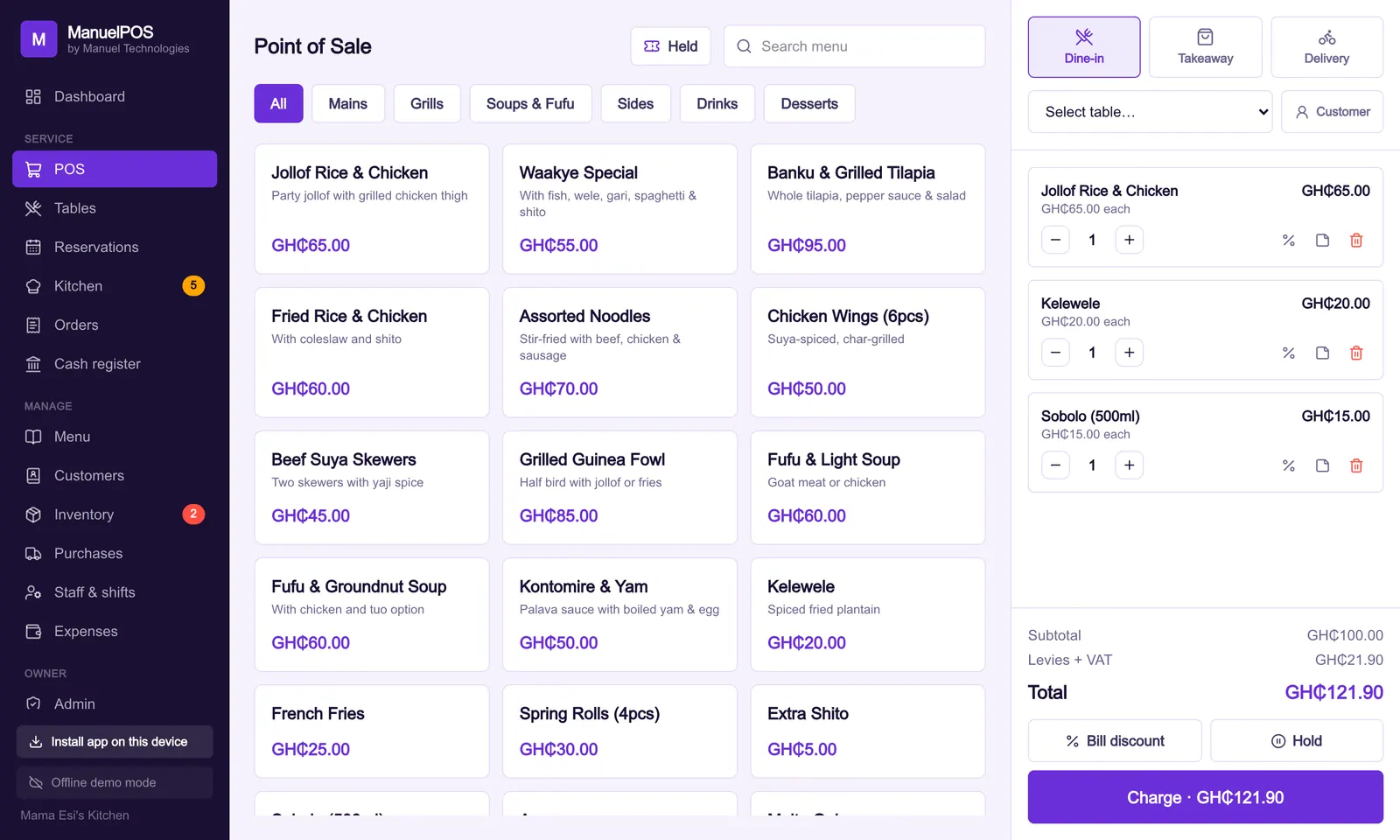
MPOS works out VAT at 15%, NHIL at 2.5% and GETFund at 2.5% on the same price, under the VAT Act 2025 (Act 1151). Menu prices include tax by default, items can be marked VAT-exempt, and every receipt shows the tax breakdown, whether it is printed on a thermal printer or sent by WhatsApp. The taxes report shows what you collected for any period, for your accountant or your return.
MPOS does not do GRA E-VAT e-invoicing, and it does not work out the tourism levy for you; follow GTA's instructions on that. For the wider picture of the 2026 change, read Ghana VAT in 2026: what changed on your receipts, and for running the whole restaurant, the complete guide to running a restaurant in Ghana. You can start a free trial and ring up a test bill.
See it with your own products
Free for 14 days. No card needed. Works on the phone or laptop you have.
Sources
- Citi Newsroom: GH¢750k VAT threshold applies to goods, not services, GRA clarifies (2 January 2026)
- Ghana Revenue Authority: VAT
- Ghana Tourism Authority: Tourism Development Fund and the 1% tourism levy
- Ghana Tourism Authority: registration and licensing of tourism enterprises and payment of the 1% levy
- Graphic Online: Ghana Tourism Authority to clamp down on unlicensed enterprises and levy defaulters
FAQ
Frequently asked questions
Quick answers to what business owners ask us about this.
Is VAT included in restaurant prices in Ghana?
Usually, yes. A VAT-registered restaurant normally shows prices that include VAT, NHIL and GETFund. Divide the price by 1.2 to find the price before tax. A business that is not registered should not charge VAT.
What is the VAT rate for restaurants in Ghana in 2026?
From 1 January 2026, GRA charges VAT at 15%, NHIL at 2.5% and GETFund at 2.5%, each on the same price, which is 20% in all. The 1% COVID-19 levy has been abolished.
How much tax is in a GH₵120 restaurant bill?
If the price includes tax, GH₵100 is the price before tax, VAT is GH₵15, NHIL is GH₵2.50 and GETFund is GH₵2.50, so the tax is GH₵20.
Do chop bars pay the tourism levy?
The Ghana Tourism Authority lists traditional catering establishments (chop bars), restaurants, fast food joints and drinking bars among the tourism enterprises that must be licensed. Licensed operators collect a 1% tourism levy as GTA's agent. Ask GTA how it applies to your business.
What must a restaurant receipt show?
GRA says NHIL, GETFund and VAT must be shown, with their total. A good receipt also shows your business name and TIN, the date, a receipt number, the items, any discount and how the bill was paid.
Is the COVID-19 levy still charged in Ghana?
No. GRA says the 1% COVID-19 Health Recovery Levy was abolished as part of the reforms in force from 1 January 2026. Remove it from your receipts and price lists.
Still have a question?
Talk to the team on WhatsApp: real people in Ghana who know your kind of business.
About the author
Emmanuel Akyeam is the founder of Manuel Technologies in Ghana, which builds MPOS: the till, bookings and stock system for restaurants, salons, barbershops and shops. He works directly with business owners to set up their systems.
You may also like
- Restaurants
How to cost a plate and set menu prices for a restaurant in Ghana
A worked GH₵ example for costing a plate of jollof and chicken, choosing a food-cost target, and setting a menu price that still pays you after tax.
21 October 2026 · 7 min read
- Restaurants
How to control ingredient stock and kitchen waste in a restaurant
A simple weekly routine for rice, oil, chicken and drinks: count, compare usage with sales, keep a waste sheet, and buy to what you really sell.
21 October 2026 · 6 min read