The short answer
Ring every takeaway and delivery order into the till as its own order type the moment it is taken, with the customer's name, phone number and notes, so the kitchen ticket says how it leaves. Charge packs and the delivery fee as items, check each bag against the ticket before it goes, and settle every rider's cash and MoMo before the next run.
Key takeaways
- Every order goes into the till first, marked dine-in, takeaway or delivery.
- Name, phone number and notes go on the order, so the kitchen and the rider see them.
- Charge packs and the delivery fee as items, so they are never forgotten.
- Check each bag against its ticket before it leaves the counter.
- Settle every rider after each run: cash counted, MoMo matched by transaction ID.
Takeaway and delivery orders go wrong in a few familiar ways. The kitchen plates a takeaway order for the dining room. The extra shito is forgotten. The rider leaves with the wrong bag, or comes back with less cash than the orders added up to. A WhatsApp order is accepted, nobody rings it in, and the customer calls back an hour later.
Most of these mistakes happen before the food is cooked, at the moment the order is taken. Get that right and the rest follows.
Ring every order in first
Every takeaway and delivery order should go into the till before the kitchen starts cooking it, the same as a table order. If the kitchen only cooks from tickets, there is no such thing as an order that was cooked but never charged.
This applies to every channel: the counter, a phone call, a WhatsApp message and an order from your online menu. The person who takes the order rings it in and sends it to the kitchen straight away.
| Channel | Who rings it in | What to capture |
|---|---|---|
| Counter takeaway | Cashier | Name, notes |
| Phone call | Whoever answers | Name, phone, address, notes |
| WhatsApp message | Whoever watches the phone | Name, phone, address, notes, how they will pay |
| Online menu order | Cashier | Already listed; check address and phone |
Mark how the order leaves
Each order needs a clear type: dine-in, takeaway or delivery. The type should print on the kitchen ticket and show on the kitchen screen, so the cook packs takeaway food in packs and not on plates, and the person at the pass knows which orders wait for a rider.
Add the notes to the right dish, not to the order as a whole: "no pepper" on the waakye, "extra gari" on the beans. A note that says "one without pepper" for an order of three plates is a guess waiting to go wrong.
- Take the order and ring it in as takeaway or delivery
- Add name, phone, address and notes to each dish
- Kitchen cooks and packs from the ticket
- Check the bag against the ticket and seal it
- Hand over with the receipt and record who took it
- Settle the payment with the rider when they return
Charge for packs and delivery
Packs, bags and the delivery fee are real costs, so make them items on your menu and add them to every order that needs them. Then they are charged every time and you can see in your sales report how much you collect.
Example: what a delivery order should show
| Line | Price |
|---|---|
| Waakye with fish and egg | GH₵55.00 |
| Fried rice with chicken | GH₵70.00 |
| Takeaway packs, 2 | GH₵4.00 |
| Delivery, within 3 km | GH₵20.00 |
| Total | GH₵149.00 |
Source: Example figures
Set delivery fees by distance or by area, and write them down so every staff member quotes the same price. If one area brings very few orders and a long ride, it may not be worth delivering there.
Check the bag before it leaves
The cheapest check in any restaurant is the person at the pass reading the ticket against the bag. Count the packs, check the notes, add the sachet water or drink, and staple the receipt or ticket to the bag. If two orders go out together, label each bag with the customer's name.
This one habit catches most of the complaints you would otherwise hear an hour later on the phone, after the food has gone cold and the rider is across town.
Keep riders' money straight
Delivery money is safest when it is settled after every run, not at the end of the night. Three things help:
- Know how each order is paid before it leaves. Paid already by MoMo, cash on delivery, or MoMo on delivery.
- Record every MoMo transaction ID. If the customer pays by MoMo at the door, they send it to the business wallet, not the rider's own number, and the ID goes against that order.
- Count the rider's cash against the orders. If a rider took three cash orders worth GH₵149, GH₵88 and GH₵62, they should bring back GH₵299, less any change you gave them as a float.
A short list on paper or in the till of which rider took which orders makes the evening count a two-minute job. Read how to reconcile Mobile Money payments for the end-of-day check.
What about delivery apps?
If you also sell through a food delivery app, treat those orders as delivery orders in your own till too. Ring each one in when it arrives, and record the payment under its own payment type, for example "Delivery app", so your reports show how much came that way. Match those totals with what the app pays you.
MPOS does not connect to delivery apps, so these orders are rung in by hand. That takes a minute, and it keeps every order going through the same kitchen ticket and the same reports.
How does MPOS help with takeaway and delivery?
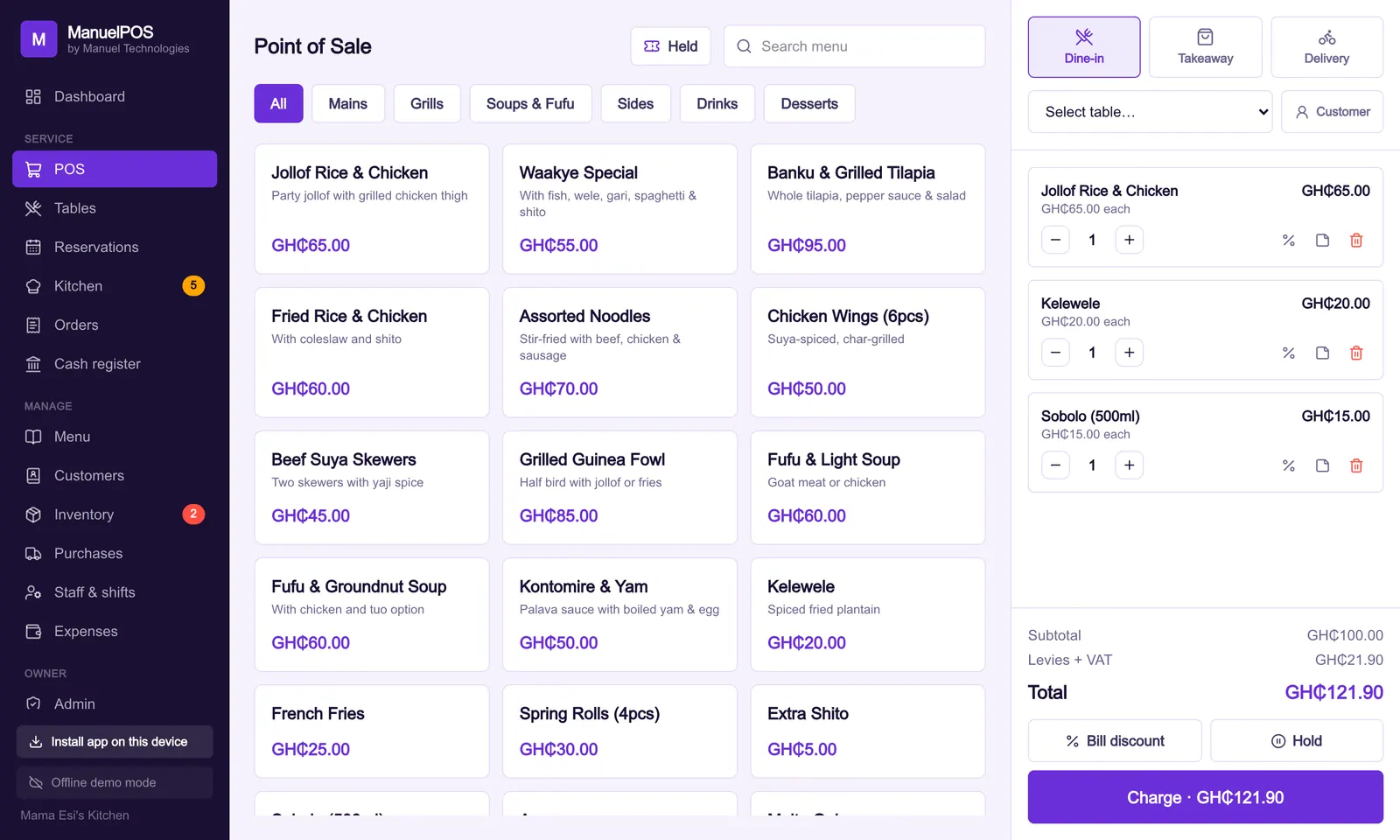
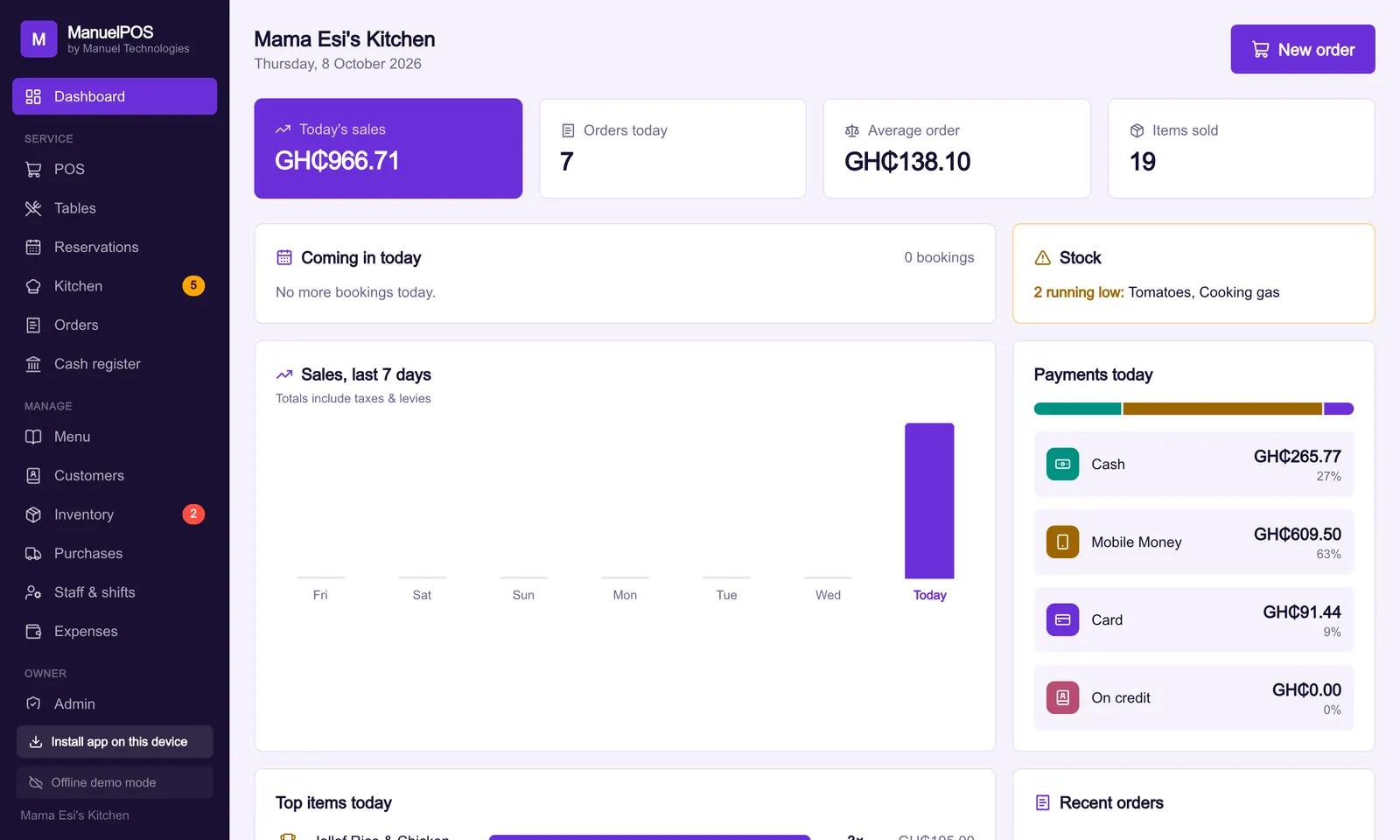
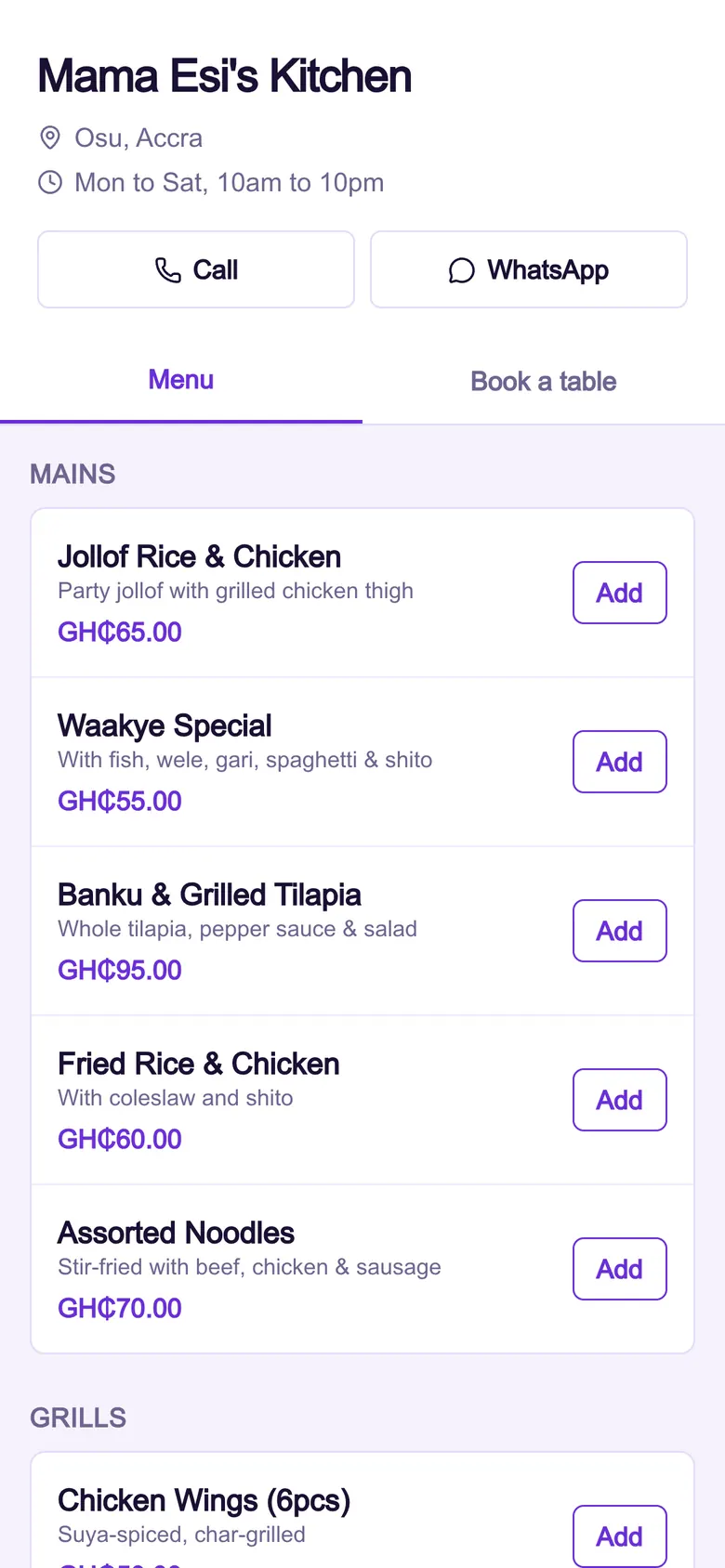
MPOS has dine-in, takeaway and delivery orders, with notes on each item, a kitchen screen and kitchen tickets, and separate printers for the kitchen and the bar. Your restaurant gets a public page with a QR menu and WhatsApp ordering, so customers send orders from your real menu with real prices. Payments can be cash, MoMo with its transaction ID, card, on credit, custom payment types or split, and receipts go by WhatsApp or print on a thermal printer. If the network goes off, the till keeps taking orders and syncs later: see keep selling when the network goes off.
For how WhatsApp orders fit a busy dining room, read running a busy chop bar. For everything else, the complete guide to running a restaurant in Ghana. You can start a free trial with your own menu.
See it with your own products
Free for 14 days. No card needed. Works on the phone or laptop you have.
FAQ
Frequently asked questions
Quick answers to what business owners ask us about this.
How do I take takeaway orders without mistakes?
Ring every order into the till before it is cooked, marked as takeaway, with notes on each dish. Cook and pack from the ticket, and check the bag against the ticket before it leaves.
Should I charge for takeaway packs?
Many restaurants do, because packs and bags are a real cost on every takeaway order. Add them as menu items so they are charged every time and show in your reports.
How do I manage delivery riders' cash?
Record how each order is paid before it leaves, settle each rider after every run, count their cash against the orders they took, and have MoMo payments sent to the business wallet with the transaction ID recorded.
Can I take orders on WhatsApp?
Yes. A public menu page lets customers choose from your real menu and send the order on WhatsApp. Whoever reads it rings it into the till straight away.
Does MPOS connect to food delivery apps?
No. Orders from delivery apps are rung in by hand as delivery orders, with their own payment type, so they still go to the kitchen and show in your reports.
Still have a question?
Talk to the team on WhatsApp: real people in Ghana who know your kind of business.
About the author
Emmanuel Akyeam is the founder of Manuel Technologies in Ghana, which builds MPOS: the till, bookings and stock system for restaurants, salons, barbershops and shops. He works directly with business owners to set up their systems.
You may also like
- Restaurants
How to cost a plate and set menu prices for a restaurant in Ghana
A worked GH₵ example for costing a plate of jollof and chicken, choosing a food-cost target, and setting a menu price that still pays you after tax.
21 October 2026 · 7 min read
- Restaurants
How to control ingredient stock and kitchen waste in a restaurant
A simple weekly routine for rice, oil, chicken and drinks: count, compare usage with sales, keep a waste sheet, and buy to what you really sell.
21 October 2026 · 6 min read