The short answer
Running a pharmacy or OTC medicine shop in Ghana well means staying licensed with the Pharmacy Council and stocking only FDA-registered products, then controlling the business daily: medicines set up by strip and box, batches sold first-expiring first, reorder levels on fast lines, the right VAT status per product, and a till where every sale, void and cash count is recorded.
Key takeaways
- The Pharmacy Council licenses premises and sellers; the FDA regulates the products. Check current rules with each.
- Set every medicine up in the smallest unit you sell, with boxes as packs that have their own price.
- Record batch and expiry on every delivery and sell first-expiring, first-out.
- Set a reorder level for each fast-moving line from real sales and your supplier's delivery time.
- Mark VAT-exempt medicines once, after checking, so mixed receipts are right.
- A POS handles sales, stock and cash; prescription records, controlled-drugs registers and NHIS claims stay elsewhere.
On this page16 sections
- 01What makes a pharmacy different from an ordinary shop?
- 02Who regulates a pharmacy or chemical shop?
- 03How should you set up medicines sold by box, strip and tablet?
- 04How do you control expiry dates and batches?
- 05How do you set reorder levels for fast-moving lines?
- 06How should VAT work on a pharmacy receipt?
- 07How do you stop stock theft and cash leakage?
- 08How should a pharmacy take payments?
- 09What happens when the network or power goes off?
- 10What should a pharmacy POS do, and what should it not claim to do?
- 11How do you set up a POS in a pharmacy?
- 12What does a pharmacy POS cost?
- 13Do you still need an accountant or Tally?
- 14A weekly routine for a well-run pharmacy
- 15How MPOS fits a pharmacy
- 16What to do next
A pharmacy or a licensed chemical shop is a shop with higher stakes. The stock is small, valuable and dated. Boxes are opened and sold by the strip. Some lines fly off the shelf every morning and others sit for months. Customers pay by cash and MoMo, often in a hurry. And above all of it sit two regulators whose rules you must keep.
This guide is for owners and managers of community pharmacies and over-the-counter medicine shops in Ghana. It covers the business side: stock, cash, tax and systems. It gives no clinical or dosing advice. Questions about which medicine a customer should take belong with a pharmacist or prescriber.
In this guide:
- Who regulates a pharmacy or chemical shop, and what they cover
- Setting up medicines sold by box, strip and tablet
- Expiry dates, batches and first-expiring, first-out
- Reorder levels for fast-moving lines
- VAT on medicines and mixed receipts
- Stopping stock theft and cash leakage
- Payments, MoMo and credit customers
- Working through network and power cuts
- Choosing, setting up and paying for a POS
- A weekly routine that keeps it all in order
Each section summarises the topic and links to a full article where there is one.
What makes a pharmacy different from an ordinary shop?
A pharmacy differs from an ordinary shop in four ways: its stock expires, it is sold in part packs, part of it may be tax-exempt, and the whole business is licensed by a regulator. Each of those changes how you set up stock, how you count it, and what your till must do.
| Ordinary provision shop | Pharmacy or chemical shop | |
|---|---|---|
| Expiry | A few lines | Nearly every line, often several batches at once |
| Units | Mostly whole items or cartons | Boxes, strips and sometimes single tablets |
| Tax | Mostly standard-rated | A mix of exempt medicines and taxable goods |
| Regulation | Business registration, local permits | Pharmacy Council licence, FDA-registered products |
| Value per shelf | Moderate | High, in a small space |
None of this needs complicated software. It needs the basics done properly, every day.
Who regulates a pharmacy or chemical shop?
Two bodies, with different jobs. The Pharmacy Council licenses the premises and the people: retail and wholesale pharmacies, and over-the-counter medicine sellers. It says it is established under Parts IV and VI of the Health Professions Regulatory Bodies Act, 2013 (Act 857). The Food and Drugs Authority regulates the products, drawing its mandate from Parts 6, 7 and 8 of the Public Health Act, 2012 (Act 851).
The Council's 2025 guidelines say a pharmacy may supply class A (prescription-only), class B (pharmacist's list) and class C (over-the-counter) medicines, under a registered pharmacist. Its guidelines for over-the-counter medicine sellers say that licence covers only class C medicines, by retail, at the one location named on it.
- 36 m²Minimum floor space, retail pharmacy
- 12 m²Minimum floor space, OTC medicine shop
- 31 JanYearly renewal deadline for both licences
- 12 monthsSuperintendent's post-registration practice
Source: Pharmacy Council Ghana, application guidelines for pharmacies (2025) and OTC medicine practitioners
These figures come from the Council's published guidelines, which it says it may amend without notice. Fees change too, and are not covered here. Our full article on who regulates what: the Pharmacy Council and the FDA sets out what each guideline says and where to check, but the regulator is always the final word.
How should you set up medicines sold by box, strip and tablet?
Set each medicine up in the smallest unit you sell and add bigger sizes as packs of that unit. If you sell strips and boxes, the strip is the product and the box is a pack of 10 strips with its own price and barcode. If you sell loose tablets of a line, the tablet is the base.
This does three things. Each sale takes the exact number out of stock. Each unit charges the price you chose, so a box is not ten strips at the strip price by accident. And your stock count stays true when a box is opened.
Strips cut from a box usually have no barcode, so print your own labels for them. Give the strip a different barcode from the box. Labelling and instructions on split packs are a regulatory matter: the Council's guidelines for OTC medicine practitioners say medicines dispensed must be "appropriately labelled and instructions clearly given", so ask the Council what that means for your premises.
Read selling medicine by the box, strip and tablet for pricing examples and a setup checklist.
How do you control expiry dates and batches?
Record the batch number and expiry date of every delivery when it arrives, sell the batch that expires first, check short-dated stock monthly, and take expired stock off the shelf the same day.
The Pharmacy Council's guidelines list the display and supply of expired medicines among the offences that attract sanctions, and make keeping shelves free of expired stock part of the superintendent pharmacist's duties. The same duty appears in its guidelines for OTC medicine sellers.
First-expiring, first-out (FEFO) is the rule: the earliest date sells first, even if that batch arrived last. On the shelf, short dates go at the front. In the system, each batch carries its own date. Before you accept a delivery, check how much shelf life is left, and agree with each supplier whether they will take back short-dated stock.
The full routine, with a monthly shelf walk and what to do with expired stock, is in medicine expiry dates and batches.
How do you set reorder levels for fast-moving lines?
Set a reorder level for each fast-moving line from two numbers: how many you sell in a day, and how many days your supplier takes to deliver, plus a few days of safety stock. When stock falls to that level, you order.
Reorder level = average daily sales x (supplier delivery days + safety days)
Here is a worked example for a strip that sells steadily.
| Line | Sold per day | Delivery days | Safety days | Reorder level |
|---|---|---|---|---|
| A pain-relief tablet, strip | 12 strips | 3 | 2 | 60 strips |
| A children's syrup, bottle | 4 bottles | 5 | 2 | 28 bottles |
| A multivitamin, box | 2 boxes | 7 | 3 | 20 boxes |
| Baby diapers, pack | 6 packs | 2 | 2 | 24 packs |
These numbers are examples. Yours come from your own sales report: take a normal month, divide units sold by the days you were open, and you have your daily figure.
Source: Example figures: 12 strips a day, 2 safety days
Two cautions for a pharmacy. First, do not chase fast lines by ordering huge quantities: every extra box is another box that can expire. Order the amount you will sell well before the date. Second, keep a separate, lower reorder level for slow lines, or order them only when a customer asks. Slow lines are where expiry losses pile up.
Review the levels every quarter, and before seasons that change demand, such as the rainy season or school reopening.
How should VAT work on a pharmacy receipt?
Treat each product according to its own tax status. As of October 2026, the Ghana Revenue Authority's exemptions page lists "medical services, essential drugs as listed under Chapter 30 of the 'HS Code' produced or supplied in Ghana, specified active ingredients for essential drugs, and selected imported special drugs determined by the Minister for Health and approved by Parliament" as exempt. GRA also says that goods and services exempt from VAT are exempt from NHIL and GETFund.
That does not make every item in a pharmacy exempt. Toothpaste, soap, cosmetics and drinks such as Milo and Voltic have their own status. Under the VAT Act 2025 (Act 1151), effective 1 January 2026, the standard rates are VAT 15%, NHIL 2.5% and GETFund 2.5%, all on the same value. And only VAT-registered businesses charge VAT at all.
Confirm with GRA or your accountant which of your lines are exempt, mark them once, and print a test receipt with an exempt and a taxable line. VAT on medicines in Ghana has a worked receipt, and Ghana VAT in 2026 covers the wider reform.
How do you stop stock theft and cash leakage?
Make every sale, void, refund and price change traceable to a person, and count the things that go missing. In a pharmacy, leakage tends to hide in five places: strips missing from opened boxes, cash sales never rung up, voids after the customer has left, short deliveries, and expiry write-offs that nobody checks.
The controls are simple:
- One login per person, so every action has a name on it.
- A manager for voids, refunds and large discounts, with a reason.
- A counted float to open the till and a counted drawer to close it.
- A weekly count of your 20 most valuable or fastest lines, in strips or tablets.
- Deliveries counted against the invoice before the driver leaves.
- Every expiry write-off checked by a second person and the stock kept apart.
Read preventing stock theft and cash leakage in a pharmacy for the full list and a 20-minute weekly check. The general version for any shop is in stop stock and cash leakage in your mini-mart.
How should a pharmacy take payments?
Take cash, MoMo and card, and record each one properly at the till. For MoMo, use only the business's own number and record the transaction ID on every sale, then match the day's MoMo total against the wallet statement. Card payments on a separate terminal should still be recorded at the till as card, so your totals add up.
Some pharmacies sell on credit to regular customers, staff or nearby businesses. If you do, put each one on an account with a credit balance, give statements, and follow up debts before they grow old. Do not keep credit in a notebook behind the counter.
Insurance and NHIS sales are a different matter. Claims to an insurer or the NHIS have their own process and paperwork, which a till does not replace. Our guide to reconciling Mobile Money payments shows the end-of-day check in detail.
What happens when the network or power goes off?
Your till should keep selling. A customer with a headache at 7 in the evening will not wait for the network to come back. A system that keeps working offline, records each sale, and syncs when the connection returns means you never fall back to a paper book you have to retype later.
Keep a charged phone or a small UPS for the till device and printer, so a power cut does not close the counter. Keep selling when the network goes off explains how an offline POS works.
What should a pharmacy POS do, and what should it not claim to do?
A pharmacy POS should handle sales, stock, batches, tax and cash, and be honest about what it leaves to other records. Use this checklist when you compare systems.
| A pharmacy POS should | Ask the seller |
|---|---|
| Sell by box, strip and tablet with separate prices | Can I set the strip as the base unit and the box as a pack? |
| Hold batches with expiry dates | Does it sell the earliest-expiring batch first? |
| Warn when stock is low | Can I see low-stock lines each morning? |
| Mark items VAT-exempt | Does a mixed receipt show tax only on taxable lines? |
| Need a manager for voids and refunds | Is there a log of voids, refunds and price changes? |
| Record MoMo transaction IDs | Does the money go to my own wallet? |
| Keep selling offline | What happens to sales made offline? |
| Track stock per branch | Can I see both shops from my phone? |
Be wary of any system that promises everything. Prescription records, a controlled-drugs register, and NHIS or insurance claims are specialised jobs with their own rules. The Council's guidelines list improper record keeping on restricted drugs among offences, so keep those records in the form the regulator requires, whatever till you use.
Our general guide on how to choose a POS system in Ghana covers devices, support and contracts.
How do you set up a POS in a pharmacy?
Start with your best-selling lines, not the whole shop. Getting 50 products right in a week is better than 2,000 products half right.
- Export your product list to Excel or CSV
- Clean it: one row per product, smallest unit, cost and price
- Import it, then add box packs with their own prices
- Mark VAT-exempt medicines after checking with your accountant
- Enter opening stock with batches and expiry dates
- Print barcode labels for strips and loose units
- Create a login for each staff member
- Run a full day of sales, then count your top 20 lines
If you are moving from Aronium, your export can be imported directly. Our comparison of MPOS and Aronium covers what moves across.
Train staff on three things only in the first week: scanning, the quantity prompt, and closing the till. Everything else can wait.
What does a pharmacy POS cost?
POS pricing in Ghana comes in two shapes: a monthly subscription, or a one-time licence with a yearly renewal. Over three or four years the totals can be very different, so work out the full cost for the time you expect to use it, including hardware, setup and support. One-time licence or monthly subscription walks through the comparison.
Hardware for a small pharmacy is usually modest: a laptop, tablet or phone you already own, a barcode scanner, and a thermal receipt printer. A second device helps if you have a busy counter or a second branch.
Do you still need an accountant or Tally?
You still need an accountant for your returns and advice. Whether you also need separate accounting software depends on how you work. Many small pharmacies can run their books from the till, with sales, purchases and expenses posted automatically, and give the accountant a trial balance at month end. If you need GRA E-VAT e-invoicing or payroll with SSNIT and PAYE, you will need another tool for those. MPOS vs Tally explains when to keep both.
A weekly routine for a well-run pharmacy
The owners who stay in control do a few small things on a fixed day, every week.
- Monday: read last week's sales, voids, refunds and price changes. Ask about anything odd.
- Tuesday: review low-stock lines and place orders using your reorder levels.
- Wednesday: count your top 20 lines in their smallest unit.
- Thursday: check deliveries received against invoices, and supplier credits for returns.
- Friday: check the expired-stock box against the write-off record, and match the week's MoMo totals.
- Monthly: walk every shelf for dates, and mark anything under three months.
- Yearly: renew your licence before 31 January, and check the Council's current guidelines.
How MPOS fits a pharmacy
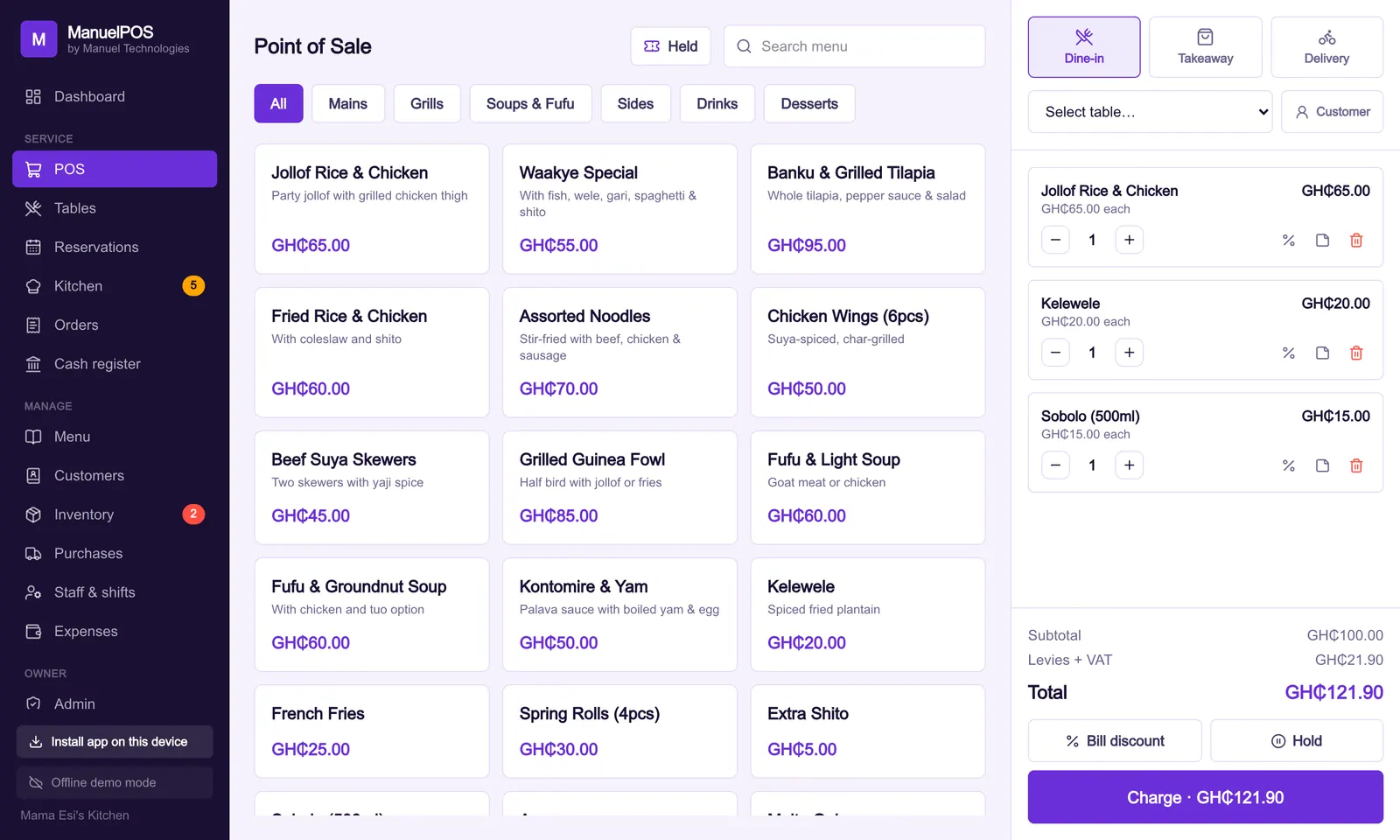
MPOS runs in the browser on any phone, tablet, laptop or Mac and keeps selling offline. The till is scan-first: after each item it asks how many, you type the number and press Enter, and scanning the next item keeps 1. Medicines are set up in their smallest unit with packs such as a box of 10 strips that have their own price and barcode, and part quantities such as half a box work too. Batches carry expiry dates and sell first-expiring-first. Stock is kept per branch, with low-stock warnings, stock takes by scanning, suppliers, purchases and supplier returns.
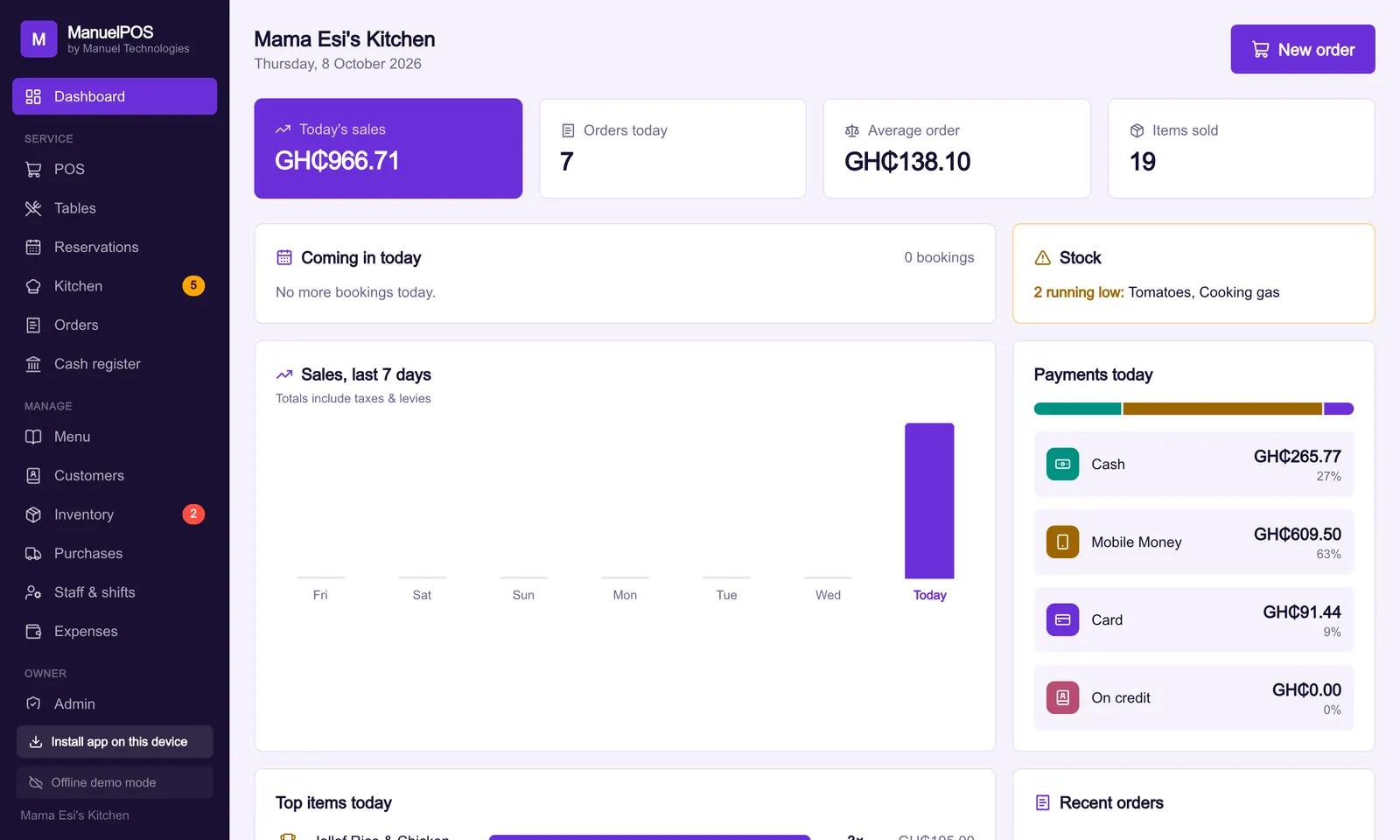
Any item can be VAT-exempt, and receipts show VAT, NHIL and GETFund on taxable lines. Each person has their own login, voids, refunds and big discounts need a manager, and every void, refund, price change and cash-up is in an activity log. MoMo payments record the transaction ID and the money goes to your own wallet. If a till closes short, the owner can get an SMS alert.
What it does not do: MPOS does not keep prescription records or a controlled-drugs register, and does not do NHIS or insurance claims. It does not connect to GRA E-VAT. Keep those where they belong.
Pricing is a setup and licence fee agreed with each business, then a yearly renewal for cloud, data and support.
What to do next
Pick one thing from this guide and do it this week. For most owners, the best first step is the shelf walk: date every product and add up what expires in the next three months. The second is a weekly count of your top 20 lines in strips.
Then work through the articles in this guide:
- Pharmacy Council or FDA: who regulates a pharmacy in Ghana?
- Selling medicine by the box, strip and tablet
- Medicine expiry dates and batches
- VAT on medicines in Ghana
- Preventing stock theft and cash leakage in a pharmacy
If you would like to see packs, batches and exempt medicines working on your own products, you can start a free trial for 14 days, with no card needed.
Every article in this guide
- Pharmacy Council or FDA: who regulates a pharmacy in Ghana?Who licenses pharmacies and chemical shops in Ghana, who registers the medicines on the shelf, what the published guidelines say, and where to check.
- Selling medicine by the box, strip and tablet at the right priceHow a pharmacy or chemical shop can sell the same medicine by the box, strip or tablet, keep prices right for each, and keep stock counts true.
- Medicine expiry dates and batches: how to sell first-expiring firstHow a Ghanaian pharmacy or OTC medicine shop can record batches and expiry dates, sell first-expiring first, and stop losing money to expired stock.
- VAT on medicines in Ghana: what is exempt and what is taxedWhat GRA says is VAT-exempt for medicines under the VAT Act 2025, how to treat a mixed basket of medicines and toiletries, and how to set it up at the till.
- Preventing stock theft and cash leakage in a pharmacyWhere money and medicines quietly go missing in a Ghanaian pharmacy or chemical shop, and the till settings and weekly habits that close each gap.
- MPOS vs Aronium: which POS suits a Ghanaian business?A side-by-side look at Aronium and MPOS for shops, restaurants, salons and barbers in Ghana: devices, internet, MoMo, tax, bookings, reports and what you pay.
- MPOS vs Tally: do you need both a till and Tally?What TallyPrime and Tally.ERP 9 are built for, what MPOS does at the counter and in the books, and when a business needs one, the other or both.
- Ghana VAT in 2026: what changed on your receiptsFrom 1 January 2026, VAT, NHIL and GETFund are charged on the same price, the COVID-19 levy is gone and the flat rate scheme has ended.
- How to choose a POS system for your business in GhanaTen questions to ask before you pay for a till system, from what happens when the network goes off to who can see your profits.
- How to reconcile Mobile Money payments at the end of the dayA simple daily routine for matching MoMo payments to sales, spotting fake payment messages and closing the till with confidence.
- One-time licence or monthly subscription: what should you pay for business software?Monthly fees, one-time licences and yearly renewals compared, with the questions that protect you whichever you choose.
- Stop stock and cash leakage in your mini-martWhere money and stock quietly disappear in a shop, and the daily habits and till settings that close the gaps.
- Keep selling when the network goes off: how an offline POS worksLight off, data finished, network down. What an offline-first till does differently, and what to check before you trust one.
See it with your own products
Free for 14 days. No card needed. Works on the phone or laptop you have.
Sources
- Pharmacy Council Ghana: About us
- Pharmacy Council Ghana: Pharmacy Business Application Guidelines (PCG/GL/01.03, 2025)
- Pharmacy Council Ghana: Guidelines for registration of Over-the-Counter Medicine Practitioner
- Food and Drugs Authority Ghana
- Ghana Revenue Authority: VAT exemptions
- Ghana Revenue Authority: Value Added Tax
FAQ
Frequently asked questions
Quick answers to what business owners ask us about this.
Who regulates pharmacies and chemical shops in Ghana?
The Pharmacy Council licenses pharmacies and over-the-counter medicine sellers under Act 857. The Food and Drugs Authority regulates the products under Act 851. Check current requirements with each regulator.
What is the difference between a pharmacy and a licensed chemical shop?
According to the Pharmacy Council's guidelines, a pharmacy may supply class A, B and C medicines under a registered pharmacist, while an over-the-counter medicine seller may sell only class C, OTC medicines, by retail, at one licensed location.
How do I sell medicines by the strip and the box?
Set the product up in the smallest unit you sell, usually the strip, and add the box as a pack with its own price and barcode. Count stock in strips so opened boxes still add up.
How do I work out a reorder level?
Multiply the average number you sell per day by your supplier's delivery time in days plus a few safety days. For a strip selling 12 a day with 3 delivery days and 2 safety days, the reorder level is 60 strips.
Are medicines VAT-exempt in Ghana?
Some are. GRA lists essential drugs under HS Chapter 30 produced or supplied in Ghana, specified active ingredients and selected imported special drugs as exempt. Other goods a pharmacy sells have their own status.
Can a POS keep prescription records or handle NHIS claims?
MPOS does not. It handles sales, stock, batches, tax and cash. Prescription records, a controlled-drugs register and NHIS or insurance claims need to be kept as the regulator and the scheme require.
Will the till work during a network outage?
MPOS keeps selling offline and syncs the sales when the connection returns, so you do not have to fall back to a paper book.
Still have a question?
Talk to the team on WhatsApp: real people in Ghana who know your kind of business.
About the author
Emmanuel Akyeam is the founder of Manuel Technologies in Ghana, which builds MPOS: the till, bookings and stock system for restaurants, salons, barbershops and shops. He works directly with business owners to set up their systems.
You may also like
- Pharmacies
Pharmacy Council or FDA: who regulates a pharmacy in Ghana?
Who licenses pharmacies and chemical shops in Ghana, who registers the medicines on the shelf, what the published guidelines say, and where to check.
21 October 2026 · 7 min read
- Pharmacies
Selling medicine by the box, strip and tablet at the right price
How a pharmacy or chemical shop can sell the same medicine by the box, strip or tablet, keep prices right for each, and keep stock counts true.
21 October 2026 · 6 min read