The short answer
Set each medicine up in the smallest unit you sell, such as the strip, then add the box as a pack of that unit with its own price and barcode. Stock is then counted in strips, every box sold takes off the right number, and the till always charges the price you set for that unit.
Key takeaways
- Create each medicine in the smallest unit you sell, then add bigger packs on top.
- Give each pack its own price, so a box is not just ten strips at the strip price.
- Count stock in the smallest unit, so a broken box still adds up.
- Print a barcode for strips and loose units that have none.
- Labelling of split packs is a regulatory question: ask the Pharmacy Council.
On this page9 sections
- 01What is the right way to set up box, strip and tablet sales?
- 02Should a box cost less than its strips sold one by one?
- 03Why count stock in the smallest unit?
- 04How do you scan strips that have no barcode?
- 05What does the till do when you scan?
- 06Can you sell wholesale and retail from the same product?
- 07What about labels and instructions on split packs?
- 08How MPOS handles packs and part quantities
- 09What to do next
In most Ghanaian pharmacies and chemical shops, the same product leaves the counter in different sizes. One customer buys a whole box. The next wants two strips. Someone else asks for a few loose tablets of a vitamin. If your records only know the box, by evening the count is wrong and nobody can say where the money went.
The fix is simple: tell your system what the smallest unit is, and build every bigger pack on top of it.
What is the right way to set up box, strip and tablet sales?
Set the product up in the smallest unit you actually sell, then add each bigger size as a pack of that unit. If you never sell below a strip, the strip is your base unit and the box is a pack of, say, 10 strips. If you do sell loose tablets of a line, the tablet is the base unit and the strip and box are packs on top of it.
| Unit | How it is set up | Example price | Stock taken off |
|---|---|---|---|
| Strip (base unit) | The product itself | GH₵7.00 | 1 strip |
| Box of 10 strips | A pack of 10 strips | GH₵65.00 | 10 strips |
| Half a box | 0.5 of the box | GH₵32.50 | 5 strips |
The prices above are examples. The point is that each unit has a price you chose, and each sale takes the right amount out of stock.
Should a box cost less than its strips sold one by one?
Usually yes, and you should decide that on purpose. A box sold whole saves you time and opening, so many owners give a small saving on the box. What matters is that the box price is a number you set, not ten times the strip price by accident.
Source: Example figures
Work it out from your cost. If a box costs you GH₵48 from the wholesaler, each strip costs you GH₵4.80. At GH₵7 a strip your margin is GH₵2.20 a strip. At GH₵65 a box it is GH₵1.70 a strip. Both may be fine, but you should know the numbers before you set them.
Why count stock in the smallest unit?
Count in the smallest unit because that is the only number that stays true once a box is opened. If your records say "12 boxes" and you have sold three strips, the true figure is 11 boxes and 7 strips, which most box-only systems cannot show.
When stock is held as strips, 12 boxes are 120 strips. Sell three strips and you have 117. Sell a box and you have 107. Your count sheet asks for one number per product, and the difference between the shelf and the system means something.
How do you scan strips that have no barcode?
Boxes usually carry the manufacturer's barcode, but cut strips and loose units do not. Print your own price labels with a barcode for the strip, and stick them on the shelf edge or on a small bag. Then the cashier scans the strip label for strips and the box barcode for boxes, and the till picks the right price each time.
Two rules keep this clean:
- One barcode, one product. Never reuse a box barcode for the strip. Each unit gets its own code.
- Scan, don't type prices. A cashier typing a price is where most wrong charges come from.
What does the till do when you scan?
On a good pharmacy till, scanning is the whole job. You scan the item, type how many, press Enter, and move on. Because the box and the strip have different barcodes, the cashier never has to choose a unit or a price from a list. If the shelf price and the till price ever disagree, fix the product once, not at every sale.
Before the till can work like that, each product needs setting up once:
- Create the product in its smallest unit, for example the strip
- Enter your cost and selling price per strip
- Add the box as a pack of 10 strips
- Give the box its own price and barcode
- Print barcode labels for strips
- Count the stock in strips
Can you sell wholesale and retail from the same product?
Yes, if your licence allows wholesale. Keep a retail price and a wholesale price on the same product, and choose the price list for the customer or the sale. Be careful here: the Pharmacy Council's guidelines say the over-the-counter medicine seller's licence permits the sale of class C or OTC medicines "by retail only". If you run a licensed chemical shop, selling on to other shops is outside that licence.
What about labels and instructions on split packs?
This is a regulatory and professional question, not a till question. The Pharmacy Council's guidelines for over-the-counter medicine practitioners say medicines dispensed must be "appropriately labelled and instructions clearly given". What that means for a strip cut from a box, and which medicines may be sold loose, is for the Council and your pharmacist to answer. Check current requirements with the Pharmacy Council before you change how you split packs.
This article gives no advice on doses or on which medicine suits a customer. That conversation belongs with a pharmacist or a prescriber.
How MPOS handles packs and part quantities
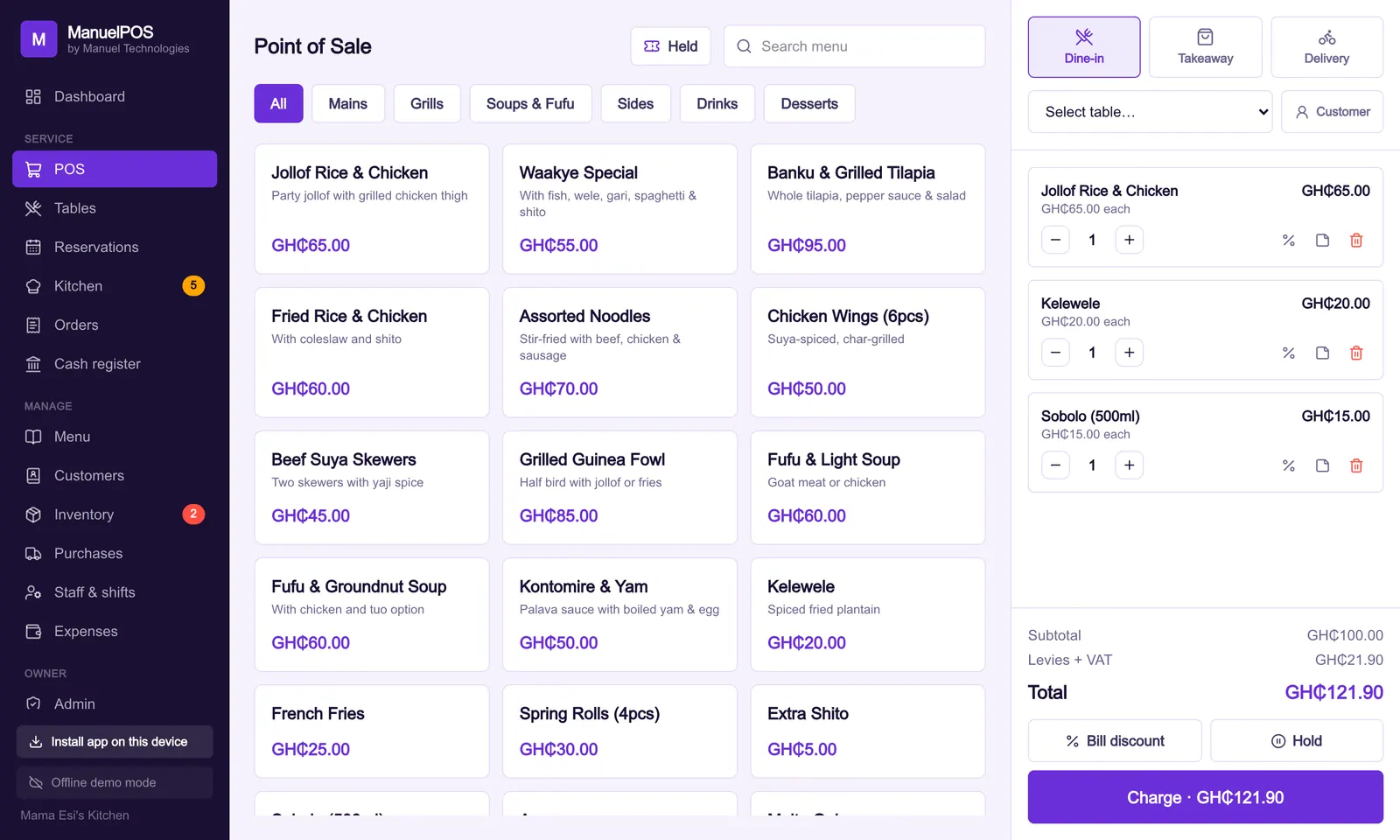
MPOS was built for this. A product is created in its smallest unit, and packs such as a box of 10 strips get their own price and barcode. Part quantities work too: half a box is sold as 0.5 of the box. Retail and wholesale prices sit on the same product.
The till is scan-first. After each item it asks how many: type the number, press Enter and scan the next item. If you just scan the next item, the quantity stays at 1. The same barcode cannot be put on two products, so a strip and a box can never get mixed up. For units that have no barcode, you give them a code of your own and MPOS prints price tags with it, and cash rounding keeps change easy when prices land on odd pesewas.
Already have your products in Excel or in Aronium? MPOS imports from Excel or CSV, including Aronium's export. Our comparison with Aronium covers the move in more detail.
What to do next
Pick your ten best-selling lines and write down, for each, the smallest unit you sell, the pack sizes, and the price you want for each. Check the margin on each unit against your cost. Then set those ten up properly before anything else.
For the bigger picture, read the complete guide to running a pharmacy in Ghana, or see how to track expiry dates and batches for the same products. You can start a free trial and set up your own strips and boxes to see how it works.
See it with your own products
Free for 14 days. No card needed. Works on the phone or laptop you have.
Sources
FAQ
Frequently asked questions
Quick answers to what business owners ask us about this.
How do I sell tablets by the strip and by the box in a POS?
Create the product in the smallest unit you sell, usually the strip. Then add the box as a pack of that many strips, with its own price and barcode. Each sale takes the right number of strips out of stock.
Should the box price be cheaper than buying strips one by one?
Many owners give a small saving on a whole box, but it is your choice. What matters is that you set the box price on purpose from your cost, not by accident.
Can I sell half a box?
Yes. In MPOS you can sell part quantities, so half a box is sold as 0.5 of the box at the box rate, and the stock goes down by the right number of strips.
What if my strips have no barcode?
Print your own barcode labels for the strip. Give the strip a different barcode from the box, so the till charges the right price for each.
Can a licensed chemical shop sell wholesale?
According to the Pharmacy Council's guidelines, the over-the-counter medicine seller's licence allows the sale of class C or OTC medicines by retail only. Check with the Council for your own premises.
Still have a question?
Talk to the team on WhatsApp: real people in Ghana who know your kind of business.
About the author
Emmanuel Akyeam is the founder of Manuel Technologies in Ghana, which builds MPOS: the till, bookings and stock system for restaurants, salons, barbershops and shops. He works directly with business owners to set up their systems.
You may also like
- Pharmacies
Pharmacy Council or FDA: who regulates a pharmacy in Ghana?
Who licenses pharmacies and chemical shops in Ghana, who registers the medicines on the shelf, what the published guidelines say, and where to check.
21 October 2026 · 7 min read
- Pharmacies
Medicine expiry dates and batches: how to sell first-expiring first
How a Ghanaian pharmacy or OTC medicine shop can record batches and expiry dates, sell first-expiring first, and stop losing money to expired stock.
21 October 2026 · 6 min read