The short answer
As of October 2026, the Ghana Revenue Authority lists medical services, essential drugs under Chapter 30 of the HS Code produced or supplied in Ghana, specified active ingredients for essential drugs and selected imported special drugs as VAT-exempt, and exempt supplies are also free of NHIL and GETFund. Other goods a pharmacy sells need their own tax status checked.
Key takeaways
- The VAT Act 2025 (Act 1151) took effect on 1 January 2026, with VAT at 15% and NHIL and GETFund at 2.5% each.
- GRA lists essential drugs under HS Chapter 30, produced or supplied in Ghana, among exempt supplies.
- A supply exempt from VAT is also exempt from NHIL and GETFund.
- Not everything in a pharmacy is a medicine: check the status of toiletries, cosmetics and drinks separately.
- Only VAT-registered businesses charge VAT. Confirm your own status and any product you are unsure of with GRA.
A customer at a pharmacy in Kumasi buys a box of tablets, a tube of toothpaste and a bottle of Voltic. Should the receipt show VAT on all three, on some, or on none? Many owners are not sure, and the till often just applies the same rate to everything.
This article sets out what the Ghana Revenue Authority (GRA) says, as of October 2026, and how to set your till up so each line is treated the way the law treats it. It is a guide, not tax advice. For a particular product, or for your own registration, check with GRA or your accountant.
Which taxes apply in Ghana in 2026?
Under the Value Added Tax Act, 2025 (Act 1151), which GRA says took effect from 1 January 2026, VAT is 15%, the National Health Insurance Levy (NHIL) is 2.5% and the GETFund Levy is 2.5%, all on the same value. Our article on what changed on your receipts in 2026 explains the reform in full.
- 15%VAT
- 2.5%NHIL
- 2.5%GETFund Levy
- NoneOn exempt supplies
Source: Ghana Revenue Authority, VAT and VAT exemptions pages
A note on names: NHIL is a levy collected with VAT. It is not the same thing as NHIS claims for patients, which are a separate scheme.
Are medicines exempt from VAT in Ghana?
Some are. GRA's VAT exemptions page lists, under medical supplies: "Medical services, essential drugs as listed under Chapter 30 of the 'HS Code' produced or supplied in Ghana, specified active ingredients for essential drugs, and selected imported special drugs determined by the Minister for Health and approved by Parliament."
The same page says: "All goods and services exempt from VAT are also exempt from the NHIL and GETFund." So an exempt medicine carries no VAT, no NHIL and no GETFund on your receipt.
Read the wording carefully. It does not say every product on a pharmacy shelf is exempt. It names essential drugs under a specific chapter of the customs tariff (the HS Code), active ingredients that are specified, and imported special drugs chosen by the Minister for Health with Parliament's approval. Whether a particular product falls inside that list is a question for GRA, your supplier's invoice and your accountant, not a guess at the counter.
What about the other things a pharmacy sells?
Most pharmacies and chemical shops sell more than medicines: toothpaste, soap, body cream, baby diapers, sanitary products, drinks such as Milo and Voltic, and sometimes supplements. These are not covered by the medicines exemption just because a pharmacy sells them. Each has its own tax status under the Act, which may be standard-rated, exempt or something else.
| What you sell | What to check |
|---|---|
| Medicines you believe are essential drugs | Whether they fall under the exemption GRA describes; your supplier's invoice is a good first clue |
| Imported special drugs | Whether they are among those determined by the Minister and approved by Parliament |
| Toiletries, cosmetics, soaps | Their own status under the Act; not covered by the medicines exemption |
| Drinks and food items | Their own status under the Act |
| Medical devices and supplements | Ask GRA or your accountant; do not assume |
Set each product's tax status once, when you create it, and only change it when you have confirmed the answer.
How does a mixed receipt work?
A receipt with both exempt and taxable lines shows tax only on the taxable lines. Here is a worked example with tax-inclusive prices, for a VAT-registered pharmacy.
GH₵84.00
- Exempt medicineGH₵60.00 (71.4%)
- Toothpaste before taxGH₵20.00 (23.8%)
- VAT 15%GH₵3.00 (3.6%)
- NHIL 2.5%GH₵0.50 (0.6%)
- GETFund 2.5%GH₵0.50 (0.6%)
Source: Example figures; rates from the Ghana Revenue Authority
The medicine is GH₵60 with no tax added. The toothpaste is priced at GH₵24 including tax, which is GH₵20 before tax plus GH₵3 VAT, 50 pesewas NHIL and 50 pesewas GETFund. The customer pays GH₵84, and the receipt shows GH₵4 of tax, all of it on the toothpaste.
If the till had charged tax on the whole basket, you would have collected tax that is not due on the medicine, and your tax report would be wrong.
Do you have to charge VAT at all?
Only if your business is registered for VAT. If you are not registered, you should not add VAT, NHIL or GETFund to a receipt at all. If you are registered, you must charge them correctly on taxable lines and show them properly.
Who must register is set by the Act and explained by GRA. Check your own position with GRA rather than copying what another shop does. Our 2026 VAT article covers the question in more detail.
Setting up VAT-exempt medicines in MPOS
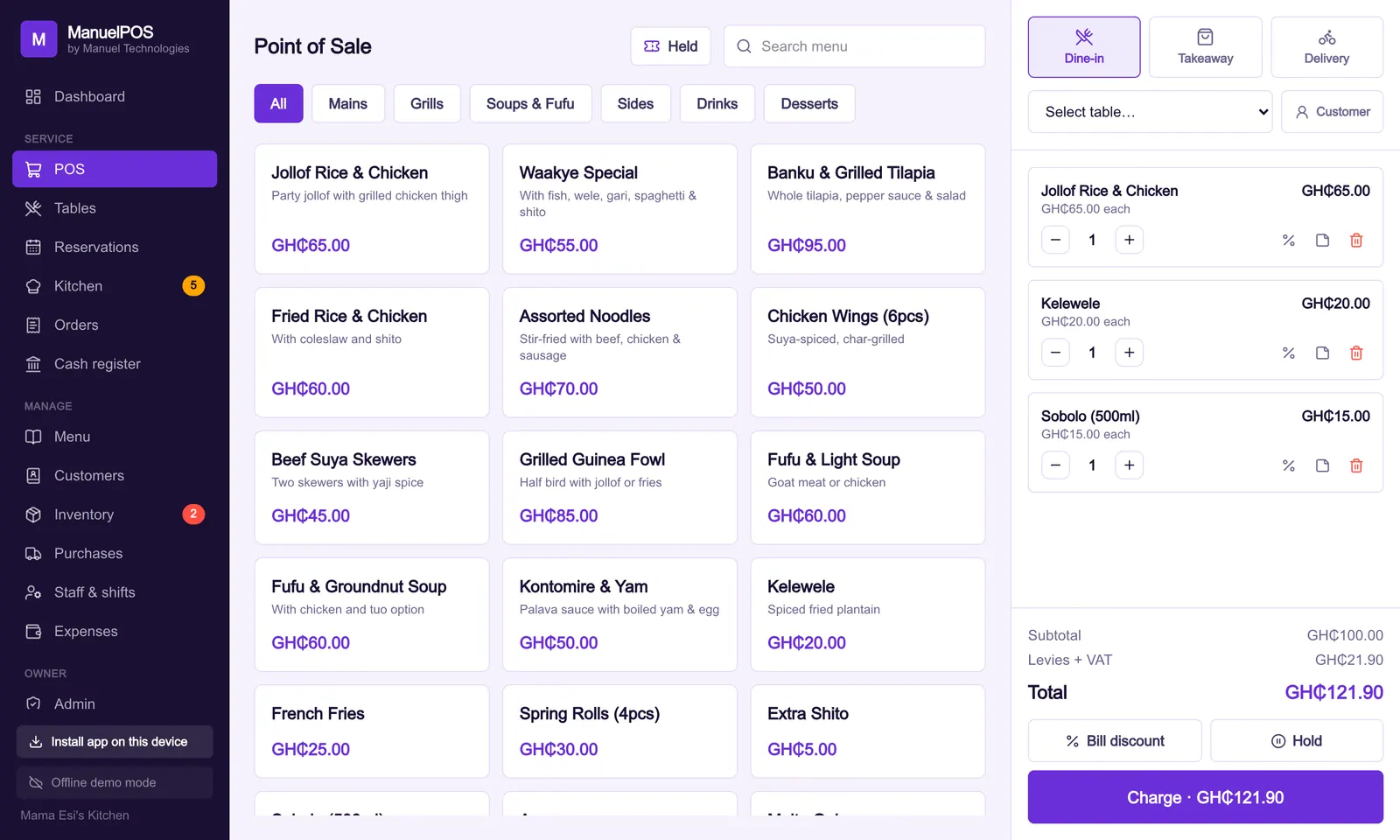
MPOS works out VAT 15%, NHIL 2.5% and GETFund 2.5% on the same price, as the VAT Act 2025 requires. Prices include tax by default, so the shelf price is what the customer pays. Any item can be marked VAT-exempt, and exempt lines carry no tax on the receipt.
- List your products by type: medicines, toiletries, drinks, others
- Confirm with GRA or your accountant which are exempt
- Mark exempt items as VAT-exempt in the product list
- Leave taxable items on the standard rates
- Print a test receipt with one of each
- Check the tax report at the end of the first week
Receipts show the tax breakdown, whether printed on a thermal printer, sent by WhatsApp or produced as an A4 invoice. The tax report for any period shows what you collected.
Two things MPOS does not do: it does not connect to GRA's E-VAT e-invoicing system, and it does not handle NHIS or insurance claims. If GRA requires you to issue E-VAT invoices, you will need a separate solution for that.
What to do next
Print your product list and mark each line: medicine, toiletry, drink or other. Take the medicines you are unsure about to your accountant or GRA, and set the tax status once it is confirmed. Then test a mixed receipt before your next busy morning.
For the rest of running the shop, see the complete guide to running a pharmacy in Ghana. To try exempt and taxable lines on your own receipts, start a free trial.
See it with your own products
Free for 14 days. No card needed. Works on the phone or laptop you have.
Sources
FAQ
Frequently asked questions
Quick answers to what business owners ask us about this.
Are medicines VAT-exempt in Ghana?
Some are. As of October 2026, GRA lists medical services, essential drugs under Chapter 30 of the HS Code produced or supplied in Ghana, specified active ingredients for essential drugs and selected imported special drugs as exempt. Check a particular product with GRA.
Do exempt medicines attract NHIL and GETFund?
No. GRA says all goods and services exempt from VAT are also exempt from the NHIL and GETFund.
Is everything sold in a pharmacy VAT-exempt?
No. The exemption covers the medicines GRA describes, not toiletries, cosmetics or drinks just because a pharmacy sells them. Each product has its own tax status.
What are the VAT rates in Ghana in 2026?
Under the VAT Act 2025 (Act 1151), effective 1 January 2026, VAT is 15%, NHIL 2.5% and GETFund 2.5%, according to GRA.
Can MPOS mark some items as VAT-exempt?
Yes. Any item can be VAT-exempt, so exempt medicines carry no tax while taxable items on the same receipt show VAT, NHIL and GETFund.
Does MPOS do GRA E-VAT invoicing or NHIS claims?
No. MPOS works out the taxes on every receipt but does not connect to GRA E-VAT, and it does not handle NHIS or insurance claims.
Still have a question?
Talk to the team on WhatsApp: real people in Ghana who know your kind of business.
About the author
Emmanuel Akyeam is the founder of Manuel Technologies in Ghana, which builds MPOS: the till, bookings and stock system for restaurants, salons, barbershops and shops. He works directly with business owners to set up their systems.
You may also like
- Pharmacies
Pharmacy Council or FDA: who regulates a pharmacy in Ghana?
Who licenses pharmacies and chemical shops in Ghana, who registers the medicines on the shelf, what the published guidelines say, and where to check.
21 October 2026 · 7 min read
- Pharmacies
Selling medicine by the box, strip and tablet at the right price
How a pharmacy or chemical shop can sell the same medicine by the box, strip or tablet, keep prices right for each, and keep stock counts true.
21 October 2026 · 6 min read