The short answer
A pharmacy stops stock and cash leakage by giving every staff member their own login, requiring a manager for voids, refunds and big discounts, counting the till at every open and close, recording MoMo transaction IDs, counting high-value lines every week in the smallest unit, and checking every delivery and write-off against paperwork.
Key takeaways
- Leakage in a pharmacy hides in broken boxes, quiet voids, personal MoMo numbers and expiry write-offs.
- One login per person makes every sale, void and refund traceable.
- Count expensive and fast-moving lines every week, in strips or tablets, not boxes.
- Treat every write-off of expired stock like cash: two people, a record and a box kept apart.
- Read the void, refund and price-change log every week.
On this page10 sections
- 01Where does a pharmacy usually lose money?
- 02Why count medicines in strips, not boxes?
- 03Which lines should you count every week?
- 04How do you stop sales that never reach the till?
- 05How should voids, refunds and discounts work?
- 06What about MoMo payments?
- 07How do you protect deliveries and supplier returns?
- 08Why do expiry write-offs need checking?
- 09How MPOS helps a pharmacy close the gaps
- 10What to do next
Pharmacies are easy places to lose money without noticing. The goods are small and valuable. Boxes get opened and strips sold one at a time. Customers pay by cash and MoMo in a rush. And a strip missing from an opened box looks exactly like a strip that was sold.
Our article on stock and cash leakage in a mini-mart covers the basics that apply to any shop. This one is about the gaps that are particular to a pharmacy or chemical shop.
Where does a pharmacy usually lose money?
Most pharmacy leakage comes from six places, and none of them looks like theft on the day.
Source: Example figures
| Where it leaks | What it looks like | The control |
|---|---|---|
| Opened boxes | Box count is right, strips are missing | Count in the smallest unit |
| Sales not rung up | Cash taken, nothing recorded | Every sale through the till, receipt every time |
| Voids and refunds | A real sale cancelled later | Manager approval and a reason |
| Deliveries | Invoice says 20 boxes, 18 arrived | Count at the door before signing |
| Expiry write-offs | Good stock written off as expired | Two people check every write-off |
| MoMo | Customer pays a staff member's number | Business number only, transaction ID on every sale |
Why count medicines in strips, not boxes?
Count in the smallest unit you sell, because that is where pharmacy stock disappears. If your system only knows boxes, an opened box with two strips missing still counts as one box. Nobody can tell whether those strips were sold or taken.
When the product is set up in strips (or tablets) with the box as a pack, every sale takes off the exact number, and a weekly count of the shelf shows a real difference. Our article on selling by box, strip and tablet shows how to set this up.
Which lines should you count every week?
Count your most expensive and fastest-moving lines every week, and everything else once a quarter. In most pharmacies that weekly list is short: a few dozen lines, often branded medicines, baby milk and toiletries that sell fast and are easy to resell.
- Pick the 20 lines on your high-value list
- Scan and count each one in its smallest unit
- Compare the count with the system
- Read the week's voids, refunds and price changes
- Check write-offs against the expired-stock box
- Ask about any difference the same day
A small difference now and then is normal. The same line coming up short week after week, or a shortfall that always falls on one person's shift, is a pattern worth a calm conversation.
How do you stop sales that never reach the till?
Make the till the only way to sell. Every sale is scanned, every customer gets a receipt, and cash goes into the drawer only through a sale. When a customer pays and leaves without a receipt, ask why.
Open each till with a counted float, record any cash taken out for transport or water with a reason, and close with a counted drawer. A drawer that is regularly over can be as telling as one that is short: it can mean sales are being rung up for less than was paid.
How should voids, refunds and discounts work?
A cashier should be able to sell, but not cancel or cut a sale alone. Require a manager for voids, refunds and large discounts, with a reason each time. Then read the log every week. In a pharmacy, watch for refunds on items that are rarely returned and for discounts given to the same "customers" again and again.
Price changes matter too. If anyone can change a price at the till, a strip can be sold at half price to a friend. Keep price changes with the owner or manager, and look at the price-change log.
What about MoMo payments?
Take MoMo only to the business's own number, and record the transaction ID on every sale. At the end of the day, match the MoMo total on the till with the wallet statement. A customer who says "I paid the boy" and shows a different number has found the gap for you. Our guide to reconciling Mobile Money payments walks through the daily check.
How do you protect deliveries and supplier returns?
Count every delivery against the supplier's invoice before the driver leaves, check the expiry dates, and record what actually arrived with its batch and date. When you send stock back to a supplier, record the return and make sure the credit appears on your next statement. Unrecorded returns are an easy place for stock to vanish.
Why do expiry write-offs need checking?
Because "it expired" is the easiest story for missing stock. The Pharmacy Council lists the display and supply of expired medicines among offences, so expired stock must come off the shelf. But each write-off should be checked by a second person, recorded, and the boxes kept apart in a marked container until disposal. If the write-off record says 12 strips and the box holds 4, you have found a problem. See tracking expiry dates and batches for the routine.
How MPOS helps a pharmacy close the gaps
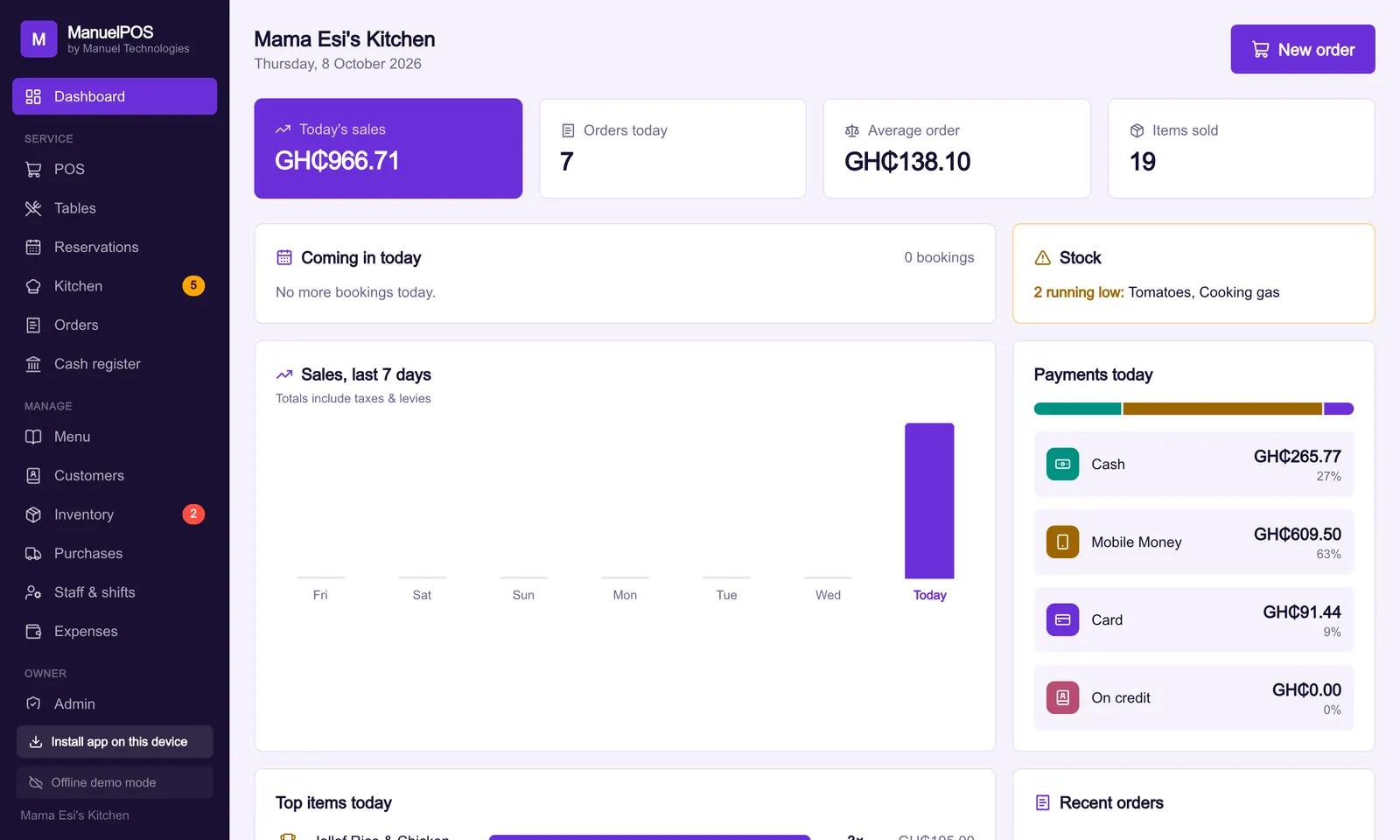
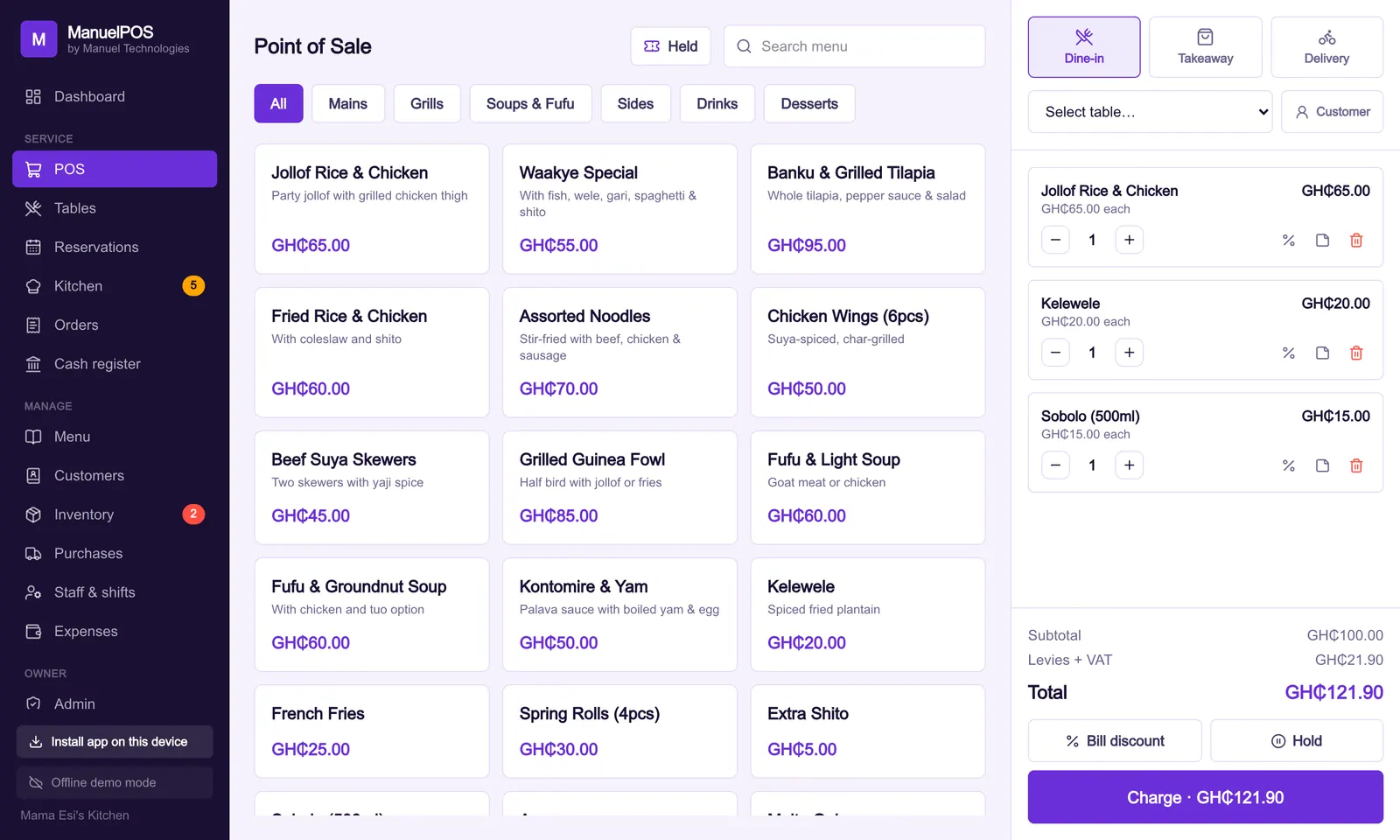
MPOS gives each person their own login with a role: owner, manager or cashier. Voids, refunds and big discounts need a manager. Every void, refund, price change and cash-up goes into an activity log you can read from anywhere.
Each till opens with a float, records cash in and out, and closes with a count, with X and Z reports. If a till closes short, the owner can get an SMS alert. MoMo payments record the transaction ID, and the money goes to the business's own wallet. MPOS never holds it.
On the stock side, products are set up in their smallest unit with packs on top, stock is kept per branch, stock takes are done by scanning, purchases and supplier returns are recorded, and dated stock is received with its batch number and expiry date. The same barcode cannot go on two products. The owner gets a weekly email report.
MPOS does not keep prescription records or a controlled-drugs register. Those stay in the form your regulator requires.
What to do next
This week, write your high-value list and count it in strips or tablets. Make sure no cashier can void or refund without a manager, and read the log on Friday. Put an expired-stock box in the store with a sheet taped to the lid.
For the full picture of running the shop, read the complete guide to running a pharmacy in Ghana. If you want to see these controls on your own counter, you can start a free trial.
See it with your own products
Free for 14 days. No card needed. Works on the phone or laptop you have.
Sources
FAQ
Frequently asked questions
Quick answers to what business owners ask us about this.
How do I stop staff stealing from my pharmacy?
Give each person their own till login, require a manager for voids, refunds and big discounts, count the till at every open and close, and count your high-value lines every week in strips or tablets. Most theft shows up as a pattern in these records.
Why are strips missing when my box count is right?
Because a box count cannot see an opened box. Set products up in the smallest unit you sell and count in that unit, so missing strips show as a difference.
How often should a pharmacy count stock?
Count expensive and fast-moving lines every week and do a full count every quarter. Weekly counts of a short list catch problems early without closing the shop.
How do I check expiry write-offs are genuine?
Have a second person check each write-off, record it, and keep the expired stock in a separate marked box until disposal. Compare the record with the box regularly.
Can MPOS alert me if the till is short?
Yes. When a till closes short, MPOS can send the owner an SMS alert, and the Z report shows the expected and counted cash.
Still have a question?
Talk to the team on WhatsApp: real people in Ghana who know your kind of business.
About the author
Emmanuel Akyeam is the founder of Manuel Technologies in Ghana, which builds MPOS: the till, bookings and stock system for restaurants, salons, barbershops and shops. He works directly with business owners to set up their systems.
You may also like
- Pharmacies
Pharmacy Council or FDA: who regulates a pharmacy in Ghana?
Who licenses pharmacies and chemical shops in Ghana, who registers the medicines on the shelf, what the published guidelines say, and where to check.
21 October 2026 · 7 min read
- Pharmacies
Selling medicine by the box, strip and tablet at the right price
How a pharmacy or chemical shop can sell the same medicine by the box, strip or tablet, keep prices right for each, and keep stock counts true.
21 October 2026 · 6 min read