The short answer
GRA E-VAT is the Ghana Revenue Authority's electronic system for issuing VAT receipts; it is not a new tax. It is for VAT-registered businesses, which GRA has been bringing on in phases, and you ask to join it by writing to your Taxpayer Service Centre. GRA installs its own system free of charge, or connects it to the invoicing system you already use.
Key takeaways
- E-VAT is a way of issuing VAT receipts electronically. It is not a new tax and the rates don't change.
- It is for VAT-registered businesses. If you are not registered for VAT, it doesn't apply to you.
- GRA has been bringing businesses on in phases, inviting them by TIN.
- You ask to join by writing to your Taxpayer Service Centre. GRA installs its system free, or connects it to yours.
- If GRA has contacted you, act on it. If not, check your VAT status and keep your records ready.
Many owners hear "E-VAT" and worry it means a new tax, a new machine or a fine. It is none of those on its own. It is a change in how a VAT-registered business issues its VAT receipts: electronically, through the Ghana Revenue Authority's system, instead of from a receipt book or a till that GRA can't see.
Here is what it is, who needs it, and how to start, as of November 2026.
What is GRA E-VAT?
E-VAT is GRA's electronic system for issuing VAT receipts. GRA says plainly that it is not a new tax. The tax on a VAT-able sale stays the same: since 1 January 2026, that is VAT at 15%, NHIL at 2.5% and GETFund at 2.5%, all on the same price.
- 15%VAT
- 2.5%NHIL
- 2.5%GETFund
- 20%In total
Source: Ghana Revenue Authority, E-VAT page
What changes is the receipt. With E-VAT, each VAT receipt goes through GRA's system as you issue it, so GRA sees the sale when it happens rather than months later in a return.
Does your business need E-VAT?
Only if your business is registered for VAT. E-VAT is for VAT-registered businesses; if you are not registered, you don't issue VAT receipts at all, so E-VAT doesn't apply to you.
For businesses supplying goods, VAT registration is required once turnover passes GH₵750,000 a year. GRA clarified in January 2026 that this threshold applies to goods, not services, so service businesses such as salons should check their own position. Our guide to Ghana VAT in 2026 explains the changes.
GRA brings businesses on in phases
GRA has not switched every VAT-registered business on at once. It has rolled E-VAT out in phases, inviting businesses by TIN and tax office. In its second phase, announced in September 2024, GRA said it would bring on another 2,000 VAT-registered taxpayers, and published the list of invited businesses.
You may see reports that GRA will extend E-VAT to more businesses soon. Until GRA announces it on its own website, treat a report as a reason to prepare, not as a rule.
| Your situation | What to do |
|---|---|
| Not registered for VAT | E-VAT does not apply to you. Keep an eye on your turnover. |
| VAT-registered, and GRA has contacted you about E-VAT | Follow GRA's instructions and dates. This comes first. |
| VAT-registered, not contacted yet | You can ask to join now. Keep your records ready either way. |
| Not sure if you are registered | Check your TIN and VAT status with your Taxpayer Service Centre. |
How does E-VAT work?
GRA offers it in two forms, and its own experts install whichever you choose:
- A complete invoicing system, for businesses that don't have one. GRA says it installs this free of charge for VAT-registered businesses.
- A connection to the system you already use, so your existing invoicing system sends its VAT receipts through E-VAT.
To use GRA's system you need a desktop or laptop, internet access and a web browser. GRA says you can generate electronic receipts online or offline for up to 24 hours, so a short network cut doesn't stop you.
How do you get started?
Write to your Taxpayer Service Centre and ask for the E-VAT system. GRA says the centre will guide you through the process. Before you write, get these ready:
- Confirm your VAT registration and your TIN
- Write to your Taxpayer Service Centre asking for E-VAT
- Choose GRA's complete system or a connection to your own
- Have a desktop or laptop with internet and a browser ready
- Let GRA's team install it and show your staff
- Issue your VAT receipts through E-VAT from the agreed date
Train everyone who issues receipts, not only the owner. The most common problem with any new receipt system is a cashier who goes back to the old book on a busy day.
How do you get your records ready?
Start with what E-VAT will show GRA: every VAT sale, as it happens. The businesses that find the switch easiest are the ones whose own records already match what they declare.
- Record every sale, including the small cash ones, in one place.
- Know which items are VAT-exempt, such as many medicines, and mark them so they are taxed correctly.
- Keep your prices consistent: if your prices include tax, every price should include it.
- Match your monthly totals to your VAT return before you file, so there are no surprises when GRA can see each sale.
What does E-VAT mean for your till?
If your till is not connected to E-VAT, it can't send its receipts to GRA. Once GRA brings you on, you would issue your VAT receipts through GRA's system, and keep using the till for everything else it does: stock, staff, credit and reports. That can mean entering the same sale in two places, which is why a connected system is the long-term answer.
Ask your Taxpayer Service Centre exactly how GRA wants it done for your business, and ask any till company whether it is connected to E-VAT today, not "soon".
Where MPOS stands
MPOS is not certified for GRA E-VAT, and it does not connect to it. We are preparing our application to become a certified provider and will only say so once GRA has certified us.
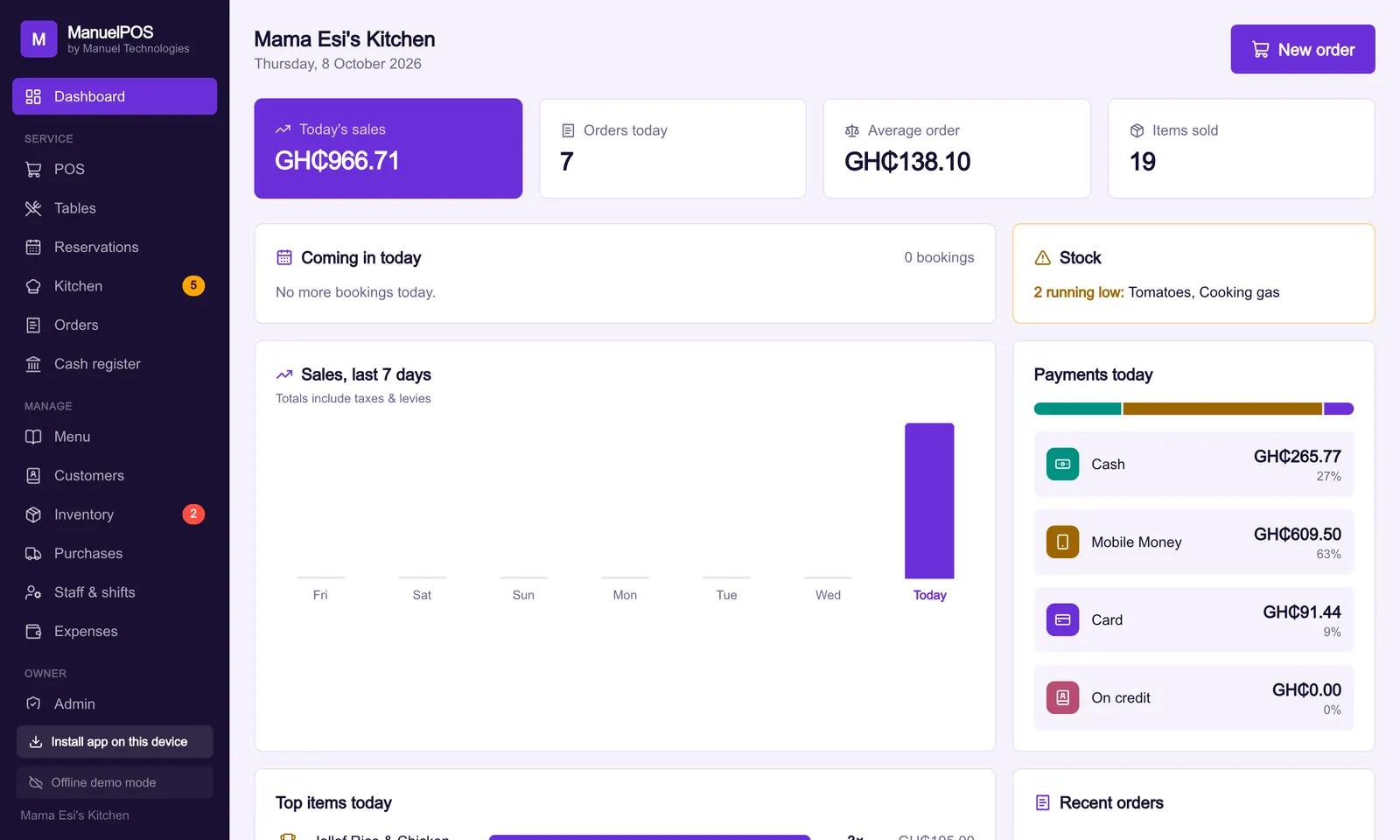
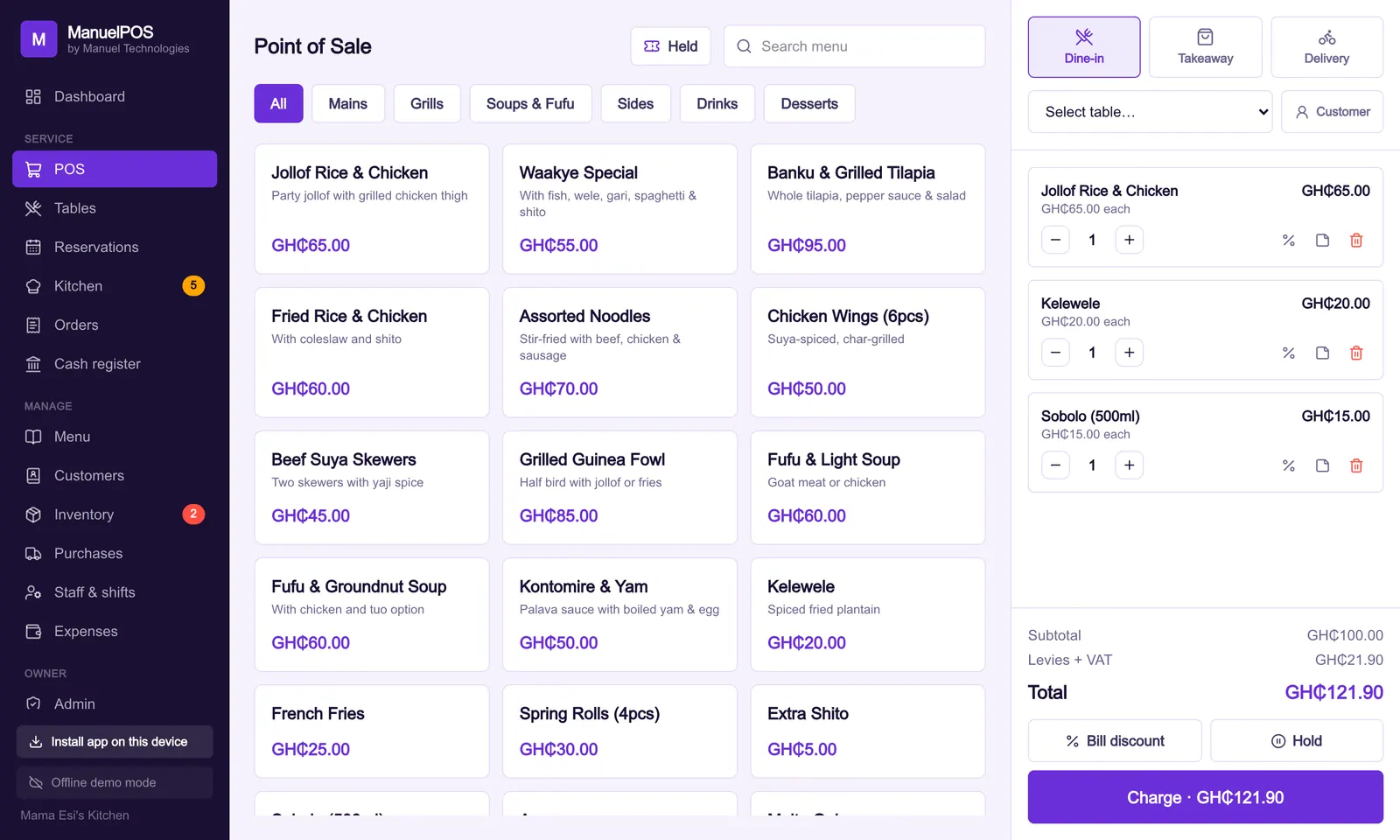
What MPOS does today: it works out VAT, NHIL and GETFund on every sale under the VAT Act 2025 and shows them on every receipt, marks VAT-exempt items, and gives you a monthly tax breakdown for your returns. If GRA has already brought your business onto E-VAT, use GRA's system for your VAT receipts as GRA directs, and talk to us about how to run the two side by side.
What to do next
Check whether you are VAT-registered. If you are, and GRA hasn't contacted you, decide whether to ask to join now. If GRA has contacted you, follow its dates. Either way, keep a clean record of every sale, because that is what E-VAT, your returns and your accountant all depend on.
If you want a till that keeps that record for you, with the taxes worked out on every receipt, you can start a free trial.
See it with your own products
Free for 14 days. No card needed. Works on the phone or laptop you have.
Sources
- Ghana Revenue Authority: E-VAT
- Ghana Revenue Authority: Implementation of electronic invoicing of VAT, phase two (4 September 2024)
- Ghana Revenue Authority: Taxpayer Service Centres
- Ghana Revenue Authority: Value Added Tax
- Citi Newsroom: GH¢750k VAT threshold applies to goods, not services, GRA clarifies (2 January 2026)
FAQ
Frequently asked questions
Quick answers to what business owners ask us about this.
What is GRA E-VAT?
It is the Ghana Revenue Authority's electronic system for issuing VAT receipts. It is not a new tax: the rates stay the same, but VAT receipts go through GRA's system as they are issued.
Does every business in Ghana need E-VAT?
No. E-VAT is for VAT-registered businesses. If your business is not registered for VAT, it does not issue VAT receipts, so E-VAT does not apply. GRA has been bringing VAT-registered businesses on in phases.
How do I register for GRA E-VAT?
Write to your Taxpayer Service Centre asking for the E-VAT system. GRA says the centre will guide you through the process, and GRA's team installs either its own system or a connection to the one you use.
Is GRA's E-VAT system free?
GRA says it installs its complete invoicing system free of charge for VAT-registered businesses that don't have one. You need your own desktop or laptop, internet access and a web browser.
Does E-VAT work without internet?
GRA says its system can generate electronic receipts online or offline for up to 24 hours, so a short network cut doesn't stop you issuing receipts.
Is MPOS certified for GRA E-VAT?
Not yet. MPOS does not connect to GRA E-VAT. We are preparing our application to become a certified provider and will say so only once GRA has certified us. Today MPOS shows VAT, NHIL and GETFund on every receipt and gives a monthly tax breakdown.
Still have a question?
Talk to the team on WhatsApp: real people in Ghana who know your kind of business.
About the author
Emmanuel Akyeam is the founder of Manuel Technologies in Ghana, which builds MPOS: the till, bookings and stock system for restaurants, salons, barbershops and shops. He works directly with business owners to set up their systems.
You may also like
- Running a business
Who owns your sales data? What to ask a POS company before you sign
Your till knows what sells, who owes you and who your best customers are. The questions that keep that record yours, and the warning signs to look for.
2 November 2026 · 7 min read
- Running a business
POS installation and training: what to prepare and what to expect
What a proper POS setup day looks like, what to have ready before the visit, how to train each member of staff, and the questions to ask whoever installs it.
2 November 2026 · 6 min read